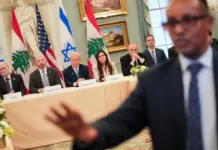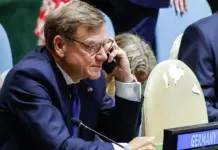
Israel Lebanon Talks — Representatives from Israel and Lebanon sat down at the US Department of State in Washington on Tuesday morning, opening the first session of a two-day round of direct negotiations aimed at ending a conflict that has killed thousands and uprooted more than a million people. The talks began at 9am local time — 13:00 GMT — marking a significant, if fragile, step in a diplomatic process that has lurched forward against a backdrop of continued military operations.
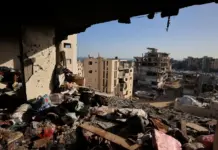
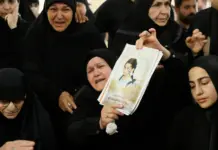
The human toll of the conflict is staggering. Lebanon’s Ministry of Public Health places the death toll at 3,468 people since March 2, while more than 1.2 million Lebanese have been displaced. Israeli ground forces have pushed deeper into Lebanese territory than at any point since the year 2000, crossing the Litani River toward the Zahrani River in the south.
The Washington session is not the first attempt at dialogue. An initial meeting between the two countries’ ambassadors to the United States took place in April, followed by a second round in May involving larger delegations. Military representatives from both sides met separately on Friday, laying groundwork for this week’s higher-stakes encounter.
Recommended Reading
Despite the diplomatic activity, Prime Minister Benjamin Netanyahu signalled no intention of halting military pressure. On Monday, he announced that Israeli strikes on Dahiyeh — Beirut’s southern suburbs and a Hezbollah stronghold — would resume. Israel had largely refrained from striking the area since April, with only two targeted operations during that period. Netanyahu’s declaration cast a long shadow over the Washington proceedings.
Lebanon’s political leadership is divided on how to approach the negotiations. President Joseph Aoun struck a pragmatic tone on Tuesday, stating plainly that "there is no option other than negotiation." Prime Minister Nawaf Salam has also voiced support for the direct talks. However, Parliament Speaker Nabih Berri and Hezbollah — which is not participating in the Washington process — favour indirect negotiations and argue that talks cannot proceed while Israeli attacks continue. Lebanon’s preferred framework leans toward an arrangement modelled on the 1949 armistice agreement between the two countries.
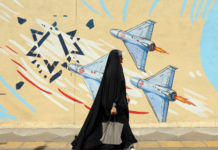
The broader regional context adds further volatility. Iran issued threats to attack northern Israel during the ceasefire negotiations, a move that underscores how deeply the conflict is entangled with wider Middle Eastern rivalries. The situation shifted dramatically on February 28, when the United States and Israel struck Iran, killing Supreme Leader Ayatollah Ali Khamenei. Two days later, Hezbollah fired six rockets toward Israel — its first such action since a ceasefire reached in late 2024, an agreement Israel had continued to violate. Hezbollah had responded only once in December 2024 despite those ongoing violations.
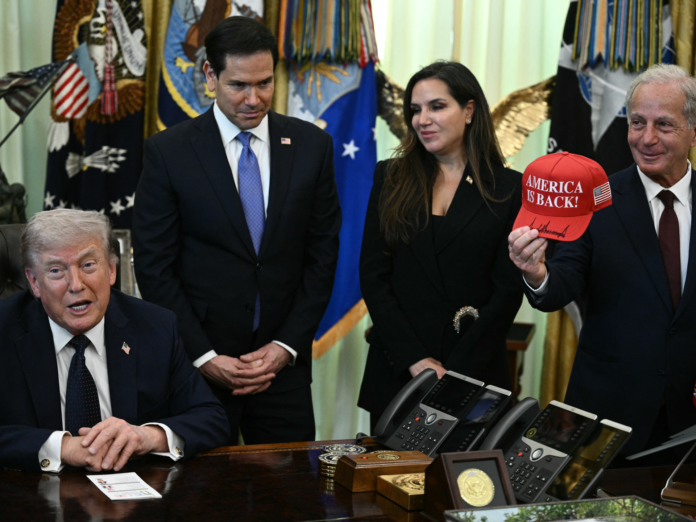
US President Donald Trump has been directly involved in managing the crisis. He announced a ceasefire between Israel and Lebanon on April 16, then announced a second ceasefire shortly thereafter. Trump also posted on Truth Social that no American troops would be sent to Beirut and that forces already en route had been turned back — a statement intended to clarify the limits of US military involvement.
Israel Lebanon Talks: Regional Implications
Behind the scenes, Saudi Arabia has worked to align Lebanon’s fractured political leadership ahead of the talks, while both Saudi Arabia and Qatar engaged the Trump administration to prevent further escalation. Their involvement reflects the Gulf states’ growing stake in stabilising Lebanon and containing the conflict’s regional spillover.
The path to any durable agreement remains narrow. Hezbollah’s exclusion from the Washington process limits what can realistically be implemented on the ground, and Netanyahu’s pledge to resume strikes on Dahiyeh signals that Israel is unwilling to freeze military operations as a precondition for diplomacy. Whether the two-day Washington session produces a framework capable of bridging those gaps — or simply buys time before the next escalation — remains to be seen.