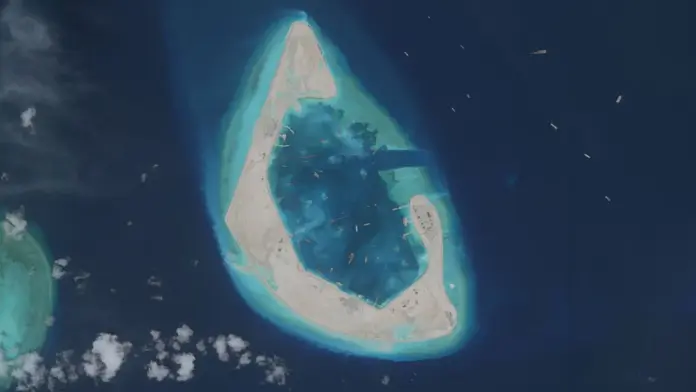
South China Sea Island — A small, teardrop-shaped reef in the north-western corner of the South China Sea has been dramatically reshaped. Antelope Reef, located in the Paracel Islands and almost entirely submerged until this year, now rises from the water as a gleaming white crescent of sand stretching across six square kilometres — the product of one of the most rapid island-building operations ever recorded.
Millions of tonnes of sand were dredged from the seabed over just six months, a feat made possible by China’s fleet of cutter suction dredgers, the largest such fleet in the world. The most powerful of these vessels can excavate up to 6,000 cubic metres of material per hour. Satellite imagery shows dozens of ships anchored inside the lagoon formed by the crescent, and a conspicuously straight-line edge along one of the newly formed beaches has raised alarm among regional analysts, who suggest it may indicate the early construction of a military-grade runway.
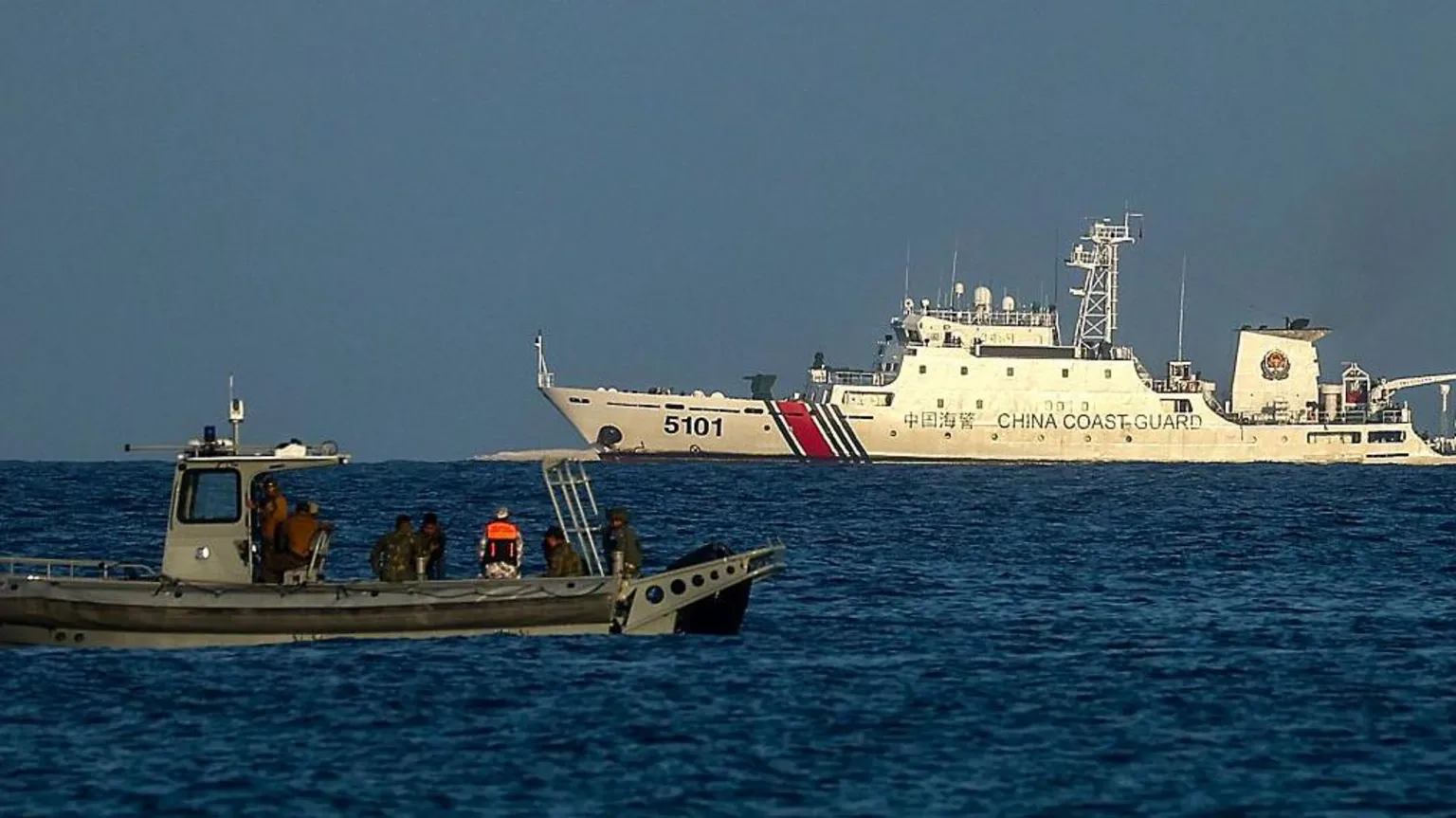
The pattern is familiar. Over the past decade, China dredged and transformed three reefs in the Spratly Islands — Mischief Reef, Fiery Cross Reef, and Subi Reef — and subsequently constructed airports and military installations on each. China already operates a well-established airstrip on Woody Island, located close to Antelope Reef in the Paracels. Beijing has drawn a nine-dash line across maps of the South China Sea, claiming sovereignty over nearly its entirety, and deploys coastguard and maritime militia vessels to enforce that claim.
Recommended Reading
China seized control of the Paracel Islands in 1974 following a brief but decisive naval battle with South Vietnamese forces. The islands are also claimed by Vietnam, Taiwan, and, along with the Spratlys, by the Philippines, Malaysia, and Brunei.
Vietnam has filed a formal diplomatic protest over the Antelope Reef construction, though in notably restrained terms — a reflection, analysts suggest, of Hanoi’s careful management of its relationship with Beijing. Vietnam’s newly elected president and party general secretary To Lam chose China as the destination for his first state visit this year, signalling a desire to maintain stable ties even as tensions simmer.
Yet Vietnam is far from passive in the broader contest for the South China Sea. Over the past three years, Hanoi has been pumping sand around at least 20 reefs of its own. According to the Asian Maritime Transparency Initiative, Vietnam has created 11 new harbours and now controls more than 11 square kilometres of reclaimed land across the disputed waters. Vietnamese forces are also beginning to install military-grade infrastructure, including navigation beacons, on contested reefs.
The Philippines has taken a more confrontational posture toward Beijing. Manila brought China’s territorial claims before the Permanent Court of Arbitration in The Hague in 2013. The court ruled that China’s nine-dash line had no basis in historical law, that Beijing’s actions violated international law, and that China had infringed upon the Philippines’ exclusive economic zone rights. China has dismissed and ignored the ruling entirely.
South China Sea Island: South China Sea Tensions in Context
On the ground — or rather, at sea — the Philippines maintains a rusting World War II-era landing craft, the BRP Sierra Madre, deliberately grounded on Second Thomas Shoal since 1999. A small detachment of Filipino soldiers remains aboard, enduring persistent harassment from Chinese vessels. The United States has provided $500 million in military aid to the Philippines in support of its position, and Manila is simultaneously expanding the runway at Pagasa Island, also known as Thitu, in the Spratlys.
Diplomatic efforts to manage the dispute have yielded little. The Association of Southeast Asian Nations agreed on a declaration regarding the South China Sea in 2002, but the document carried no binding obligations. Asean has spent the past 30 years attempting to negotiate a formal code of conduct between China and its member states, without success.
The transformation of Antelope Reef underscores the accelerating pace of territorial competition in one of the world’s most strategically vital waterways. Roughly one-third of global maritime trade passes through the South China Sea each year. With China’s island-building capabilities now demonstrated to operate at extraordinary speed, and with multiple claimants expanding their own physical presence across the disputed waters, the window for diplomatic resolution appears to be narrowing.