BEIRUT/WASHINGTON — Donald Trump announced Monday that Israel and Hezbollah have agreed to halt attacks on each other, following what he described as separate direct communications with Israeli Prime Minister Benjamin Netanyahu and senior Hezbollah representatives — a diplomatic manoeuvre without precedent in American history.
Israel-Hezbollah De-Escalation — Trump disclosed the outreach on his Truth Social platform, stating he had spoken with Netanyahu and had also engaged Hezbollah through what he called ‘highly placed representatives.’ No sitting US president has ever communicated with the Lebanese militant group, which Washington designates as a terrorist organisation. The announcement immediately drew international attention, not only for its substance but for the extraordinary channel through which it was conducted.
Under the terms of the reported arrangement, Hezbollah would cease firing into Israeli territory while Israel would halt strikes on Beirut and its densely populated southern suburbs. Trump stated that Netanyahu had agreed to pull back Israeli troops who had been preparing to advance on the Lebanese capital, adding that ‘there will be no troops going to Beirut and any troops on their way have been turned back.’ He described his call with the Israeli prime minister as ‘very productive.’
Recommended Reading
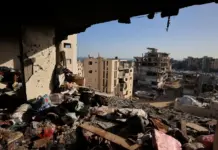
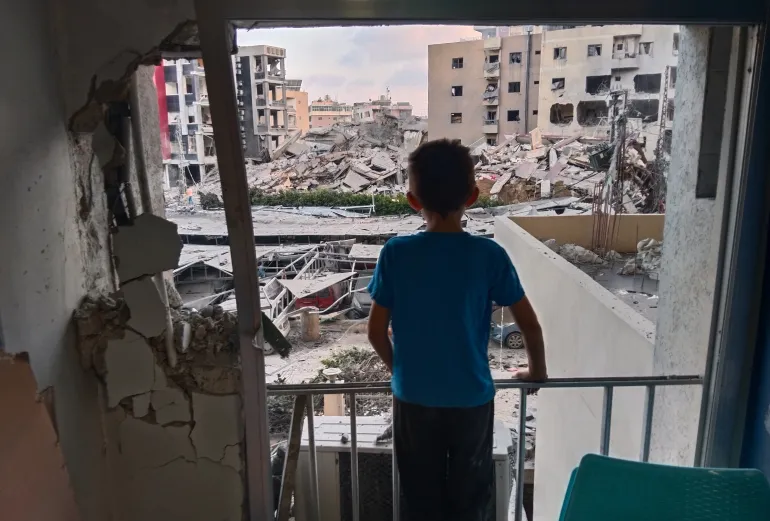
![A destroyed building hit by an Israeli air strike is seen through a shattered window of the Jabal Amel Hospital in the southern port city of Tyre, Lebanon, on June 1, 2026 [AP]](https://world-tension.s3.us-east-2.amazonaws.com/articles/1248/cdc5d6d95b9649a68103e2b6c5182b18.webp)
Netanyahu’s office, however, issued a pointed caveat: Israel reserves the right to strike Beirut if Hezbollah attacks continue. The Israeli military underscored that posture by issuing forced displacement orders Monday, warning residents of Beirut’s southern suburbs to evacuate. Neither Israel nor Hezbollah has formally and publicly accepted the reported agreement, leaving its durability in immediate doubt.
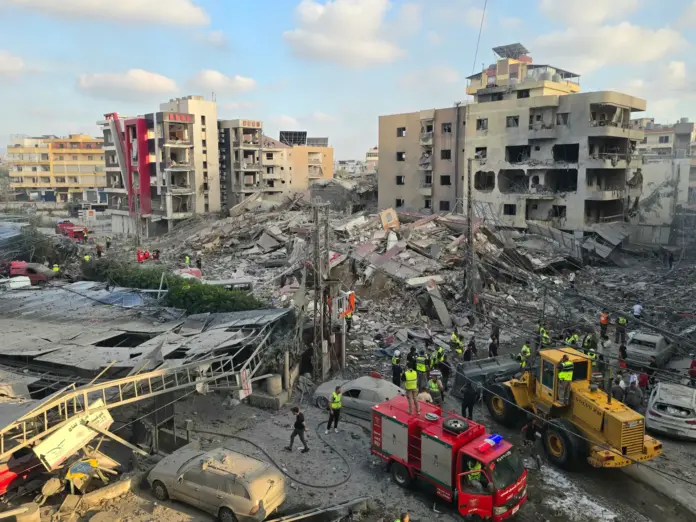
On Tuesday morning, no Israeli strikes on the Lebanese capital were reported. Yet the guns had not fallen entirely silent. Israeli forces continued artillery fire near Nabatieh in southern Lebanon and struck the villages of Choukine and Kfar Tibnit. At least five people were killed in Israeli attacks across the south, according to Lebanese state media. Two Syrians died when an Israeli strike hit a plant nursery in Jebchit in Nabatieh governorate. Drone strikes killed two more people on Martyr Sabra Street in Toul and in the Dhi’at al-Arab neighbourhood of Ansar, and a separate drone attack killed the driver of a car in Nabatieh.
The Israeli military also reported that air defences intercepted two projectiles crossing from Lebanon into northern Israel in the hours following Trump’s announcement. Hezbollah claimed no responsibility for cross-border fire but did acknowledge attacks against Israeli troops occupying southern Lebanon, where at least two Israeli soldiers were killed near Beaufort Castle in the past 24 hours. Israeli forces had seized the 900-year-old strategic hilltop fortress on Saturday in what military analysts described as the deepest Israeli incursion into Lebanon in more than two decades.
Lebanese officials moved quickly to signal support for the diplomatic opening. Lebanese President Joseph Aoun‘s office confirmed the terms of the reported agreement. Parliamentary Speaker Nabih Berri, who played a central role in brokering the November 2024 ceasefire, said he could personally vouch for Hezbollah’s ‘full, comprehensive and immediate’ adherence to any ceasefire deal. Hezbollah MP Hassan Fadlallah told the al-Manar broadcaster that the group supports a ‘full ceasefire on all Lebanese territory,’ framing any halt in fighting as a precursor to Israeli troop withdrawal from the country.
Lebanon’s UN Ambassador Ahmad Arafa commended the Trump administration for what he called ‘constructive efforts aimed at giving diplomacy a chance.’ Lebanon’s embassy in Washington described the proposal as an exchange: Hezbollah stops attacks on Israel, Israel halts strikes on Beirut and its suburbs.
Israel-Hezbollah De-Escalation: Regional Implications
The humanitarian toll of the conflict has been severe. Since fighting escalated in early March, the Lebanese Ministry of Public Health reports more than 3,412 people killed and 10,269 wounded. Over one million Lebanese have been displaced. Israel currently occupies approximately one-fifth of Lebanese territory.
The backdrop to Monday’s announcement is a conflict that has defied repeated attempts at resolution. A ceasefire announced in November 2024 was breached near-daily by Israeli forces. A 10-day truce declared on April 22 and subsequently extended by three weeks failed to produce a genuine halt in hostilities. Hezbollah began its current campaign of cross-border fire following US-Israeli strikes on Tehran at the end of February, and Iran — Hezbollah’s principal backer — has stated that Israeli withdrawal from Lebanon is among its conditions for any broader regional settlement.
Complicating the diplomatic picture further, Iranian state media reported Sunday that Tehran was suspending message exchanges with Washington in protest over US policy. On April 24, Trump had demanded that Iran stop funding Hezbollah as part of any wider regional deal. Secretary of State Marco Rubio has characterised Hezbollah as the primary obstacle to peace between Israel and Lebanon.
A rare milestone was reached on April 14, when Israeli and Lebanese officials held their first direct negotiations since 1983. Whether Trump’s unconventional outreach to Hezbollah can translate that tentative diplomatic momentum into a durable ceasefire remains deeply uncertain. The group was founded in 1982 specifically to resist Israeli occupation of southern Lebanon — a mission its leadership shows no sign of abandoning, even as the human cost of the current escalation mounts by the day.