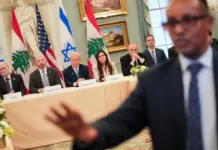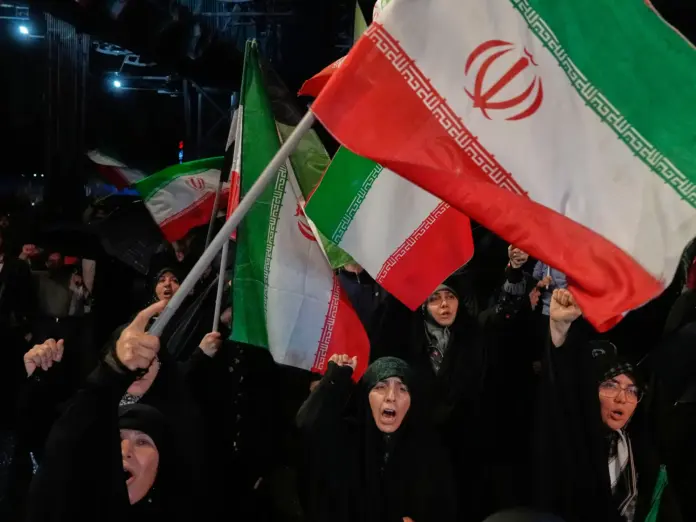
Iran Nuclear Talks — The United States and Iran are locked in a high-stakes diplomatic sprint, with President Donald Trump issuing a two-to-three day ultimatum for Tehran to conclude a nuclear agreement — even as Washington’s own legislative branch moved to constrain his war-making authority. The Republican-controlled Senate voted to advance a War Powers Resolution that would require explicit congressional approval before any military campaign against Iran could proceed.
Trump, speaking to legislators, insisted Washington would end the conflict with Iran ‘very quickly.’ Vice President JD Vance offered a more measured assessment, acknowledging that both sides have made considerable progress in negotiations. The competing signals reflect the volatile nature of a standoff that has already sent shockwaves through global energy and food markets.
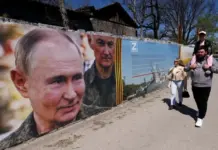
Iranian Foreign Minister Abbas Araghchi struck a defiant tone, warning that any return to open warfare would feature ‘many more surprises.’ His remarks came shortly after he travelled to Moscow on April 27 for direct consultations with Russian President Vladimir Putin. Russian Deputy Foreign Minister Sergey Ryabkov subsequently confirmed that Moscow stands ready to assist in resolving the US-Iran dispute — a significant signal of diplomatic alignment between the two sanctioned powers.
Recommended Reading
The geopolitical architecture surrounding the crisis grew more complex following a meeting between Chinese President Xi Jinping and Russian Foreign Minister Sergey Lavrov on April 15, during which Xi urged closer and stronger strategic coordination between Beijing and Moscow. Putin has since arrived in China for talks focused on energy security, underscoring how the Iran standoff is reshaping great-power relationships in real time.
The economic consequences of the crisis are already measurable. The Strait of Hormuz — through which roughly one-third of the world’s fertiliser supply normally transits — has been a focal point of disruption. Gulf states export 41 percent of the world’s urea, and nitrogen urea prices have surged approximately 80 percent since February. The United Nations has warned that up to 45 million additional people could be pushed into hunger if disruptions continue, potentially bringing the global total facing food shortages to 363 million.
Two Chinese supertankers — the Yuan Gui Yang and the Ocean Lily — departed the Strait of Hormuz after being stranded for nearly two months. The Yuan Gui Yang had loaded 2 million barrels of Iraqi Basrah crude on February 27, while the Ocean Lily carried 1 million barrels each of Qatari al-Shaheen and Iraqi Basrah crude loaded between late February and early March. Their departure offered a rare moment of relief in an otherwise tightly constricted maritime corridor.
The UN has separately slashed its global growth forecast to 2.5 percent for the year, down from an estimated 3 percent in 2024, citing the compounding effects of geopolitical instability and trade disruption.
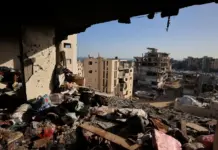
While diplomats negotiate, Israeli military operations continued to exact a human toll across multiple fronts. Israeli forces carried out air raids on the southern Lebanese towns of Habbouch and Jibshit, as well as the Nabatieh district, where nine people were killed. The cumulative death toll from Israeli attacks since March 2 has climbed to 3,042.
Iran Nuclear Talks: The Nuclear Dimension
In the occupied West Bank, Israeli forces shot and wounded Kamal Ahmad Abu Turki near Sidat al-Fahs in southern Hebron. Troops also arrested a man, his son, and a third young man from the Jaber neighbourhood in Hebron’s Old City. Separately, Israeli forces burned down several homes in the Jenin refugee camp, while Israeli settlers abducted Ahmad Ar’ara from the al-Ma’azi Bedouin community northeast of Jerusalem.
At sea, Israeli forces intercepted 77 ships belonging to the Gaza-bound Global Sumud Flotilla, further tightening the blockade on the territory as humanitarian organisations struggle to deliver aid.
The convergence of a nuclear standoff, active military campaigns, and cascading economic disruption has placed the Middle East at the centre of a crisis with genuinely global dimensions. Whether the diplomatic window Trump has set will produce results — or give way to a broader confrontation — may become clear within days.