Washington / Tehran — US President Donald Trump ordered his military to stand down from a scheduled strike on Iran on Tuesday, yielding to urgent appeals from Gulf allies even as the two countries remain locked in a fundamental dispute over Tehran’s nuclear programme.
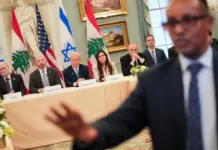
Iran Nuclear Deadlock — Trump directed Secretary of Defense Pete Hegseth, Chairman of the Joint Chiefs of Staff General Dan Caine, and the broader US military apparatus to cancel the planned attack after the leaders of Qatar, Saudi Arabia, and the United Arab Emirates personally asked him to hold off. The president nonetheless warned that forces remain on standby for a ‘full, large-scale assault’ should negotiations collapse.
‘There is a very good chance we can reach an agreement,’ Trump said Monday, striking a cautiously optimistic tone even as his administration kept maximum military pressure in place.
Recommended Reading
The pause comes as Iran submitted a revised 14-point peace plan to Washington through Pakistan, acting as an intermediary. The proposal, reported by Iran’s semi-official Tasnim news agency, calls for the release of frozen Iranian assets abroad, the lifting of sweeping economic sanctions, an end to the US naval blockade imposed on Iranian ports in April, and a halt to fighting across all active fronts — including in Lebanon, where Israeli forces continue daily strikes and have pressed forward with a ground invasion in the south of the country.
Iran has also previously sought compensation for damage inflicted by US-Israeli military operations, a demand Washington has shown no willingness to entertain.
The central obstacle remains Iran’s stockpile of enriched uranium. Tehran is believed to hold approximately 440 kilograms of uranium enriched to 60 percent — well below the 90 percent threshold required for weapons-grade material, though representing a significant technical capability. Iran has never formally declared an intention to build a nuclear weapon.
Washington is demanding that Iran hand over its entire enriched stockpile to the United States and agree to a moratorium on all uranium enrichment lasting up to 20 years. Tehran has flatly rejected surrendering material directly to Washington, indicating it might consider transferring it to a neutral third party. Foreign Minister Abbas Araghchi confirmed he had discussed with Russian officials a proposal for Moscow to store Iran’s enriched uranium — a potential off-ramp that has yet to gain traction.
‘We have reached a deadlock on the question of Iran’s enriched material,’ Araghchi acknowledged, offering one of the starkest public assessments yet of where the talks stand.
The uranium dispute is compounded by a parallel standoff over the Strait of Hormuz. Since early March, Iran has restricted shipping through the waterway, requiring vessels to negotiate transit with the Islamic Revolutionary Guard Corps and, in earlier proposals, suggesting the imposition of fees or tolls. Washington has repeatedly rejected any arrangement that would give Tehran financial or operational control over a chokepoint that, before the war, carried one-fifth of the world’s crude oil and liquefied natural gas supply. Technical teams from Iran and Oman met in Muscat to explore a mechanism for safe passage, but no agreement has been announced.
Iran Nuclear Deadlock: The Nuclear Dimension
The fragility of the current situation was thrown into sharp relief over the weekend when a drone struck the Barakah Nuclear Energy Plant in the United Arab Emirates on Sunday. A day later, Saudi Arabia intercepted three additional drones. No group immediately claimed responsibility for either attack, but the incidents rattled Gulf capitals already anxious about the conflict’s trajectory.
An initial temporary ceasefire took effect on April 8, six weeks into the war, but fighting has continued on multiple fronts. Iran’s broader strategic network — the so-called ‘axis of resistance‘ encompassing Hezbollah in Lebanon, the Houthis in Yemen, and armed factions across Iraq and Syria — remains active. Houthi forces have continued targeting Israel-linked shipping in the Red Sea, while Israeli ground and air operations in Lebanon show no sign of abating.
The diplomatic backdrop is shaped by the wreckage of the 2015 Joint Comprehensive Plan of Action, under which Iran was permitted to enrich uranium only to 3.87 percent. The International Atomic Energy Agency certified that Tehran had complied with those terms before Trump withdrew the United States from the agreement in 2018, triggering a cascade of sanctions and, ultimately, Iran’s decision to dramatically expand its enrichment activities.
Whether the revised Iranian peace plan offers enough common ground to bridge the gap remains deeply uncertain. Trump’s decision to pause — rather than cancel — the military option signals that Washington views the threat of force as its primary leverage. For Gulf leaders who depend on regional stability for their own economic survival, the priority is buying time. Whether that time translates into a durable agreement or simply delays a wider confrontation is the question now hanging over the entire region.