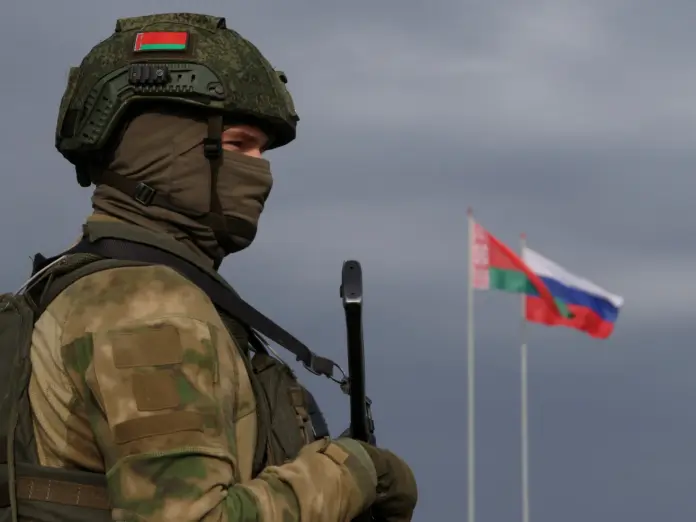
Minsk — Belarusian and Russian military units have commenced joint training exercises focused on nuclear weapons combat, the Belarusian Ministry of Defence announced, escalating tensions along NATO’s eastern flank and drawing urgent warnings from Kyiv and its Western allies.
Belarus Russia Nuclear Drills — The ministry described the drills as a planned event with no specific third-party target, stating the exercises are designed to test combat readiness and the ability to carry out missions from unprepared positions across Belarusian territory. The Russian Ministry of Defence had not published any information about the exercises at the time of the announcement.
Ukraine’s reaction was swift and unequivocal. The Ukrainian Ministry of Foreign Affairs condemned the drills, arguing that transforming Belarus into a nuclear staging ground on NATO’s doorstep amounts to a legitimisation of nuclear weapons proliferation. Kyiv simultaneously called on Western governments to impose tighter sanctions on both Moscow and Minsk.
Recommended Reading
The timing of the exercises is particularly charged. They were announced the day after Ukraine launched what Russian officials described as one of the largest drone barrages of the war against Moscow, an attack that killed at least five people according to Russian authorities. Kremlin spokesman Dmitry Peskov dismissed Ukrainian President Volodymyr Zelenskyy‘s allegations of a planned Russian offensive through Belarus as a deliberate attempt to inflame tensions and prolong the conflict.
Zelenskyy, however, has pressed the warning with increasing urgency. Speaking on Friday, he cautioned Belarus against allowing itself to be drawn into Russia’s war, citing intelligence assessments suggesting Moscow is actively considering deploying forces northward once again. He further warned that Belarus could serve as a launchpad not only for strikes into Ukraine but also for attacks on NATO member states sharing borders with Belarus — Latvia, Lithuania, and Poland.
The spectre of a northern offensive carries particular weight given recent history. On February 24, 2022, Russian forces used Belarus as a corridor to invade Ukraine, advancing to the outskirts of Kyiv before being repelled by Ukrainian defenders. Those forces were subsequently accused of committing numerous war crimes during their advance. The memory of that assault underpins Kyiv’s insistence that any military build-up in Belarus must be treated as a direct threat.
Russian tactical nuclear weapons were deployed to Belarus following a formal request by President Alexander Lukashenko, who has argued the warheads provide a necessary security guarantee against what he characterises as an existential threat from NATO. Lukashenko, whose country is heavily dependent on Moscow economically, has simultaneously sought to ease his international isolation, recently pursuing improved relations with the United States and seeking relief from Western sanctions.
Belarus Russia Nuclear Drills: The Nuclear Dimension
NATO allies have echoed Ukrainian concerns about the drills. The alliance has watched the militarisation of Belarus with growing alarm since Lukashenko survived a contested 2020 election with Russian backing and subsequently deepened his country’s strategic integration with Moscow. Belarus now hosts Russian troops and, with the deployment of tactical nuclear warheads, has become a forward nuclear platform on the alliance’s eastern border.
The joint exercises represent the most visible demonstration yet of that nuclear posture. While Minsk insists the drills are routine, critics argue they serve a broader signalling function — reinforcing the threat of nuclear escalation at a moment when the war in Ukraine shows no sign of resolution and diplomatic channels between Russia and the West remain largely frozen.
Kyiv’s calls for tightened sanctions reflect a broader frustration that economic pressure on both Russia and Belarus has not been sufficient to alter their strategic calculus. With Lukashenko navigating between dependence on Moscow and tentative outreach to Washington, the nuclear exercises complicate any near-term prospect of Minsk charting a more independent course.