Us Strikes Iran — The Middle East lurched toward a broader regional war on Monday as US Central Command (CENTCOM) carried out strikes on Iran’s Qeshm Island, American forces intercepted Iranian missiles aimed at Gulf allies, and diplomatic channels between Washington and Tehran showed signs of severe strain.
CENTCOM confirmed it conducted what it described as self-defence strikes on Qeshm Island, targeting an Islamic Revolutionary Guard Corps (IRGC) communications tower south of the island. Iranian state media acknowledged explosions in the vicinity. The strikes came after Iranian forces launched salvoes of missiles and drones at both Kuwait and Bahrain, two Gulf states that host significant American military infrastructure.
Kuwait’s military reported that its air defence systems successfully intercepted incoming projectiles. Two Iranian missiles fired at Kuwait fell short or broke apart before reaching their targets, according to CENTCOM. In Bahrain, warning sirens were activated across the country as three missiles were launched toward the island kingdom — all three were intercepted by a combination of US and Bahraini air defence forces. The IRGC claimed its forces had struck the US Fifth Fleet headquarters in Bahrain, a claim CENTCOM flatly dismissed, stating that all Iranian attacks on American forces failed.
Recommended Reading
The exchange of fire extended to the waters near the Strait of Hormuz, one of the world’s most critical oil shipping lanes. The IRGC alleged that US forces struck an Iranian oil tanker in the area, damaging its engine room, and said it retaliated by firing naval missiles at what it described as a US-Israeli vessel. CENTCOM did not immediately confirm the tanker strike.
President Donald Trump denied that nuclear negotiations with Iran had stalled, even as the military confrontation intensified. Secretary of State Marco Rubio delivered a firm public message to Tehran, stating that Washington would not lift sanctions in exchange for Iran reopening the Strait of Hormuz. Any form of economic relief, Rubio made clear, is contingent on Iran surrendering its stockpiles of enriched uranium — a demand Tehran has consistently rejected. The US Treasury Department compounded the economic pressure by announcing new sanctions targeting Iran’s largest cryptocurrency exchange.
The escalation in the Gulf unfolded against a backdrop of continued conflict in Lebanon, where Israel’s military campaign has now killed at least 3,468 people since March 2, according to Lebanon’s Health Ministry. A further 10,577 people have been wounded. On Tuesday alone, Israeli strikes on the towns of Burj Shemali, Ebba and Tibnin killed five people, including a child, and wounded 45 others.
Hezbollah reported launching 13 separate attacks against Israeli forces in southern Lebanon, deploying rocket salvoes, artillery, guided missiles and attack drones. Israel’s bombing campaign in the south continued unabated.
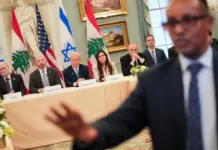
Despite the violence, diplomatic activity persisted. Israeli and Lebanese delegations completed a fourth round of direct negotiations in Washington, DC, with another session scheduled for the following day — a sign that back-channel efforts to reach a ceasefire arrangement have not entirely collapsed.
Us Strikes Iran: Regional Implications
Israeli Prime Minister Benjamin Netanyahu announced sweeping plans to fortify northern Israel, describing what he called ‘massive plans’ to strengthen communities along the Lebanese border. The fortification zone extends up to seven kilometres — roughly three miles — from the border, backed by a $20 billion government investment aimed at restoring security and economic vitality to a region that has been largely evacuated since hostilities intensified.
Trump’s direct involvement in the crisis extended beyond the Iranian front. The US president reportedly clashed with Netanyahu during a phone call over Israel’s threat to strike the suburbs of Beirut, with the conversation described by those familiar with it as unusually heated. Trump also made what was characterised as an unprecedented direct call to Hezbollah, the details of which have not been fully disclosed but which underscored the administration’s willingness to engage unconventional diplomatic channels as the region teeters on the edge of a wider war.
The convergence of military strikes, missile exchanges, sanctions pressure and fragile diplomacy marks one of the most volatile periods in the Middle East in years, with the risk of miscalculation by any of the parties carrying potentially catastrophic consequences for the broader region and global energy markets.