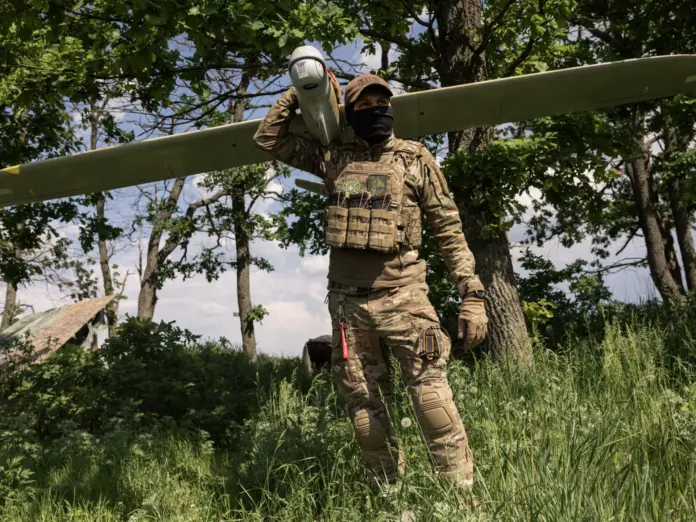
Kyiv — Ukrainian drones struck oil refineries, fuel pumping stations, and energy infrastructure across a wide arc of Russian territory overnight, in one of the most geographically expansive drone campaigns of the war, hitting targets from the Volga River basin to regions bordering Ukraine.
Ukrainian Drones Strike Russian Oil — Ukraine’s military confirmed it targeted the Saratov oil refinery, a major industrial facility in the Volga region that has come under repeated Ukrainian attack in recent years. Governor Roman Busargin acknowledged that civil infrastructure sustained damage in the overnight strikes on Sunday, without specifying the full extent of the destruction.
In a strike that underscored the growing reach of Ukraine’s drone programme, a facility in the Urzhumsky district of the Kirov region was also hit. The Kirov region sits northeast of Moscow, roughly 1,300 kilometres — approximately 800 miles — from Ukrainian territory, making it one of the most distant targets struck in the conflict to date. Governor Alexander Sokolov confirmed the drone strikes in his region, while Ukraine’s military specifically identified the Lazarevo oil-pumping station as the target of the Kirov attack.
Recommended Reading
The campaign extended across multiple fronts simultaneously. Governors in the Rostov, Voronezh, and Belgorod regions — all of which share a border with Ukraine — reported drone strikes on their territories. The Belgorod strikes proved the most costly in human terms, with three civilians injured as a result of the overnight attacks.
In Crimea, the Moscow-backed governor Sergei Aksyonov announced that authorities were introducing restrictions on petrol sales across the peninsula. The move reflects sustained pressure on fuel supply chains; Ukraine has conducted months of strikes against energy and fuel infrastructure in southwestern Russia in close proximity to Crimea, steadily degrading the logistical networks that support Russian military operations in the south.
The breadth and simultaneity of the strikes signal a deliberate escalation in Ukraine’s campaign to degrade Russian industrial and energy capacity deep inside Russian territory, stretching air defence resources across an enormous geographic front.
Separately, Ukraine firmly rejected Russian accusations that it had struck the Zaporizhzhia nuclear power plant, located in Russian-occupied Ukrainian territory. Kyiv denied any involvement in the alleged incident at the facility, which has been a persistent flashpoint and source of nuclear safety concern throughout the conflict.
As the drone campaign unfolded, President Volodymyr Zelenskyy announced that Ukraine had received a new Iris-T air defence missile launcher from Germany, a significant addition to the country’s layered air defence network. The Iris-T system has been among the most effective platforms deployed by Ukraine against Russian aerial threats. Zelenskyy used the announcement to renew his appeal to Western allies, stressing that Ukraine urgently requires additional missiles for its air defence systems to sustain protection against intensifying Russian strikes on Ukrainian cities and infrastructure.
Ukrainian Drones Strike Russian Oil: The Wider European Impact
‘We need missiles for our air defence systems,’ Zelenskyy stated, framing the request as critical to Ukraine’s ability to withstand ongoing Russian bombardment while simultaneously pressing its own long-range offensive operations.
The dual dynamic — Ukraine striking deep into Russia while appealing for greater defensive capacity at home — reflects the war’s current strategic logic. Kyiv has increasingly bet that sustained pressure on Russian oil refineries, pumping stations, and fuel depots will erode Moscow’s ability to sustain its military machine, while also imposing economic costs that reverberate through the Russian domestic economy.
The Saratov region, home to several refineries along the Volga River, has emerged as a recurring target in this campaign. Its industrial infrastructure represents a significant node in Russia’s fuel production and distribution network, and repeated strikes there have drawn attention to the vulnerability of facilities that were long considered safely beyond the reach of the conflict.
The overnight operation represents one of the most expansive single-night drone campaigns Ukraine has conducted, with confirmed strikes spanning from the Ukrainian border regions in the west to the Kirov region deep in central Russia — a testament to both the scale of Ukraine’s drone production and the ambition of its targeting strategy as the war enters its fourth year.