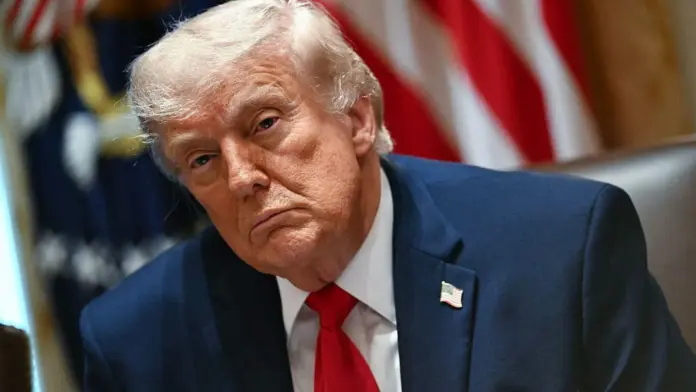
Iran Nuclear Ultimatum — President Donald Trump gathered senior advisers in the White House Situation Room on Friday to make what he called a "final determination" on a potential deal with Iran, as a fragile ceasefire between the two countries showed fresh signs of fracturing and a tentative diplomatic framework remained unsigned by either side.
The White House confirmed the Situation Room meeting concluded without providing further details. Trump, however, laid out his conditions publicly, demanding that Tehran permanently renounce nuclear weapons, allow the United States to remove and destroy its enriched uranium stockpiles, and reopen the Strait of Hormuz to unrestricted shipping in both directions — including the clearance of any remaining mines. He also stated that no money would change hands until further notice, and indicated Washington was prepared to lift its naval blockade of the strait as part of broader negotiations.
The backdrop is a conflict now entering its third month. US and Israeli forces launched coordinated strikes against Iran on 28 February, triggering Iranian retaliatory attacks on Israel and US-allied Gulf states. Tehran subsequently moved to effectively close the Strait of Hormuz, a chokepoint through which roughly a fifth of the world's oil supply passes, sending global energy prices sharply higher. A ceasefire came into effect on 8 April, though both governments have accused each other of violating its terms in recent days.
Recommended Reading
The most serious breach came Thursday, when Iran's Islamic Revolutionary Guard Corps said it struck a US air base in Kuwait, claiming the facility had been the launch point for earlier American strikes on Bandar Abbas, a strategically vital Iranian port city near the Strait of Hormuz. US Central Command condemned the attack as an "egregious ceasefire violation."
Against that volatile backdrop, US officials confirmed Thursday that negotiators from both countries had reached a tentative framework — described as a memorandum of understanding — that would extend the ceasefire by 60 days and open the door to formal talks on Iran's nuclear programme. The agreement, however, still requires sign-off from Trump and Iran's leadership, and significant gaps remain.
Iran's response was pointed. Foreign ministry spokesman Esmaeil Baqaei stated flatly that no final agreement had been reached and that Tehran rejected the use of the word "must" in Trump's public framing of the conditions — language he characterised as incompatible with the spirit of negotiations. Baqaei also described the US naval blockade as an illegal act and a violation of the ceasefire in its own right.
Iran's chief negotiator, Mohammad Baqer Qalibaf, struck a harder line still. "Tehran does not trust guarantees and words — only actions are the criterion," he said, adding that Iran would take no steps until the other side moved first. The foreign ministry separately stated that Iran was not negotiating its nuclear programme, a position that directly contradicts one of Washington's core demands.
The Fars state news agency, citing sources close to the talks, reported that the memorandum of understanding was in the final stages of ratification but contained no provisions requiring the destruction of Iran's nuclear materials — a direct contradiction of Trump's stated conditions. Fars also reported that any arrangements for reopening the Strait of Hormuz could include ship monitoring and inspection protocols.
Iran Nuclear Ultimatum: The Nuclear Dimension
Vice-President JD Vance acknowledged the talks remained unresolved, saying negotiators were still going back and forth on specific language, particularly around the question of uranium enrichment. The US has long insisted Iran halt the production of highly enriched uranium and surrender its existing stockpile. Iran maintains its nuclear programme is entirely peaceful and has consistently denied any intention to develop weapons.
The divergence between Washington's public demands and what Iran says is actually on the table raises questions about how close the two sides truly are. Trump has previously signalled deals were imminent before agreements materialised, and the gap between his stated conditions and Tehran's red lines remains substantial. Iran's insistence that it will not negotiate its nuclear programme as part of a ceasefire extension stands in direct tension with the US position that denuclearisation must be central to any lasting arrangement.
Deep mutual mistrust continues to define the relationship. Qalibaf's insistence on actions over words reflects a broader Iranian scepticism about American commitments — a sentiment shaped by years of sanctions, broken agreements, and military confrontation. For Washington, the challenge is securing verifiable concessions from a government that views any capitulation on nuclear matters as an existential vulnerability.
Whether Friday's Situation Room deliberations produce a signed agreement, a breakdown, or further ambiguity remains unclear. What is certain is that the Strait of Hormuz, global oil markets, and the broader architecture of Middle East security hang in the balance as both governments navigate one of the most consequential diplomatic junctures in years.