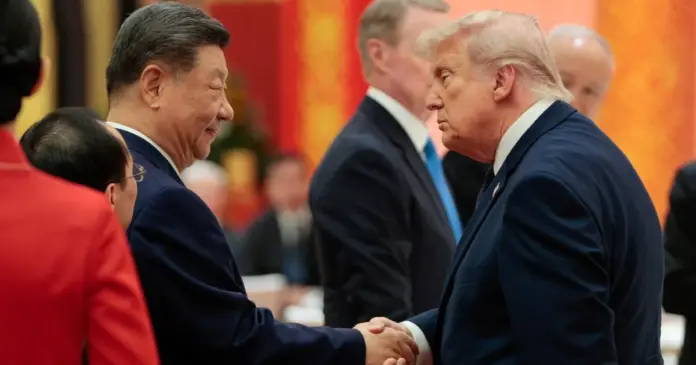
President Donald Trump and Chinese President Xi Jinping met Thursday in a high-stakes summit overshadowed by the ongoing US-Israeli war on Iran and the near-closure of one of the world’s most vital maritime chokepoints. The two leaders reached a shared position that the Strait of Hormuz must remain open to ensure the free flow of global energy supplies.
Trump said Xi told him directly that China wants the strait kept open because Beijing purchases enormous volumes of oil from the region. Xi also stated his opposition to any militarisation of the waterway and rejected the notion of charging vessels a toll for passage — a position that aligns with Washington’s own stance, even as the two powers remain at odds on broader geopolitical questions.
Trump further claimed that Xi assured him China would not supply military equipment to Iran, a significant pledge if upheld. US Treasury Secretary Scott Bessent reinforced the message, saying Beijing would ‘do what they can’ to help reopen the waterway to commercial traffic.
Recommended Reading
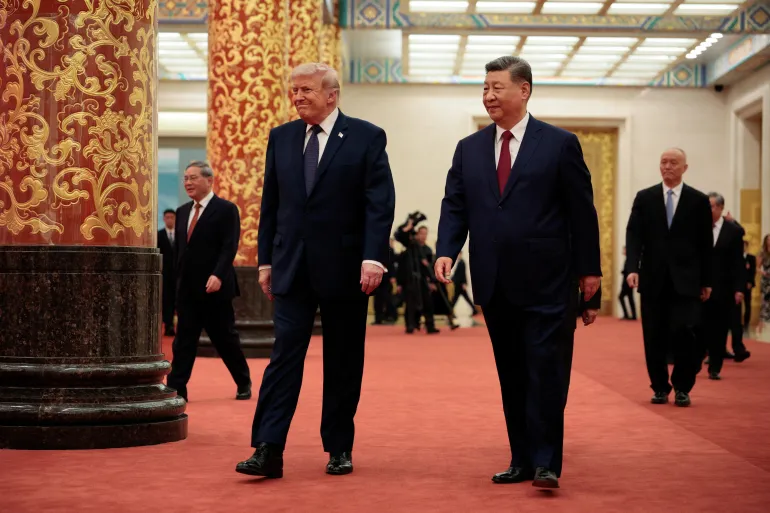
Notably, the Chinese Foreign Ministry’s official readout of the talks made no mention of Iran or the Strait of Hormuz, raising questions about the depth of the consensus and how Beijing intends to translate any private assurances into action.
On the ground, the situation in and around the strait is rapidly evolving. Since the US-Israeli campaign against Iran began at the end of February, Tehran has effectively shut down the waterway to most commercial traffic. Iranian officials have now formalised that control through a new body called the ‘Persian Gulf Strait Authority,’ which requires vessels seeking transit to submit detailed documentation — including cargo manifests, ownership records, destination ports, route plans, and transit timing — to Iranian naval authorities before being permitted passage.
Iran’s judiciary spokesperson Asghar Jahangir stated Thursday that the seizure of what he described as ‘US tankers’ was being conducted in accordance with both domestic and international law. Iranian officials added that commercial vessels would be permitted through the strait provided they cooperate with Tehran’s naval authorities under the new mechanism.
Shipping data indicated that at least one Chinese tanker transited the strait on Wednesday. Iran’s Fars News Agency reported Thursday that an agreement had been reached allowing some Chinese ships to pass, while state broadcaster IRIB reported approximately 30 vessels had transited since Wednesday evening — suggesting selective enforcement rather than a blanket closure.
The United States has been enforcing its own blockade targeting ships travelling to or from Iranian ports. As of Thursday, the US had redirected 70 commercial vessels and disabled four others. In a separate incident, a ship anchored off the United Arab Emirates was seized and moved toward Iran on Thursday, further illustrating the volatile maritime environment.
Strait Of Hormuz: The Energy Security Dimension
An Indian-flagged wooden cargo vessel sank Wednesday while sailing through Omani waters after sustaining what appeared to be a drone or missile strike that triggered a fire on board. The ship had been en route from Somalia to the UAE. All 14 crew members were rescued by the Omani coast guard.
Despite the diplomatic activity, a peace deal between Washington and Tehran remains elusive. The US is demanding that Iran hand over its stockpile of enriched uranium as a precondition for any agreement. Iran, in turn, is seeking the lifting of sanctions and formal recognition of its sovereignty over the Strait of Hormuz — a demand Washington is unlikely to accept. The two sides are no closer to bridging that gap.
The strait carries roughly 20 percent of the world’s oil supply, making its status a matter of acute concern not only for the US and China but for energy-importing nations across Asia and Europe. The emergence of Iran’s new transit authority, combined with selective passage for certain national fleets, signals that Tehran is attempting to leverage control of the waterway as a negotiating tool rather than impose a total blockade — a strategy that complicates both US enforcement efforts and the broader diplomatic picture.
Thursday’s Trump-Xi meeting took place against a backdrop of additional uncertainty over Taiwan, with the two leaders navigating a relationship defined by strategic competition even as shared economic interests — particularly energy security — create narrow corridors for cooperation.