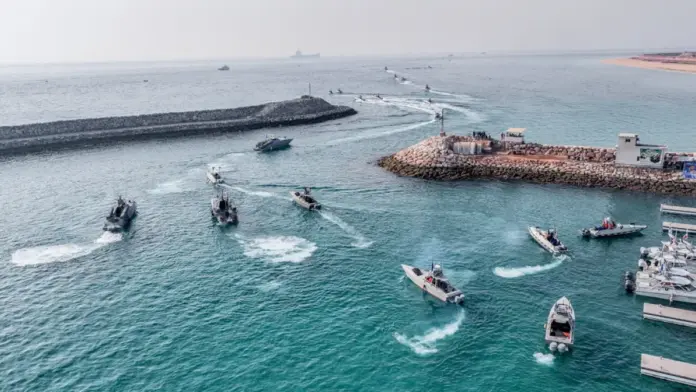
Iran Hormuz Toll Authority — Iran’s Islamic Revolutionary Guard Corps seized a Barbados-flagged oil tanker in the Gulf of Oman on Thursday, as Tehran simultaneously unveiled sweeping new maritime regulations that would impose toll fees and mandatory clearance requirements on all vessels transiting the Strait of Hormuz — one of the world’s most critical energy chokepoints.
The IRGC announced the detention of the Ocean Koi, stating that the vessel had been attempting to disrupt Iranian oil exports and undermine national interests. Iranian Navy rangers and marines boarded the tanker and directed it toward Iran’s southern coast. State television broadcast footage of the operation, showing armed Iranian personnel on the vessel’s deck.
The seizure marks at least the fourth confirmed instance of Iran detaining a commercial ship in the Strait of Hormuz and surrounding waters, continuing a pattern of maritime confrontations that has periodically rattled global energy markets. The Iranian Army issued a stark warning alongside the announcement, declaring it would defend Iranian interests and assets in territorial waters and would not tolerate what it described as violators or aggressors.
Recommended Reading
Far more consequential for international shipping, however, was Tehran’s announcement of the Persian Gulf Strait Authority, a newly created body tasked with managing vessel passage through the Strait of Hormuz. Under the new framework, ship operators intending to transit the strait must submit an email to Iranian authorities disclosing the vessel’s country of origin, cargo details, and final destination. Iranian officials will then assess each request and determine whether to grant clearance — and at what toll cost.
The regulations explicitly require full coordination with Iranian forces before any passage is permitted. The practical and legal implications are sweeping: the Strait of Hormuz is an internationally recognised transit passage under the United Nations Convention on the Law of the Sea, and unilateral attempts to impose toll regimes or clearance requirements on foreign-flagged vessels in such waterways have no standing in international maritime law.
Approximately one-fifth of the world’s oil supply passes through the strait on any given day, making it the single most important maritime chokepoint for global energy flows. Any sustained disruption — or even the credible threat of one — is capable of sending crude prices sharply higher and triggering diplomatic crises among the world’s largest oil-importing nations.
The timing of the Ocean Koi seizure and the authority’s creation suggests a deliberate escalation in Iran’s posture toward maritime control in the region. Analysts have noted that Tehran has increasingly used ship seizures as a tool of leverage during periods of heightened tension with Western powers, and the formalisation of a toll and clearance system represents a significant institutional step beyond ad hoc detentions.
Iran Hormuz Toll Authority: The Energy Security Dimension
The United States has previously conducted strikes on Iranian targets near the Strait of Hormuz, and Washington maintains a substantial naval presence in the Persian Gulf specifically to ensure freedom of navigation. The new Iranian authority is likely to draw a sharp response from the U.S. Navy and from major maritime nations whose commercial fleets depend on unimpeded access to the strait.
No immediate statement was issued by the government of Barbados regarding the detention of the Ocean Koi, nor had the vessel’s operator publicly commented on the seizure as of the time of reporting. The fate of the crew members aboard the tanker remained unclear.
The broader strategic picture is one of intensifying Iranian assertiveness at sea. By coupling a high-profile vessel seizure with the announcement of a formal regulatory body, Tehran appears to be signalling that its maritime ambitions extend beyond opportunistic detentions toward a more permanent claim of authority over one of the planet’s most vital waterways — a claim that the international community is almost certain to contest.