Victory Day Parade Russia — MOSCOW — Russia will mark the 80th anniversary of its World War II victory on Friday with a dramatically scaled-back military parade, stripping Red Square of the tanks, ballistic missiles and junior cadets that have defined the spectacle for years — a stark reflection of the grinding attrition war being fought hundreds of kilometres to the south and west.
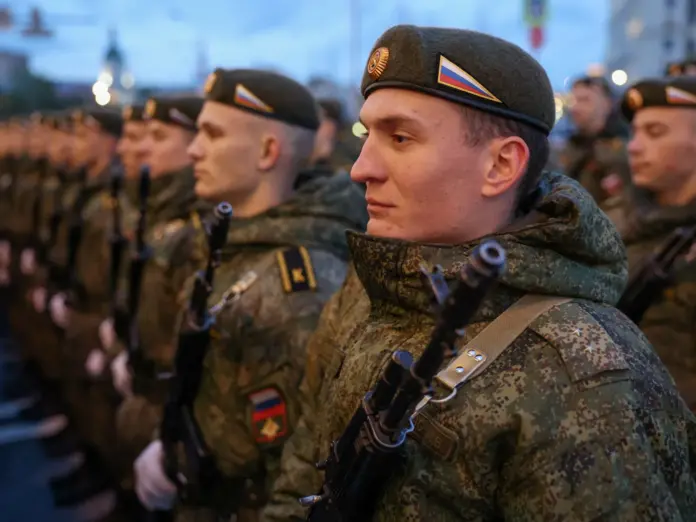
The Victory Day parade, held annually on May 9 to commemorate the Soviet Union’s defeat of Nazi Germany — the German surrender was finalised on that date in 1945 — will for the first time in nearly 20 years feature no armoured vehicles, no mobile missile launchers and no young cadets marching in formation. Personnel from higher-level military academies will still march on foot, and the aerial display will include an aerobatic show alongside Sukhoi Su-25 ground-attack jets trailing smoke in the colours of the Russian flag.
The absence of hardware is impossible to separate from the war’s devastating ledger. According to the open-source intelligence project Oryx, more than 14,000 Russian tanks, armoured personnel carriers and other combat vehicles have been destroyed, captured, abandoned or otherwise lost since President Vladimir Putin launched the full-scale invasion of Ukraine in February 2022. Rolling a column of tanks across Red Square while that figure circulates globally would carry uncomfortable symbolism for the Kremlin.
Recommended Reading
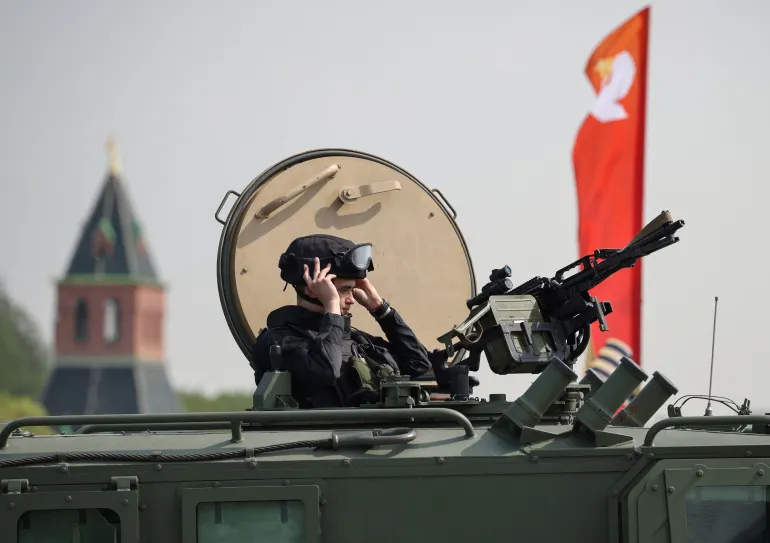
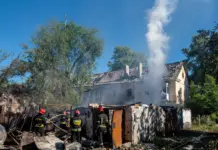
Security pressures compound the logistical calculus. Ukrainian armed forces began striking Moscow with drones in 2023, with one unmanned aircraft hitting the Kremlin itself. Since then, drone attacks have intensified sharply; by 2025, they have completely overshadowed other forms of long-range strike. A recent wave of attacks struck the oil refinery in Tuapse on Russia’s Black Sea coast, triggering what authorities described as an ecological catastrophe and forcing the evacuation of the town. Ukrainian drones now target oil facilities and airfields across Russian territory on an almost daily basis.
In the days preceding Friday’s parade, mobile internet services were periodically shut down across Moscow, Saint Petersburg and other cities — a precautionary measure authorities have employed before major public events to degrade the navigation and coordination capabilities of potential drone operators. Moscow’s layered air defence network, incorporating short-range surface-to-air missile systems, additional missile batteries, small arms and electronic warfare equipment, remains on heightened alert.
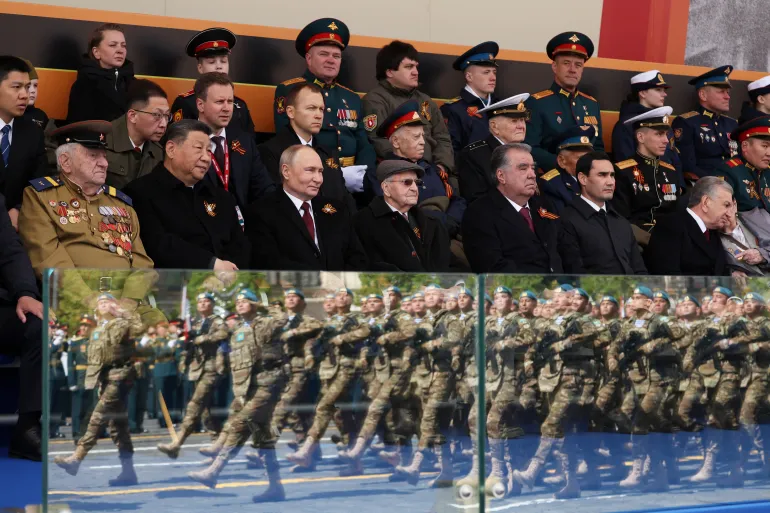
The contrast with recent parades is striking. In 2023, the event featured modern tanks, TOS-2 Tosochka heavy flamethrower systems and Iskander ballistic missiles rolling past the Kremlin walls, while Russian troops marched alongside Chinese soldiers. Chinese leader Xi Jinping sat beside Putin in the reviewing stand, joined by 27 heads of state including Brazilian President Luiz Inácio Lula da Silva and Burkina Faso’s Ibrahim Traore. By 2024, the armoured column had shrunk to a single Soviet-era T-34 tank, though armoured personnel carriers and mobile missile launchers were still present. This year, even those are gone.
The Victory Day tradition itself carries a complex history. Parades were a fixture of the communist era but were shelved for nearly two decades after the Soviet Union collapsed in December 1991. Putin revived them in 2008, transforming the commemoration into an annual showcase of Russian military power and national identity built around the memory of a conflict in which approximately 27 million Soviet citizens perished — more than any other country. The Red Army hoisted its flag over the Reichstag in Berlin in 1945, an image that remains central to Russian state mythology.
Victory Day Parade Russia: The Wider European Impact
Ukraine views that mythology with deep scepticism, characterising the modern Russian celebration as a cynical distortion of history — particularly as Moscow wages a war of aggression against a neighbouring country that also lost millions in the same conflict. The tension between commemoration and current conduct has never been sharper than in 2025, as Operation Spiderweb — a coordinated campaign involving small drones delivered inside Russian territory — demonstrated the vulnerability of Russian infrastructure to asymmetric attack.
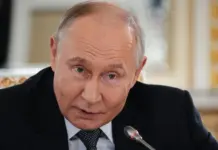
Friday’s parade will still draw significant domestic and international attention. For Putin, the optics of a diminished display on the most symbolically charged day in the Russian calendar present a delicate challenge: honouring a victory of historic proportions while managing the visible costs of a war that shows no sign of ending.