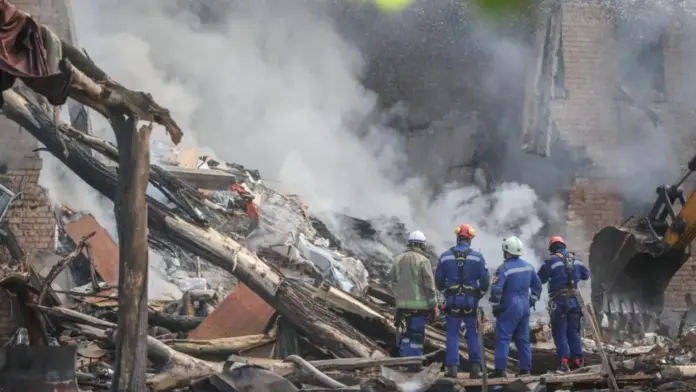
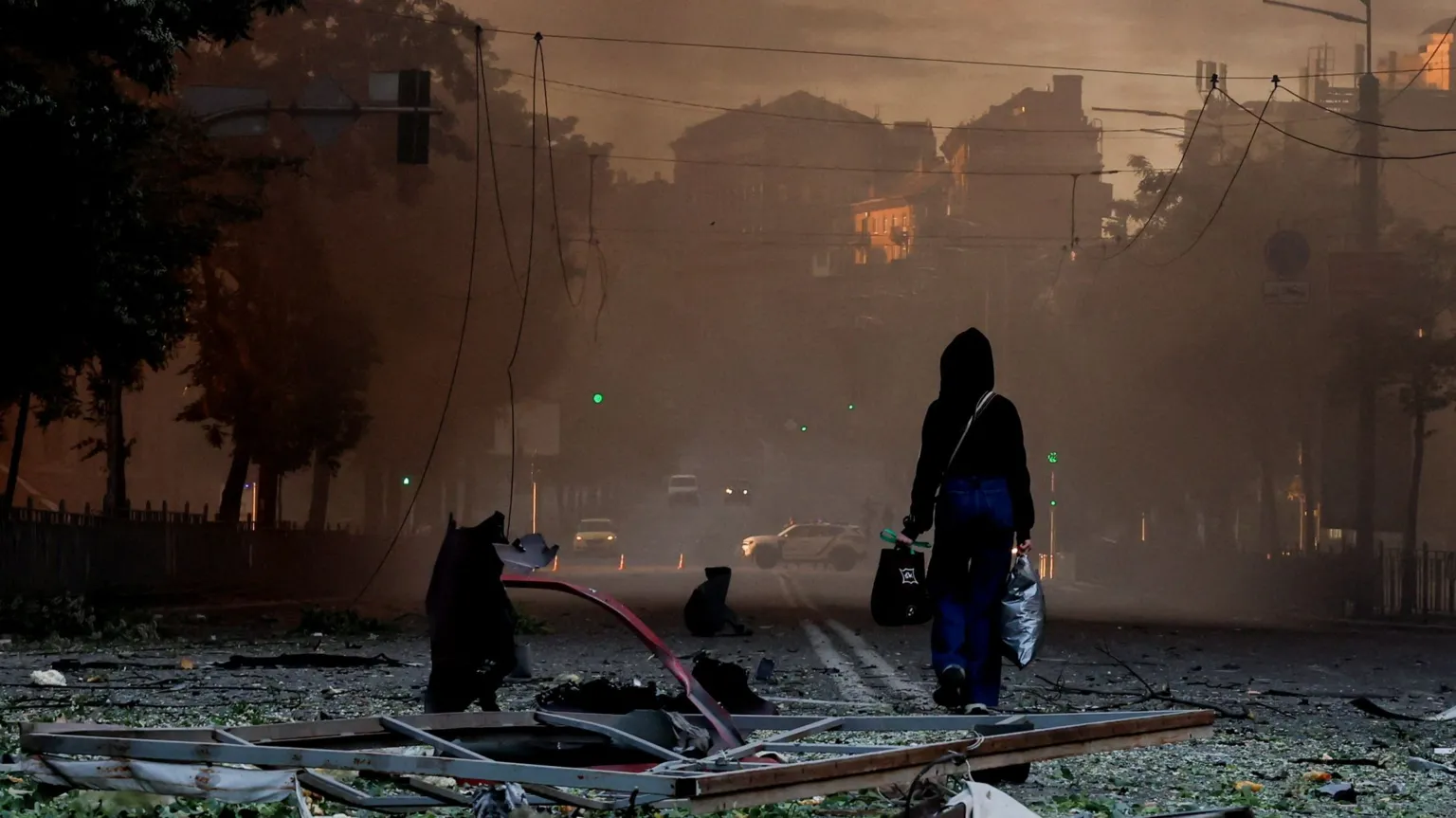
Kyiv, Ukraine — Russian strikes tore through Ukraine’s capital and its surrounding region overnight into Sunday, killing four people, wounding more than 50 others and leaving a trail of destruction across every district of the city. Three children were among those injured as rescue teams worked through the wreckage of damaged apartment blocks and schools.
Russia Strikes Kyiv — The bombardment struck more than 40 locations across Kyiv, with falling debris igniting fires in residential buildings, warehouses, a supermarket and a shopping centre. In the Shevchenko district, a person died when a nine-storey apartment building was hit, with flames breaking out across its upper floors. A separate strike near a school in the same district landed close to an air raid shelter, burying its entrance under rubble and trapping several people inside.
Kyiv Mayor Vitali Klitschko confirmed damage in all of the capital’s districts, while Tymur Tkachenko, head of Kyiv’s military administration, coordinated emergency response efforts across the city. Two additional fatalities were recorded in the wider Kyiv region, according to regional head Mykola Kalashnyk.
Recommended Reading
The overnight assault came days after a devastating Russian strike on a student dormitory in Starobilsk, a city in Russian-occupied eastern Ukraine, which killed 18 people on Friday. Ukrainian President Volodymyr Zelensky cited intelligence gathered jointly by Ukrainian, European and American services indicating that Vladimir Putin was preparing a large-scale combined strike on Ukrainian territory — a warning that lent grim context to Sunday’s bombardment.
Putin had vowed retaliation following the Starobilsk dormitory attack, though Ukraine’s general staff maintained it had struck an elite Russian military unit near the city overnight on Friday, framing the operation as a legitimate military target.
Adding to concerns over the scale of potential future attacks, Zelensky raised the spectre of Russia deploying its Oreshnik hypersonic missile — a weapon reported to travel at more than ten times the speed of sound and currently considered impossible to intercept by existing air defence systems. No confirmation has emerged that the Oreshnik was used in Sunday’s Kyiv bombardment, but its potential deployment has heightened alarm among Ukrainian officials and Western allies.
The strikes underscore the continued vulnerability of Ukraine’s capital despite extensive air defence networks. Russia’s targeting of civilian infrastructure — residential towers, schools and commercial centres — has drawn repeated international condemnation throughout the conflict, now in its fourth year since Moscow’s full-scale invasion in February 2022.
Russia Strikes Kyiv: The Wider European Impact
Rescue operations were ongoing as dawn broke over the city, with emergency workers clearing debris and searching for survivors in affected buildings. Authorities urged residents to remain in shelters as the security situation was assessed.
The pattern of escalating strikes on civilian areas, combined with intelligence warnings of a broader offensive in preparation, signals a potentially dangerous new phase in the conflict. Ukraine’s allies in Europe and North America face renewed pressure to accelerate weapons deliveries and bolster Kyiv’s air defence capabilities before any large-scale coordinated assault materialises.