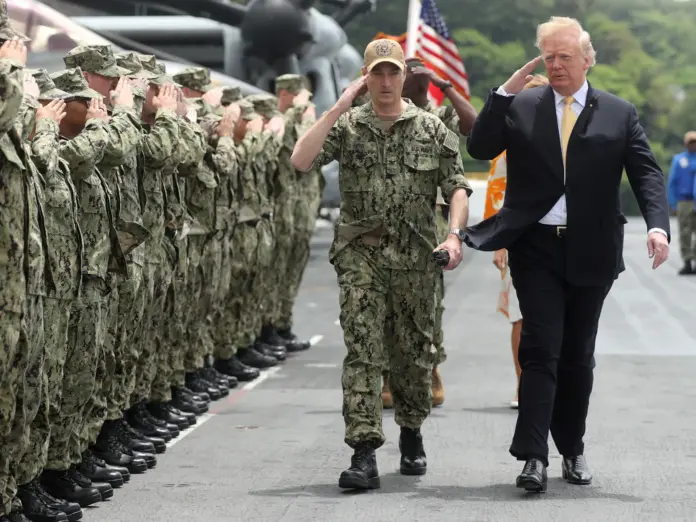
Trump Troops Poland — US President Donald Trump announced late Thursday that he would deploy an additional 5,000 troops to Poland, a dramatic reversal that came barely a week after the Pentagon abruptly cancelled a planned deployment of 4,000 soldiers to the same country — and on the same day he threatened to pull thousands more American forces from Germany.
Trump made the announcement via social media, attributing the decision not to strategic military calculus but to his personal relationship with Karol Nawrocki, Poland’s recently elected right-wing president, whom Trump had publicly endorsed during the Polish presidential campaign. The move drew an immediate welcome from Polish Foreign Minister Radek Sikorski, who said Friday that the deployment would ensure American troop presence in Poland remains at previously established levels.
The announcement landed amid a swirl of contradictory signals from Washington. Even as Trump pledged forces to Warsaw, he declared he was withdrawing 5,000 troops from Germany following a public dispute with German Chancellor Friedrich Merz, who had stated that Washington was "humiliated" by Iranian negotiators. Trump went further, warning he would be "cutting a lot further than 5,000" troops from Europe more broadly. The Pentagon has separately announced plans to reduce the number of combat brigades stationed across Europe from four to three.
Recommended Reading
The contradictions left defence officials in Washington visibly disoriented. European allies, already navigating a fraught relationship with the Trump administration, struggled to interpret the shifting posture. Swedish Foreign Minister Maria Malmer Stenergard captured the mood among many European capitals, describing the overall situation as "confusing" and "not always easy to navigate."
The backdrop to these announcements was a NATO foreign ministers meeting hosted by Sweden on Friday, attended by US Secretary of State Marco Rubio. NATO Secretary-General Mark Rutte welcomed Trump’s Poland deployment announcement, offering a note of reassurance to an alliance that has grown increasingly anxious about American commitment to European security.
That anxiety is well-founded. Trump has repeatedly criticised European NATO partners for insufficient defence spending, and his administration has largely stepped back from efforts to broker a ceasefire in Russia’s ongoing war against Ukraine. European states, for their part, have pushed back against Washington on multiple fronts — most recently by refusing to join the US-Israeli military campaign against Iran and criticising the conflict openly.
The Poland deployment carries particular financial and political significance. Warsaw pays substantial sums toward the cost of hosting American forces, making it one of the alliance’s most committed contributors to the US military presence on the continent. The country’s eastern position, bordering both Ukraine and the Russian exclave of Kaliningrad, also gives it outsized strategic importance as the war in Ukraine grinds on.
Trump Troops Poland: The Wider European Impact
Trump’s broader posture toward Europe has alarmed alliance members beyond the troop numbers alone. His repeated threats to annex Greenland — an autonomous territory belonging to Denmark, a NATO member — have added a layer of tension that extends well beyond defence budgets. European governments are accelerating efforts to develop independent defence capabilities, though officials acknowledge the process is slow and the capability gaps significant.
The net effect of this week’s announcements remains deeply ambiguous. Poland gains a commitment that restores — at least on paper — the troop levels it had previously been promised. Germany faces a reduction. The broader European theatre confronts a Pentagon simultaneously shrinking its footprint and expanding it, driven by presidential social media posts rather than coordinated strategic planning. For an alliance built on predictability and collective deterrence, the uncertainty itself carries a cost.