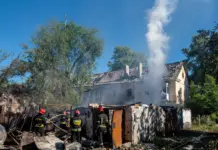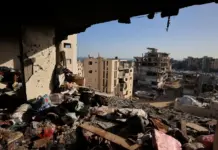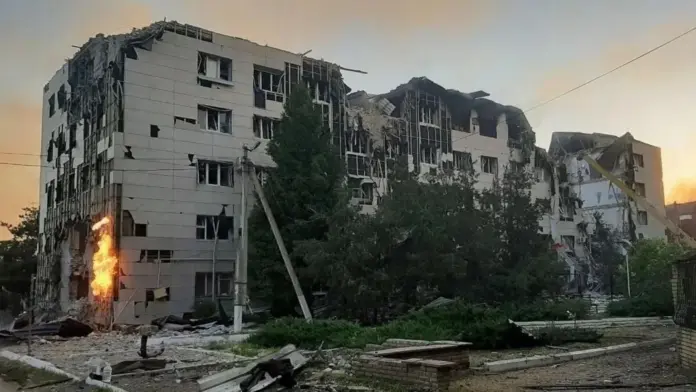
Luhansk Drone Strike — A drone strike on a college dormitory in Russian-occupied eastern Ukraine killed at least 21 people and wounded 42 others in the early hours of Friday, demolishing a five-storey building and triggering an emergency session of the United Nations Security Council.
The attack struck the dormitory of Starobilsk Professional College in the Luhansk region, a territory Moscow claims to have annexed. Emergency rescue teams worked through the weekend before completing their search-and-rescue operation late Saturday. Among those pulled from the wreckage was Olga Kovaleva, a 21-year-old survivor who was trapped beneath rubble before being extracted alive.
Russian officials attributed the strike to a Ukrainian drone attack and brought the matter before the Security Council, where Russian UN Ambassador Vasily Nebenzya declared the incident a violation of international humanitarian law. "This constitutes a war crime," Nebenzya told the council, demanding international condemnation.
Recommended Reading
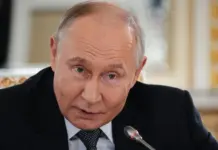
President Vladimir Putin described the strike as a "terrorist strike," insisting there were "no military facilities, intelligence service facilities or related services in the vicinity." He ordered Russia’s defence ministry to draw up a formal response to the attack, a directive issued on Friday that signalled the potential for escalatory action.
Ukraine’s position stands in direct contradiction to Moscow’s account. The General Staff of Ukraine’s Armed Forces confirmed it conducted an operation near Starobilsk overnight on 21-22 May, stating that the target was a Russian military unit — not a civilian institution. Kyiv has consistently maintained that Russian forces routinely use civilian infrastructure to billet troops, making such sites legitimate military objectives under the laws of armed conflict.
That argument found implicit support at the Security Council, where Denmark’s UN representative pushed back sharply against Russia’s framing. The Danish diplomat noted that applying Russia’s logic to the broader conflict — in which Ukrainian cities have endured relentless bombardment — would necessitate emergency Security Council sessions twice daily.
The exchange underscored the deep divisions within the council over how to assess proportionality and targeting in a war now well into its third year. Russia’s annexation of Luhansk, along with three other Ukrainian regions, has not been recognised by the United Nations or the vast majority of the international community, complicating legal arguments over jurisdiction and accountability.
Adding a further dimension to the crisis, Sergey Karaganov, honorary chairman of Russia’s Council on Foreign and Defence Policy and a figure known for advocating aggressive strategic postures, publicly urged strikes against European targets in the wake of the Starobilsk incident — remarks that drew immediate attention in Western capitals already on edge over the trajectory of the conflict.
Luhansk Drone Strike: The Wider European Impact
Starobilsk sits deep within Russian-controlled territory in Luhansk, an area that has seen relatively limited frontline activity compared to the grinding battles further south and west. The strike’s reach into this rear-area town signals Ukraine’s continued capacity and willingness to conduct long-range operations against what it characterises as military logistics and billeting infrastructure, even at the cost of significant international controversy.
The destruction of the college building and the civilian death toll will likely fuel competing narratives for weeks. Russia will press the incident as evidence of Ukrainian disregard for civilian life, while Kyiv and its Western backers will argue the burden of proof lies with Moscow to demonstrate the site held no military personnel or equipment. Independent verification remains impossible given restricted access to Russian-controlled territory.
With Putin’s defence ministry now tasked with formulating a response and hawkish voices in Moscow calling for strikes on European soil, the Starobilsk attack has injected fresh volatility into a conflict that has already resisted every diplomatic effort to bring it to a negotiated close.