Russia Missile Strike Ukraine — Russia launched a sweeping overnight missile assault against Ukraine in the early hours of Tuesday, killing at least four people and wounding dozens more across the country’s major cities in one of the most intense bombardments in recent weeks.
The deadliest toll came from Dnipro, where four residents were killed — among them a 73-year-old woman — and five others sustained injuries. In Kharkiv, eight people were wounded, while four more were injured in the capital, Kyiv, where the scale of destruction drew immediate emergency responses and sent thousands of civilians rushing to underground shelters.
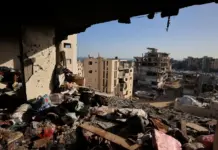
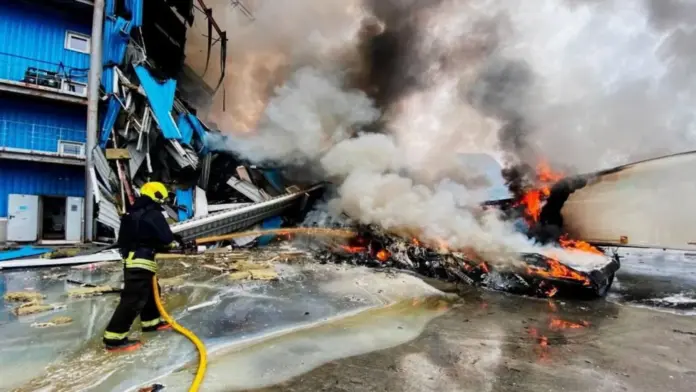
Two high-rise apartment buildings were struck in Kyiv, sending large plumes of smoke billowing above the city centre. Rescue teams moved quickly to the sites amid fears that residents remained trapped beneath the rubble. Air defence units were active throughout the assault, working to intercept incoming projectiles as the attack unfolded.
Recommended Reading
Kyiv Mayor Vitali Klitschko urged residents to remain in shelters and not return to the streets until authorities declared it safe. Tymur Tkachenko, head of Kyiv’s City Military Administration, confirmed that the enemy had deployed ballistic missiles during the strike — weapons designed to travel at speeds that compress response windows for air defence systems.
The attack came less than 24 hours after President Volodymyr Zelenskyy issued a direct public warning. In his Monday nightly video address, Zelenskyy told Ukrainians that intelligence assessments pointing to a major Russian strike remained active and urged citizens to pay close attention to air raid alerts. The warnings proved prescient.
"The intelligence warnings regarding Russian strikes remained in effect," Zelenskyy stated, in remarks that took on added gravity as the missiles began falling in the pre-dawn hours.
The breadth of the assault — spanning Dnipro in the country’s east, Kharkiv in the northeast, and the capital in the centre-west — underscored Russia’s continued strategy of targeting civilian infrastructure and population centres simultaneously across multiple fronts. The use of ballistic missiles, which are significantly harder to intercept than cruise missiles, signals an escalation in the technical complexity of the strikes.
Rescue and emergency services were deployed across all three cities as dawn broke, with medical teams treating the wounded and search operations continuing at collapsed or damaged structures in Kyiv. The full extent of the damage to residential buildings and infrastructure remained under assessment.
Russia Missile Strike Ukraine: The Wider European Impact
The overnight assault marks one of the more significant attacks on Ukrainian urban centres in recent weeks, arriving at a moment of heightened diplomatic uncertainty surrounding the conflict. Zelenskyy’s government has repeatedly called on Western allies to accelerate the delivery of advanced air defence systems capable of countering ballistic missile threats — a demand that Tuesday’s attack is likely to amplify.
Ukraine’s air defence forces have intercepted large volumes of Russian missiles and drones in previous strikes, but ballistic trajectories present a persistent challenge. Officials have not yet released figures on how many incoming missiles were shot down during Tuesday’s assault.
The human cost in Dnipro — a city that has endured repeated strikes throughout the war — was particularly stark. The death of a 73-year-old woman among the four killed highlighted the disproportionate toll borne by elderly civilians who are often less mobile and less able to reach shelters quickly when alerts sound.
As Ukrainian authorities worked through the aftermath, Zelenskyy was expected to address the attacks in further public statements, continuing his pattern of using each major strike to press the international community for greater military and political support.