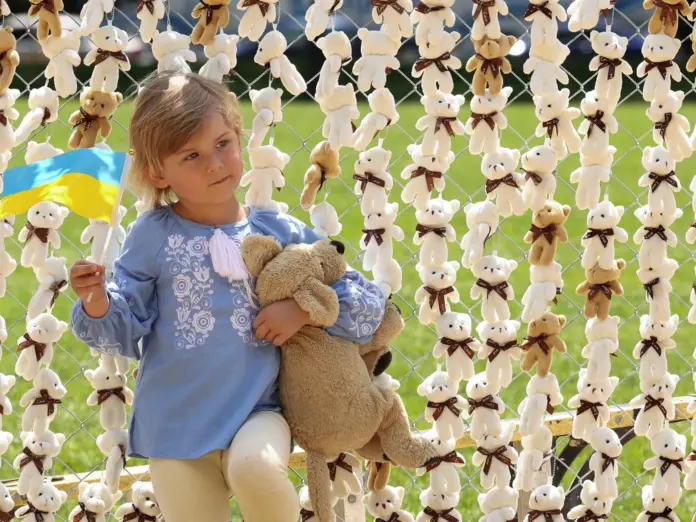
Ukrainian Children Deportation — More than four years after Russia launched its full-scale invasion of Ukraine, the forced removal of over 20,000 Ukrainian children to Russian-controlled territory has crystallised into one of the conflict’s most extensively documented atrocities — drawing criminal indictments, landmark judicial rulings, and an expanding web of international sanctions.
The scale of the transfers, which began in earnest following Russia’s 2022 offensive but trace their roots to Moscow’s initial occupation of Ukrainian lands in 2014, has been condemned by international legal bodies as a systematic violation of humanitarian law. International investigations established that the majority of documented transfers were carried out without the consent of living parents or legal guardians, directly contradicting Russian officials’ insistence that the removals constituted humanitarian evacuations to protect children from the fighting.
The human reality behind the statistics is stark. Lesya, who was 15 years old when Russian forces occupied her village in the Kherson region in 2022, was loaded onto a truck alongside more than 30 other children and transported to a rehabilitation centre in Feodosia, Crimea. There, children were compelled to study exclusively in Russian using Russian-issued textbooks and underwent military training two days each week — a pattern consistent with what investigators describe as systematic forced assimilation and militarisation.
Recommended Reading
Under international humanitarian law, all forcible transfers and deportations of protected persons from occupied territory are prohibited except in evacuations strictly required for their immediate safety. The same legal framework obligates an occupying power to identify and register children in its care and to actively facilitate family reunification — obligations Russia has not fulfilled.
The legal reckoning has been swift and broad. In March 2023, the International Criminal Court issued arrest warrants for Russian President Vladimir Putin and Maria Lvova-Belova, Russia’s Commissioner for Children’s Rights, on charges of unlawful deportation and transfer of Ukrainian children. That action was followed in March 2025 by a finding from the United Nations Independent International Commission of Inquiry on Ukraine that Russia’s deportation and forcible transfer of children amount to crimes against humanity. In July 2025, the European Court of Human Rights ruled Russia responsible for human rights violations that included the organised removal of children, in a case brought jointly by Ukraine and the Netherlands.
Sanctions have followed in waves. On May 11, the European Union sanctioned 16 individuals and seven entities specifically for actions related to Ukrainian children, bringing the total number of people and organisations sanctioned by Brussels for such conduct to more than 130. On the same date, the United Kingdom sanctioned 29 individuals and entities for offences spanning deportation, forced transfer, forced assimilation, indoctrination, militarisation, and unlawful adoption. The United States, Canada, Australia, Japan, Switzerland, and several other nations have introduced parallel measures.
Ukrainian Children Deportation: The Wider European Impact
Recovery efforts have made limited but meaningful progress. Six Ukrainian non-governmental organisations, including Save Ukraine, have worked alongside government agencies and foreign mediators to facilitate returns. To date, more than 2,000 children have been brought back — a figure that represents a fraction of those taken. The logistical and political obstacles to broader repatriation remain formidable, with Russia showing no systemic willingness to cooperate with identification or reunification processes.
The convergence of criminal accountability, civil litigation, and economic pressure marks an unusually coordinated international response to a specific category of war crime. Whether that pressure translates into the return of the remaining children — now scattered across Russian territory, some placed in Russian families through what investigators describe as unlawful adoptions — remains the central unresolved question of one of the conflict’s gravest chapters.