Gaza Ceasefire Collapse — An Israeli air raid struck a residential building in Gaza City on Wednesday, killing at least ten people — among them four children — and wounding more than twenty others. The attack came just hours after the funeral of Mohammad Odeh, the recently appointed commander of Hamas‘s armed wing, who was killed in a separate Israeli strike the day before.
Odeh had held the position for less than a week. His predecessor, Izz al-Din al-Haddad, was eliminated by Israel only days before Odeh’s appointment, making Wednesday’s strike the second consecutive killing of Hamas’s top military commander in rapid succession. Odeh’s wife and son also died in Tuesday’s attack. Israeli Prime Minister Benjamin Netanyahu identified Odeh as having served as Hamas’s head of intelligence during the October 7, 2023 attacks on Israel.
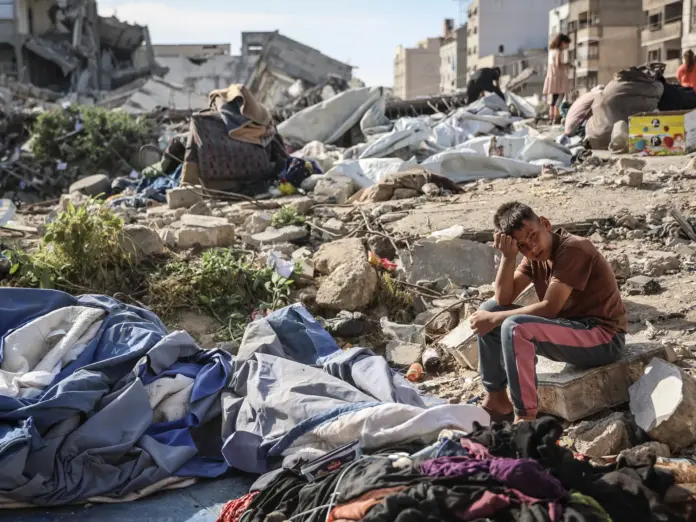
The human cost of Wednesday’s strike extended beyond the dead. Several children had been playing in a nearby park when the building was hit. Survivors described a community already paralysed by fear — parents reluctant to allow their children outside, families sheltering in tents and makeshift homes, dreading the next strike. The atmosphere in Gaza City, witnesses said, was one of acute dread.
Recommended Reading
The strikes are occurring against the backdrop of a ceasefire that came into effect in October and has since frayed almost beyond recognition. Gaza’s Government Media Office documented 3,005 violations and serious breaches by Israel over 227 days of the agreement. Aid flows, a central pillar of the ceasefire terms, have fallen drastically short of commitments: only 49,973 trucks carrying humanitarian supplies entered Gaza out of the 135,600 that were supposed to do so — a compliance rate of just 36 percent.
The two sides offer sharply divergent explanations for the breakdown. Israel insists that Hamas’s refusal to disarm remains the fundamental obstacle to any durable arrangement. Hamas counters that continued Israeli military operations and the strangling of aid deliveries have rendered the agreement meaningless. Both parties accuse the other of bad faith, and neither shows signs of stepping back from entrenched positions.
Concerns are mounting that the conflict could escalate into full-scale war once again. The near-daily rhythm of Israeli strikes, combined with the targeted killing of successive Hamas military commanders, suggests a deliberate campaign to decapitate the organisation’s armed leadership rather than a posture consistent with ceasefire maintenance. For ordinary Palestinians in Gaza, the distinction between a ceasefire and open warfare has become increasingly difficult to discern.
The killing of Odeh — appointed to lead Hamas’s military wing only last week — underscores the speed at which Israel is moving against the group’s command structure. Netanyahu’s public identification of Odeh as a key figure in the October 7 intelligence apparatus signals that Israel views the targeted killing campaign as both retributive and strategically necessary, regardless of the diplomatic framework nominally in place.
Gaza Ceasefire Collapse: Regional Implications
Humanitarian organisations and international observers have repeatedly warned that the collapse of aid delivery mechanisms risks compounding the civilian toll. With fewer than four in ten promised aid trucks having reached Gaza, shortages of food, medicine, and basic supplies have become chronic. The gap between the ceasefire’s written terms and its implementation on the ground has grown so wide that the agreement’s continued existence as a meaningful constraint on violence is openly questioned by analysts tracking the conflict.
For the families of the ten people killed on Wednesday — and for the more than twenty wounded, some critically — the geopolitical arguments are remote abstractions. In Gaza City, where the rubble of residential buildings marks the landscape and parents weigh the risk of letting children step outside, the ceasefire exists in name only.