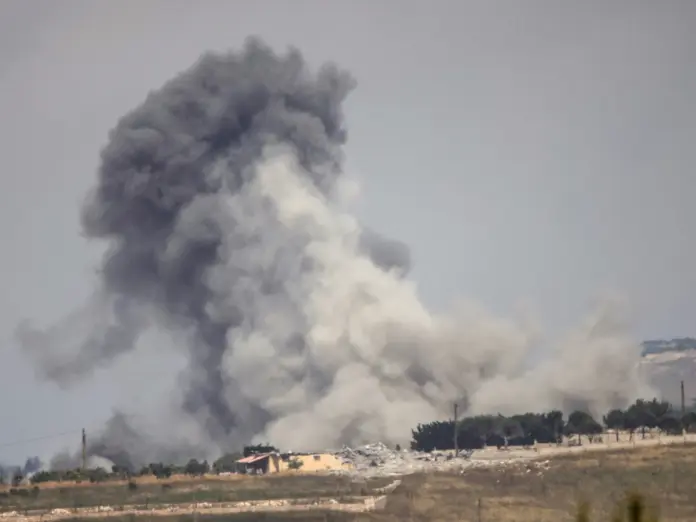
SOUTHERN LEBANON — Israeli military forces have crossed the Litani River and pushed toward the outskirts of Nabatieh, a major southern Lebanese city, marking the deepest Israeli ground incursion into Lebanese territory since 2006 and signalling a dramatic deterioration of a fragile ceasefire that has held only nominally since mid-April.
Israeli Forces Litani River — The advance beyond the Litani — long considered the informal northern boundary of Israel’s self-declared buffer zone — represents a significant escalation in a conflict that has already displaced more than 1.2 million people, roughly 20 percent of Lebanon’s entire population. Israeli army spokesperson Avichay Adraee issued immediate evacuation orders for at least 10 villages in the south as troops closed in on Nabatieh, a city regarded as both an economic engine and a cultural centre for the region.
The military push drew a swift response from Hezbollah, which fired rockets at the northern Israeli town of Kiryat Shmona and struck a military base in northern Israel. In a separate engagement near the village of Ghandouriyeh, Hezbollah fighters ambushed Israeli soldiers and claimed to have forced their withdrawal from the area. Two Lebanese soldiers were also seriously wounded by an Israeli drone strike near Nabatieh on Saturday.
Recommended Reading
Israeli air raids on Friday killed at least 14 people across southern Lebanon, adding to a mounting civilian toll that has accompanied weeks of intensifying operations. Israel maintains that its military campaign is aimed exclusively at dismantling Hezbollah’s military infrastructure and disarming the group — a goal that Lebanese officials themselves acknowledge is an extraordinarily difficult undertaking given Hezbollah’s deep entrenchment in the country’s political and social fabric.
The conflict traces its current phase to early March, when Iran-backed Hezbollah launched a sustained offensive against Israel following the assassination of Iranian Supreme Leader Ali Khamenei. A ceasefire was declared in the aftermath of the October 2023 war, but that agreement has been repeatedly violated as both sides have continued military operations. The latest Israeli advance effectively renders the ceasefire framework defunct on the ground, even as diplomats work to salvage it at the negotiating table.
Lebanese President Joseph Aoun convened an emergency meeting with Prime Minister Nawaf Salam on Saturday to assess the rapidly deteriorating security situation. The two leaders face mounting pressure to respond to Israeli operations while simultaneously managing the delicate process of reining in Hezbollah — a task that carries enormous domestic political risk.
Paradoxically, the military escalation is unfolding in parallel with the most substantive diplomatic engagement between the two countries in decades. Israeli and Lebanese officials have been meeting in Washington, with the United States serving as the primary facilitator, in talks aimed at reaching a permanent end to hostilities. A further round of negotiations is expected in the American capital the following week. The direct talks — the first of their kind in decades — represent a significant diplomatic opening, though the battlefield developments threaten to undermine whatever goodwill has been generated at the negotiating table.
Israeli Forces Litani River: Regional Implications
The situation in Nabatieh is being watched closely as a potential inflection point. The city’s symbolic and economic importance to southern Lebanon means its encirclement by Israeli forces carries weight far beyond its strategic military value. For the hundreds of thousands of Lebanese already uprooted by the fighting, the prospect of combat operations reaching one of the south’s most significant urban centres raises fears of a humanitarian catastrophe on a new scale.
Whether Washington can translate its diplomatic leverage into a halt to the ground offensive — and whether Hezbollah’s rocket campaign will draw further Israeli retaliation — will likely determine the trajectory of the conflict in the days ahead. For now, the Litani River, once a symbolic red line, has been crossed, and the consequences remain deeply uncertain.