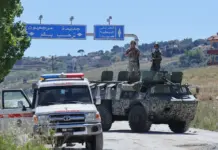
Israel Lebanon Offensive — Israeli ground forces crossed the Litani River on Friday and pressed northward through southern Lebanon, reaching the outskirts of the town of Choukine and issuing a forced evacuation order for its residents. The advance forms part of a broader offensive that has already prompted blanket evacuation orders for the entire cities of Nabatieh and Tyre, displacing more than one million people across the country.
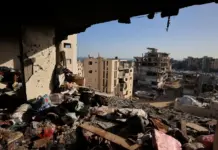
Lebanese Prime Minister Nawaf Salam condemned the campaign in unsparing terms, accusing Israel of pursuing a ‘scorched-earth policy’ as its troops pushed along a ridgeline flanking the Litani River, navigating terrain dominated by a 900-metre-high gorge. The human cost continued to mount: Israeli forces killed a paramedic in the south, while in Gaza, a doctor named Jamal Abu Aoun was killed in an Israeli strike on central Deir el-Balah.
Hezbollah claimed responsibility for a further series of rocket and drone attacks on northern Israel, signalling that the militant group retains offensive capacity despite sustained Israeli pressure. The cross-border exchanges show no sign of abating as Israeli columns continue their northward push toward Nabatieh.
Recommended Reading
The escalation in Lebanon unfolded against a backdrop of high-stakes diplomatic maneuvering over Iran’s nuclear programme. President Donald Trump convened advisers in the White House Situation Room on Friday but left without endorsing a ceasefire extension framework, leaving a near-finalised memorandum of understanding between Washington and Tehran in limbo. The draft agreement still lacks Trump’s formal sign-off.
The two sides remain divided on fundamental economic terms. Iran is demanding the immediate return of its frozen assets upon any deal announcement, while the United States insists the process must be gradual and tied to verifiable performance benchmarks. Tehran is also calling for the lifting of sanctions on its oil and petrochemicals sector and is seeking a reconstruction fund worth approximately $300 billion — a figure that reflects the cumulative toll of decades of economic isolation.
Defense Secretary Pete Hegseth struck a dual tone on Saturday, expressing confidence that an agreement would ultimately be reached while simultaneously warning that Washington is fully prepared to resume military strikes against Iran should negotiations collapse. The warning carries immediate weight: a US naval blockade of the Strait of Hormuz remains in place, and American forces recently disabled a Gambia-flagged vessel attempting to sail toward an Iranian port.
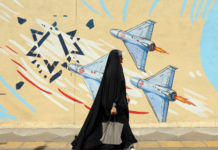
Iran’s military has responded with a show of force of its own. During a ceremony in Tehran’s Enqelab Square, the Iranian navy unveiled a new fast attack boat designated the ’27 Rajab,’ capable of reaching speeds of up to 100 knots — roughly 185 kilometres per hour — and equipped to launch long-range cruise missiles. Iranian commanders simultaneously reasserted their claim to control over the Strait of Hormuz, warning that foreign vessels failing to comply with Iranian regulations will be targeted.
Israel Lebanon Offensive: Regional Implications
The strategic significance of the waterway is difficult to overstate. Prior to the current confrontation, 20 percent of the world’s oil and liquefied natural gas transited the Strait of Hormuz, making any sustained disruption a potential shock to global energy markets. The combination of a US naval blockade, Iranian military posturing, and unresolved nuclear diplomacy has placed the strait at the centre of an increasingly volatile standoff.
The overlapping crises — an expanding ground war in Lebanon, unresolved nuclear negotiations, and a naval confrontation in one of the world’s most critical chokepoints — reflect the degree to which the Middle East remains on a knife-edge. With Trump yet to commit to any diplomatic framework and Israeli forces continuing to advance, the window for de-escalation appears to be narrowing on multiple fronts simultaneously.