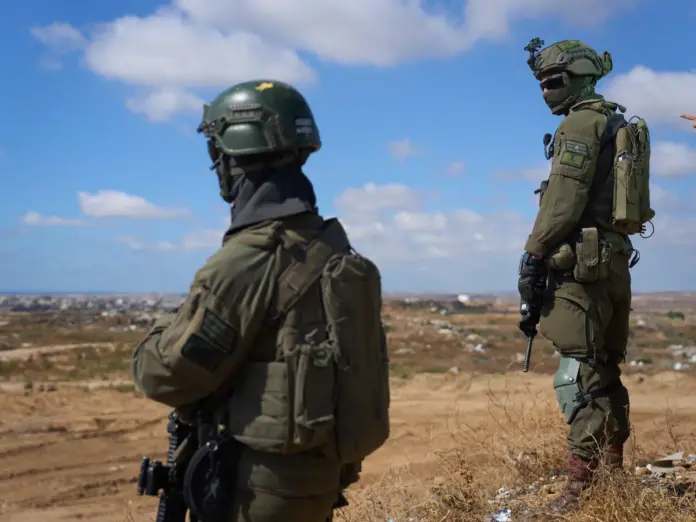
Israel Military Bases Gaza — Israel has constructed eight new military bases inside Gaza since a ceasefire agreement took effect in October 2025 — a truce that explicitly required the full withdrawal of Israeli forces from the territory. Satellite imagery analysed through May 18, 2026, identified a total of 40 distinct Israeli military outposts across Gaza, connected by an expanding network of earthen berms, trenches, and internal military roads.
The analysis, covering a seven-month period following the signing of the US-brokered ceasefire, shows that construction activity accelerated rather than ceased after the truce went into force. One military site remained under active construction as of mid-May 2026. The ceasefire framework was built around a 21-point peace plan proposed by President Donald Trump, and its terms required Israel to fully vacate the territory.
The eight newly established bases are distributed across the length of Gaza. Two are located in the north, two in central Gaza, one east of the strategically significant Netzarim Corridor, and three in the southern city of Khan Younis. In Beit Lahiya, satellite imagery showed an area that appeared entirely clear in October 2025 undergoing engineering works by mid-November of that year. By May 2026, a fully enclosed military structure with internal facilities had been completed on the site.
Recommended Reading
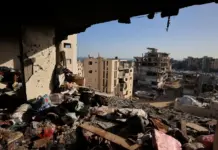
Among the most striking findings is a military installation built on the ruins of the Eastern Cemetery in Khan Younis. Engineering works on the bulldozed burial ground began in November 2025. By May 18, 2026, the site had been equipped with vehicle staging areas and repetitive structures consistent with a permanent military presence. An existing Israeli outpost east of Gaza City expanded its surface area by an estimated 70 percent between October 2025 and May 2026, while deep defensive trenches were excavated around a separate installation in central Gaza. Earthworks at a site in Juhor ad-Dik began in March 2026, transforming what had been open ground into an emerging military base.
Three separate Israeli military outposts now guard areas east of and around the Netzarim Corridor, a strip of land that bisects Gaza and has served as a key axis of Israeli military operations throughout the conflict. The 40 outposts collectively form an interconnected defensive architecture rather than isolated positions.
Israeli forces have pulled back to what is known as the ‘Yellow Line’, a buffer and military zone that encompasses approximately 60 percent of Gaza’s total territory. Prime Minister Benjamin Netanyahu has publicly acknowledged and defended this footprint. ‘We are currently squeezing Hamas; we now control 60 percent of the territory,’ Netanyahu stated. When pressed on calls for complete annexation of Gaza, he responded: ‘Let’s go step by step. First of all, 70. Let’s start with that.’
The continued military presence has come at a severe human cost. Since the war began in October 2023, Israeli attacks have killed nearly 73,000 Palestinians and injured more than 172,919 others, with women and children comprising the majority of casualties. The violence has not halted under the ceasefire: at least 929 Palestinians have been killed and 2,811 injured in the seven months since the truce officially took effect — an average of more than four deaths per day during a period that was supposed to mark a cessation of hostilities.
Israel Military Bases Gaza: Regional Implications
The scale of Israel’s construction activity raises fundamental questions about the durability and intent behind the October 2025 agreement. The systematic nature of the infrastructure — permanent structures, enclosed compounds, staged vehicle areas, and interconnected road networks — suggests a long-term strategic posture rather than a temporary operational presence. The establishment of bases on sites of cultural and religious significance, such as the Eastern Cemetery, adds a further dimension to international concerns about the conduct of the occupation.
The United States, as the primary broker of the ceasefire framework, has not publicly addressed the satellite evidence of ongoing construction. The Trump administration’s 21-point plan formed the basis of the truce, but enforcement mechanisms remain unclear. With Israeli leadership openly discussing expanding territorial control beyond the current 60 percent threshold, the gap between the ceasefire’s stated terms and conditions on the ground continues to widen.