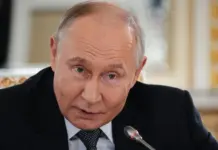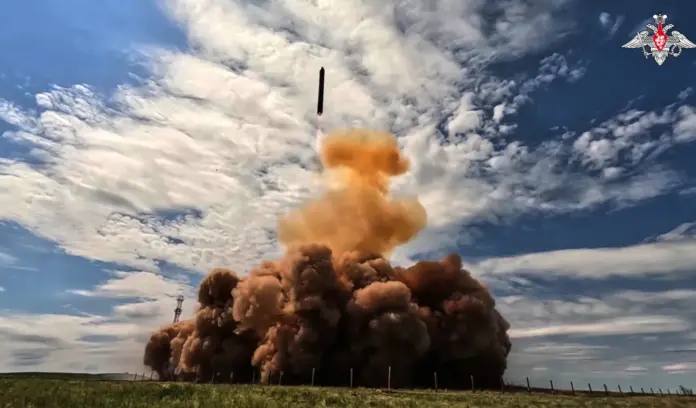
MOSCOW — Russia has conducted a test of the RS-28 Sarmat intercontinental ballistic missile, with President Vladimir Putin declaring the weapon the most powerful of its kind on earth and vowing it will enter active combat service before the end of the year. The announcement underscores Moscow’s accelerating drive to overhaul its nuclear deterrent even as the war in Ukraine grinds toward what both sides suggest may be an approaching conclusion.
Rs-28 Sarmat Missile — Putin claimed the Sarmat’s combined warhead yield exceeds that of any Western equivalent by more than four times — an assertion that Western analysts have not independently verified. Known in NATO circles as ‘Satan II’, the missile is designed to replace approximately 40 ageing Soviet-era Voyevoda missiles, a system that has formed the backbone of Russia’s land-based nuclear deterrent for decades.
The Sarmat is a formidable machine by any measure. Standing 35.3 metres tall, 3 metres in diameter, and weighing 208.1 tonnes, it carries a maximum payload of 10 tonnes, according to an April 2024 assessment by the Center for Strategic and International Studies. Putin placed the missile’s maximum range at more than 35,000 kilometres — a figure that, if accurate, would allow it to strike targets via either polar trajectory. Western analysts, however, estimate the actual maximum range at roughly 18,000 kilometres, broadly comparable to the Voyevoda’s assessed range of 16,000 kilometres. The missile’s minimum range is classified at 5,500 kilometres. For context, Moscow sits approximately 7,500 kilometres from New York and around 9,700 kilometres from Phoenix, Arizona — well within the weapon’s reach under any credible estimate.
Recommended Reading
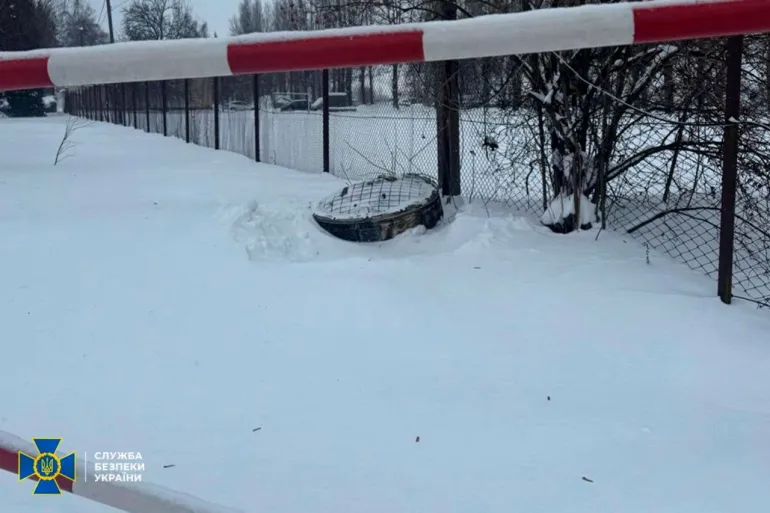
The road to operational deployment has not been without setbacks. A test conducted in September 2024 reportedly ended in a catastrophic explosion, raising questions about the programme’s readiness. Development of the Sarmat stretches back to 2011, making it one of Russia’s longest-running advanced weapons projects.
The Sarmat is far from the only next-generation system Putin has sought to showcase. In 2018, he unveiled a suite of weapons he claimed would render United States missile defence systems obsolete. That portfolio has since expanded considerably. Russia has already fielded the Avangard hypersonic glide vehicle, capable of travelling at 27 times the speed of sound, and has commissioned the nuclear-capable Oreshnik intermediate-range ballistic missile, which carries a range of up to 5,000 kilometres. The Oreshnik has been used twice in its conventionally armed configuration against targets in Ukraine. Putin has also announced that Russia is in the final stages of developing the Poseidon nuclear-armed underwater drone and is pressing ahead with the Burevestnik cruise missile, which is powered by miniature atomic reactors.
The timing of the Sarmat announcement carries geopolitical weight. The United States is currently debating a sweeping missile defence initiative — the so-called ‘Golden Dome’ — which the Congressional Budget Office has estimated will cost $1.2 trillion to build and sustain over 20 years. Russia’s accelerated nuclear modernisation effort appears calibrated, at least in part, to signal that any such shield can be overwhelmed.
Meanwhile, the conflict that has defined European security since February 2022 may be entering a new phase. Putin suggested over the weekend that the war in Ukraine, now more than four years old, was approaching its end. Kremlin spokesperson Dmitry Peskov echoed that assessment on Tuesday, saying that progress in negotiations with the United States and Ukraine would soon bring the conflict to a close.
Rs-28 Sarmat Missile: The Nuclear Dimension
Ukrainian President Volodymyr Zelenskyy, however, showed no sign of easing military pressure. In his nightly video address on Tuesday, Zelenskyy announced that Ukrainian forces had struck gas facilities in Russia’s Orenburg region in the country’s southwest — a target more than 1,500 kilometres from the Ukrainian border. The strike is consistent with Kyiv’s stated strategy of targeting Russian energy infrastructure to deprive Moscow of the revenues needed to sustain its war effort.
The juxtaposition of nuclear sabre-rattling and tentative peace signals reflects the deeply uncertain moment in which the conflict now sits. Russia is projecting strategic strength through weapons programmes decades in the making, while simultaneously suggesting it is ready to negotiate. Whether those two postures can be reconciled — and on whose terms — remains the central question hanging over any prospective settlement.