MOGADISHU — Armed clashes rocked the Somali capital on Wednesday, with rocket-propelled grenades and sustained gunfire echoing through central Mogadishu as the country’s deepening political crisis threatened to spiral into open conflict.
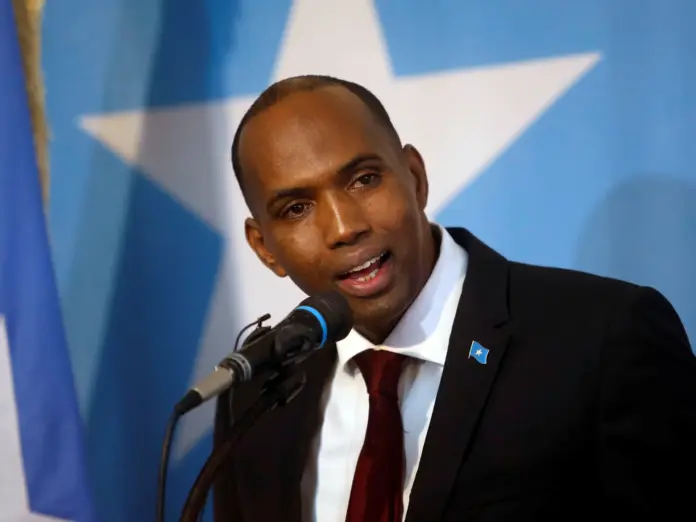
Somalia Political Crisis — Former Prime Minister Hassan Ali Khaire accused government forces loyal to President Hassan Sheikh Mohamud of launching a direct attack on his residence in the Howl Wadaag district, where he had relocated from the heavily fortified green zone near the airport in order to participate in anti-government demonstrations planned for Thursday. Khaire described the assault as a deliberate attempt to prevent him from joining the protests.
Witness Saleban Mahad reported that the gunfire lasted approximately 15 minutes, with armed opposition fighters exchanging fire with Somali police. Panicked residents fled through the streets of Howl Wadaag as the clashes unfolded, the chaos captured on camera by a journalist in the area.
Recommended Reading
The violence is a direct consequence of Mohamud’s announcement that he would extend his presidential term by one year after it was formally due to expire on May 15. The opposition and Somalia’s regional leaders swiftly rejected the move, denouncing it as an unconstitutional power grab. Thursday’s demonstrations were organised in direct response to that decision.
Former President Sharif Sheikh Ahmed, who also moved into central Mogadishu ahead of the planned protests, declared that Mohamud no longer holds a legitimate official mandate. He insisted the attack on Khaire’s residence would not deter residents of the capital from taking to the streets. "The demonstrations will go ahead," he said, signalling that the opposition remains undeterred despite the show of force.
The crisis carries uncomfortable echoes of a previous standoff. Former President Mohamed Abdullahi Farmaajo remained in office for more than a year beyond the expiry of his mandate in 2021, a period that triggered widespread violence and drew sharp international condemnation before a political resolution was eventually reached. Critics of Mohamud fear a similar trajectory.
The United States and the United Kingdom have both attempted to broker dialogue between the government and the opposition, though those efforts have so far failed to produce a breakthrough. Opposition figures and regional leaders frame Mohamud’s push for a term extension not as a democratic transition measure but as a calculated effort to centralise power at the expense of Somalia’s fragile federal structure.
Somalia Political Crisis: The Broader African Context
Mohamud has positioned his agenda as a modernising project. A new constitution passed by parliament in March established a framework for direct elections, part of his stated goal of moving Somalia away from the clan-elder-based indirect voting system that has governed the country’s politics for decades. Supporters argue the term extension is necessary to see that transition through.
Yet the political confrontation is unfolding against a backdrop of severe insecurity. Large swaths of Somali territory remain under the control of al-Shabab, the al-Qaeda-linked armed group that has waged a decades-long insurgency against the central government. The prospect of elite political violence in Mogadishu adds a volatile new dimension to an already precarious security environment.
With demonstrations still scheduled for Thursday and opposition leaders firmly entrenched in the capital, the coming hours will test whether Somalia’s institutions can contain a crisis that, on Wednesday, had already turned deadly on the streets of Howl Wadaag.