Ethiopia Elections Conflict — Ethiopia held nationwide parliamentary elections on June 1, 2026, mobilising more than 50.5 million registered voters across Africa’s second-most populous nation — a country simultaneously navigating economic promise and entrenched armed conflict.
The vote fills all 547 seats in the federal parliament, with the National Election Board of Ethiopia (NEBE) scheduled to announce official results on June 11. Prime Minister Abiy Ahmed, who has governed since 2018, leads the dominant Prosperity Party, which currently holds 457 of those seats — a commanding majority that underscores the party’s grip on federal institutions.
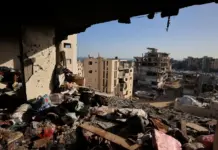
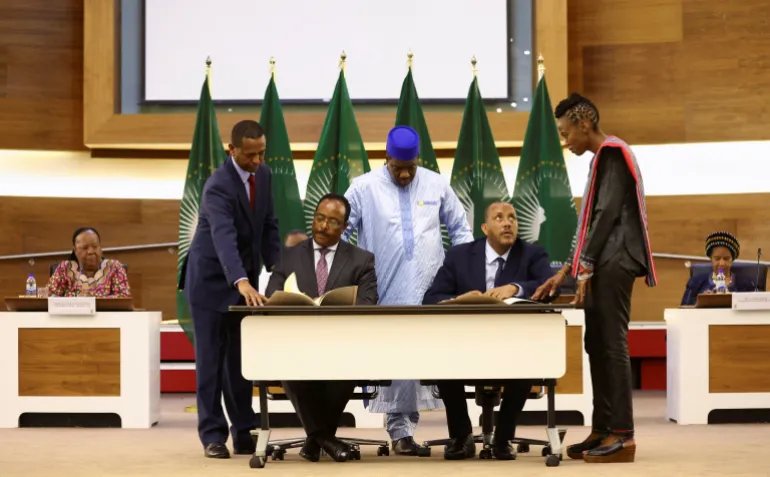
Parliamentary elections in Ethiopia occur every five years, and this cycle arrives at a particularly fraught moment. Despite a peace agreement that ended the devastating Tigray war between the federal government and the Tigray People’s Liberation Front (TPLF) in 2022, fresh clashes erupted in Tigray in January 2026 between TPLF forces and Ethiopian government troops, casting doubt on the durability of that accord.
Recommended Reading
The scale of violence across the country in recent years is stark. Between January 1, 2022 and May 15, 2026, more than 7,400 armed attacks were recorded across Ethiopia, according to data compiled by the Armed Conflict Location & Event Data Project (ACLED). The Amhara region alone accounted for more than half — 3,719 incidents — as fighting between the Amhara Fano self-defence militia and federal forces spread across more than 31 districts spanning 11 zones, continuing well into 2026. In Oromia, 2,735 attacks were recorded over the same period, driven largely by conflict between the Oromo Liberation Army (OLA), regional forces, and the Ethiopian National Defense Force (ENDF). The OLA, which seeks autonomy for ethnic Oromos, signed a peace agreement with the federal government in December 2024, though hostilities have not fully ceased. Tigray registered 262 attacks, and the Gambela region recorded 144.
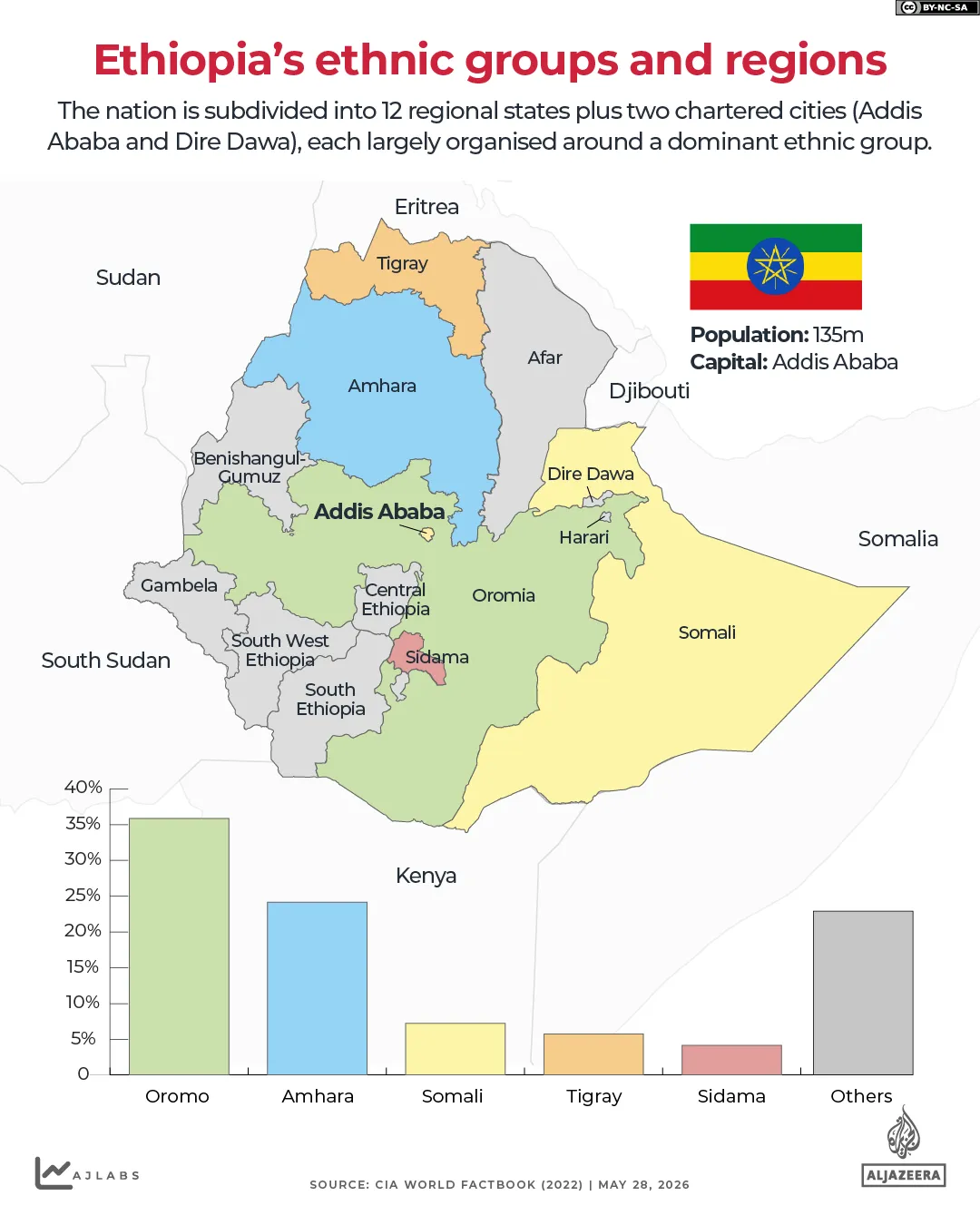
The OLA conflict has killed thousands of civilians since 2019, making Oromia one of the most consistently deadly theatres of internal violence in the country. The Oromo are Ethiopia’s largest ethnic group, comprising roughly 35 percent of the population, followed by the Amhara at 24 percent, the Somali at 7 percent, the Tigrayan at 6 percent, and the Sidama at 4 percent. Ethiopia’s more than 80 distinct ethnic groups are organised under an ethnic-based regional system introduced in 1992 and formalised in the 1994 constitution, a framework that has both institutionalised identity politics and fuelled territorial grievances.
The country is home to approximately 135 million people, making it the tenth most populous nation on earth. It spans 1,104,300 square kilometres in the Horn of Africa, bordered by Eritrea, Sudan, South Sudan, Kenya, Somalia, and Djibouti. Five official languages — Afar, Amharic, Oromo, Somali, and Tigrinya — reflect its extraordinary diversity, as does its religious composition: roughly two-thirds of the population are Christian and one-third Muslim.
Economically, Ethiopia presents a contrasting picture. The International Monetary Fund projected a 9.2 percent economic expansion for the country in 2026 — the highest growth rate on the African continent. Yet an inflation rate of 11.7 percent as of April 2026 continues to erode purchasing power for millions of citizens, many of whom live in regions still scarred by active conflict.
Ethiopia Elections Conflict: The Broader African Context
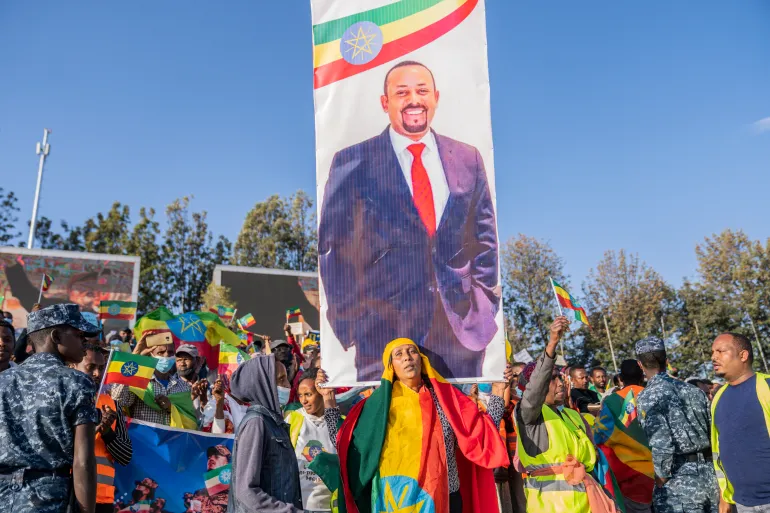
The elections are being watched closely as a test of whether Abiy Ahmed’s government can project democratic legitimacy while simultaneously prosecuting military campaigns against multiple armed factions. Critics have long argued that the Prosperity Party’s dominance — built in part on the consolidation of formerly separate ethnic-based parties — leaves little space for genuine political competition. The party’s near-total parliamentary control following the last election cycle reinforces those concerns.
Ethiopia is subdivided into 12 regional states and two chartered cities, Addis Ababa and Dire Dawa, each with its own political dynamics. The June 1 vote represents not only a federal exercise but a simultaneous test of stability across regions where ballot boxes and battle lines exist in uncomfortable proximity.