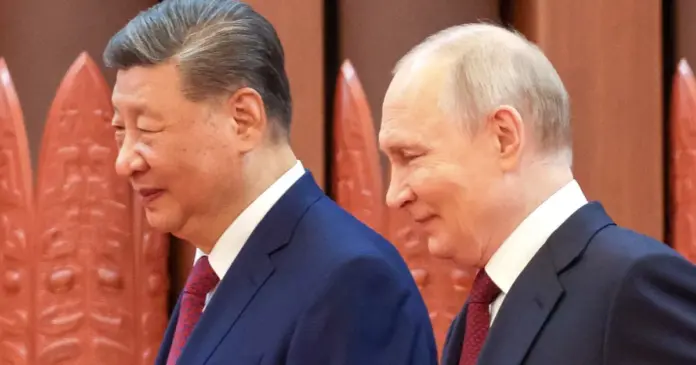
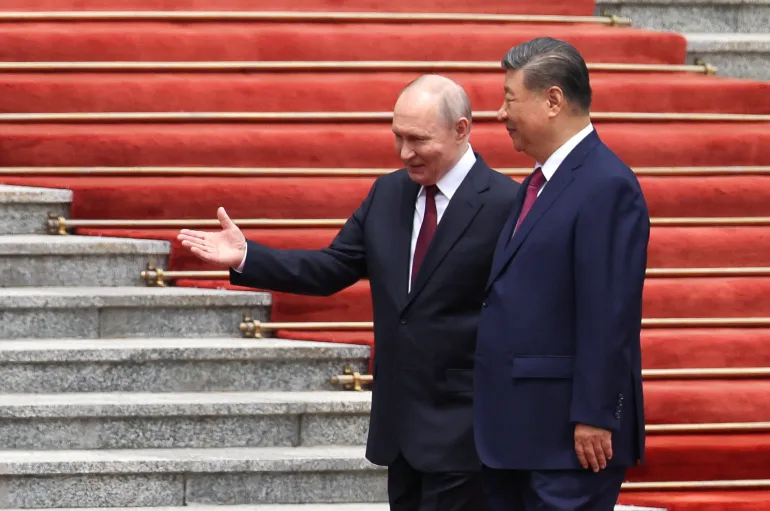
BEIJING — Chinese President Xi Jinping and Russian President Vladimir Putin stood side by side outside the Great Hall of the People on Wednesday as military bands played both nations’ anthems, staging a display of solidarity that carried unmistakable geopolitical weight. The summit, arriving just days after US President Donald Trump concluded his own official visit to China, underscored Beijing’s determination to maintain strategic depth on multiple fronts simultaneously.
Xi Putin Alliance — Xi described the bilateral relationship as ‘unyielding’ in the face of trials and tribulations, while Putin declared that Russia-China interaction and economic cooperation were demonstrating strong momentum despite what he called unfavourable external factors. The Russian president, who has visited China dozens of times and met Xi on more than 40 previous occasions, framed Wednesday’s talks as a milestone marking 25 years of Sino-Russian friendship.
The two leaders oversaw the signing of approximately 40 agreements spanning economy, tourism, education, and energy security — a breadth of engagement that both sides presented as evidence of a relationship operating well beyond the realm of mere diplomatic convenience.
Recommended Reading
Energy dominated the substantive discussions. Putin called the sector the ‘driving force of economic cooperation’ between the two countries, a characterisation that reflects hard economic reality: China has become one of Russia’s most critical oil buyers since Western nations severed or curtailed economic ties following Moscow’s invasion of Ukraine. Xi said Beijing and Moscow had deepened political mutual trust and strategic cooperation in what he described as an increasingly chaotic world.
One major infrastructure ambition, however, remained unresolved. The proposed Power of Siberia 2 gas pipeline — a project that would dramatically expand Russian gas exports to China — produced no new consensus. Kremlin spokesperson Dmitry Peskov acknowledged the two sides had reached only a ‘basic understanding’ on the pipeline’s route and said there was no clear timeline for construction to begin. The absence of a concrete deal on what would be one of the world’s largest energy infrastructure projects highlighted the complexity of negotiations that have stretched for years.
Beyond bilateral commerce, the summit generated a joint political statement with pointed global implications. The Kremlin-released communiqué warned of a danger of fragmentation of the international community and a return to what it called the ‘law of the jungle’. It declared that attempts by states to unilaterally manage global affairs and impose their interests on the world had failed — language widely understood as directed at Washington.
Putin pledged that Russia and China would pursue an ‘independent and sovereign’ foreign policy programme together, while insisting the partnership was ‘not aligning against anyone, but working for the cause of peace and universal prosperity’. He was accompanied in Beijing by a large delegation of Russian businesspeople and senior government officials, signalling the meeting’s commercial as well as strategic ambitions.
Xi also used the occasion to weigh in on the conflict involving Iran, telling Putin that further escalation of the US-Israeli war on Iran was ‘inadvisable’ and that a ceasefire was necessary. The statement positioned Beijing as a voice for de-escalation in a conflict that has rattled energy markets and strained diplomatic alignments across the Middle East and beyond.
Xi Putin Alliance: The Diplomatic Context
The timing of the summit — bracketed by Trump’s China visit on one side and ongoing turbulence in global trade and security on the other — gave the Xi-Putin encounter an atmosphere of deliberate counter-positioning. Both leaders have invested heavily in the narrative that the international order shaped by Western institutions is giving way to a more multipolar arrangement, and Wednesday’s ceremony in Beijing was crafted to reinforce that message.
Putin stated in a video address ahead of the talks that Russia and China were prepared to cooperate on core interests including the protection of sovereignty and national unity. Xi echoed the sentiment, saying the partnership had proven its resilience precisely because it had been tested.
Whether the relationship can translate its rhetorical solidarity into durable economic and strategic outcomes will depend in part on resolving outstanding questions like the Power of Siberia 2 impasse. For now, both governments appeared content to project unity — and to ensure that projection was seen clearly in Washington.