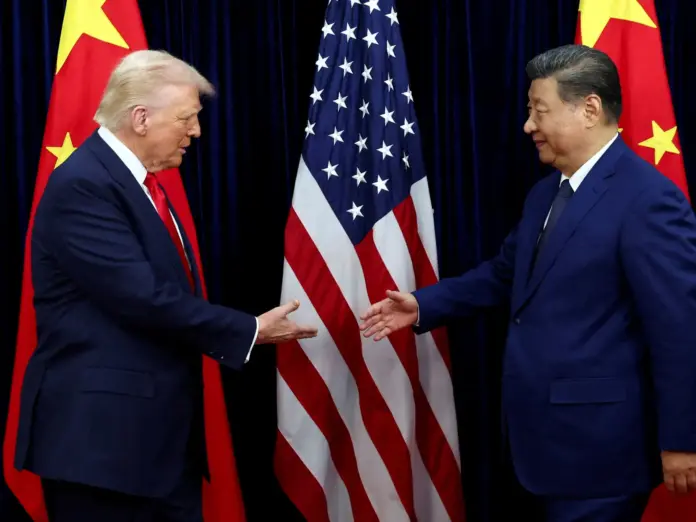
BEIJING — U.S. President Donald Trump touches down in Beijing on Wednesday evening for a two-day summit with Chinese President Xi Jinping, bringing with him a delegation of business executives and a list of grievances that spans Iran’s oil lifeline, global trade imbalances, and the shadow of the ongoing conflict in the Middle East.
Trump Beijing Summit — The formal opening ceremony and bilateral meeting between the two leaders are scheduled for Thursday morning, with Trump’s delegation departing the Chinese capital on Friday. Washington has also confirmed plans to host Xi for a reciprocal visit later in 2025, signalling that both governments are investing in sustained high-level engagement despite deep structural tensions.
The trip was originally planned for earlier in the year but was shelved in March after the outbreak of the U.S.-Israel war on Iran upended diplomatic schedules. That conflict now sits at the centre of the Beijing agenda. A senior U.S. administration official indicated Trump intends to press Xi directly on China’s continued purchase of Iranian crude, warning that Washington could apply significant pressure on Beijing over both energy imports and the sale of dual-use military-civilian goods to Tehran.
Recommended Reading
Treasury Secretary Scott Bessent has been blunt in his characterisation of the relationship, accusing China of effectively funding Iran by absorbing roughly 90 percent of the country’s energy exports. Beijing has consistently refused to recognise what it calls Washington’s unilateral sanctions on Iran’s oil sector, a position that has become a major flashpoint between the two powers.
The geopolitical stakes were sharpened further last week when China hosted Iranian Foreign Minister Abbas Arraghchi in Beijing — a meeting that U.S. officials viewed as a pointed signal of where Chinese sympathies lie. Meanwhile, Iran’s closure of the Strait of Hormuz in response to U.S.-Israeli military strikes has sent shockwaves through global energy markets, with Asian economies that depend heavily on Middle East imports bearing a disproportionate share of the economic pain.
Beyond Iran, Trump is expected to raise China’s ongoing material support for Russia, a subject that has strained U.S.-China relations throughout the broader arc of Eurasian conflict. Trade policy and access to rare earth minerals — resources in which China holds dominant global reserves — are also firmly on the table.
The composition of the U.S. delegation underscores the commercial dimension of the visit. Executives from Boeing and several major agricultural companies are travelling with the presidential party, reflecting American industry’s appetite for renewed market access in China even as the two governments spar over strategic issues.
On Taiwan, the administration moved to dampen expectations of any shift. A senior official stated flatly that no change to the U.S. position was anticipated. Washington maintains deep security and economic commitments to the island, while Beijing regards Taiwan as an inalienable part of its territory — a fundamental disagreement that no single summit is likely to resolve.
Trump Beijing Summit: The Diplomatic Context
White House Principal Deputy Press Secretary Anna Kelly framed the broader purpose of the visit in terms of structural recalibration rather than transactional deal-making, describing it as carrying "tremendous symbolic significance" and focused on rebalancing the bilateral relationship with an emphasis on reciprocity, fairness, and restoring American economic independence.
The summit arrives at a moment when the architecture of the post-Cold War international order is under acute stress. The Iran conflict has disrupted energy flows, rattled financial markets, and forced governments across Asia to reassess supply chain dependencies. For Beijing, the visit offers an opportunity to demonstrate diplomatic centrality; for Washington, it is a chance to test whether economic leverage can translate into behavioural change from a rival that has shown little inclination to bend under pressure.
Whether the two leaders can move beyond managed disagreement toward any concrete convergence remains the defining question hanging over the Chinese capital as Air Force One prepares to land.