Iran Hormuz Strikes — The United States and Iran traded military strikes across the Gulf this weekend in the third known escalation within a week, threatening to derail fragile ceasefire negotiations over a waterway through which roughly one-fifth of the world’s oil and liquefied natural gas shipments flow.
US Central Command launched what it described as self-defence strikes against Iranian radar installations and command and control sites after an American drone was shot down over international waters. The targets included military facilities in the city of Goruk, near Iran’s southern coast, and on Qeshm Island, situated in the Strait of Hormuz. US fighters also struck Iranian air defences, a ground control station, and destroyed two drones. No American personnel were reported injured in the operations.
Iran’s Islamic Revolutionary Guard Corps confirmed it had targeted a communications tower on Sirri Island, a Gulf outpost roughly 40 miles from Iran’s southern coastline, describing the strike as a response to what it characterised as American aggression. The IRGC also claimed to have targeted an air base used by US forces, warning that any repetition of US strikes would draw a response that would be, in its words, ‘completely different.’
Recommended Reading
Kuwait found itself drawn into the confrontation, with its military reporting that air raid sirens sounded across the country on Monday as its air defence systems engaged hostile missiles and drones. Kuwaiti authorities said the country had already been targeted last week when Tehran struck an air base on Kuwaiti territory in retaliation for earlier American air strikes — a significant escalation that extended the conflict beyond the immediate US-Iran bilateral dynamic.
The flare-up is unfolding against a backdrop of tense diplomatic manoeuvring. A ceasefire came into effect on 8 April, but its durability has been tested repeatedly by exchanges of fire. President Donald Trump met with senior aides on Friday to make what was described as a final determination on a framework for extending the truce. The proposed terms include a 60-day cessation of hostilities, a commitment to reopen the Strait of Hormuz to commercial shipping, and a framework for resuming negotiations on Iran’s nuclear programme — specifically addressing the removal of highly enriched uranium stockpiles.
Trump has also sought changes to deal terms relating to the Strait of Hormuz shipping channel, underscoring Washington’s acute sensitivity to any disruption of the critical maritime artery. Iran’s chief negotiator, however, made clear that Tehran would not accept any agreement unless Iranian rights were, in his formulation, fully secured — a position that leaves significant gaps between the two sides.
Despite the weekend’s violence, Trump projected confidence on social media, posting on Truth Social early Monday urging critics to ‘sit back and relax’ and asserting that Iran ‘really wants to make a deal, and it will be a good one for the USA.’ The remarks reflected the administration’s dual-track approach of maintaining military pressure while keeping diplomatic channels open.
The broader regional picture has grown more volatile in parallel. Israel has pushed deeper into Lebanon, seizing a 12th-century Crusader fortress in what analysts described as its most significant incursion into Lebanese territory in decades. European leaders condemned the move, and oil markets responded to the combined pressures of the US-Iran exchanges and Israel’s Lebanon operations, with prices rising sharply.
Iran Hormuz Strikes: Regional Implications
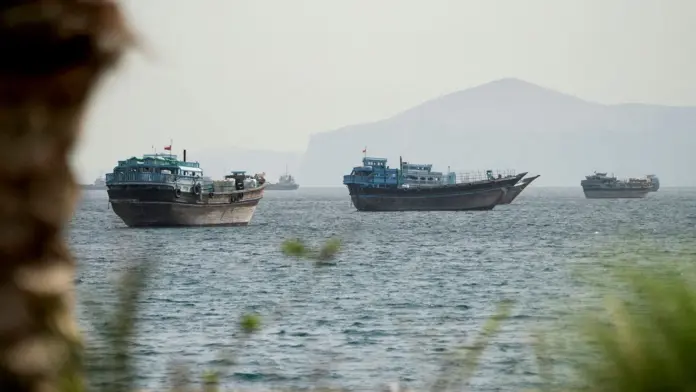
The Strait of Hormuz remains the central strategic prize in the standoff. The narrow channel between Iran and the Arabian Peninsula serves as the sole maritime exit for oil exports from Kuwait, Iraq, Saudi Arabia, the UAE, and Qatar. Any sustained closure or disruption would send shockwaves through global energy markets at a moment when geopolitical risk premiums are already elevated.
Military analysts note that the pattern of tit-for-tat strikes, each side calibrating its response to avoid outright war while signalling resolve, carries inherent escalation risks. The involvement of Kuwait — a country hosting significant US military infrastructure — adds a new and potentially destabilising dimension to a confrontation that both Washington and Tehran have, at least publicly, said they wish to contain.
Whether the ceasefire framework can survive another week of exchanges remains the defining question for a region on edge.