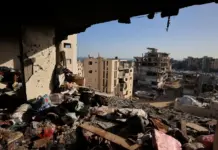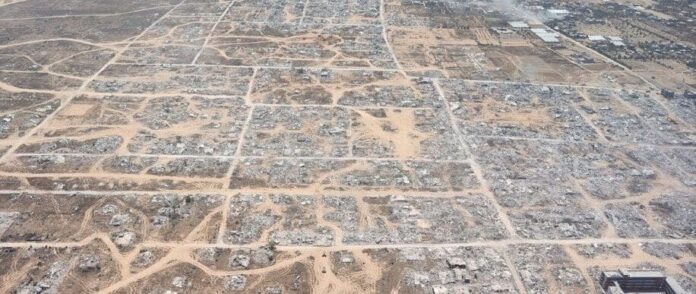
Gaza Urban Destruction — Satellite imagery captured on February 25, 2026, has laid bare the systematic destruction of Gaza’s built environment, revealing a landscape transformed beyond recognition after more than two years of relentless conflict. From historic cemeteries converted into military outposts to entire university campuses levelled by controlled detonations, the evidence points to an erasure that extends far beyond battlefield necessity.
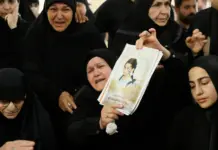
In Khan Younis, the Sheikh Mohammed cemetery in the Maan area — a site of cultural and religious significance — has been replaced by an Israeli military outpost. Palestinian journalist Muhannad Qishta, whose sisters Reem and Walaa are buried in Khan Younis, is among the countless Palestinians confronting the obliteration of their most intimate connections to the land. The Euro-Med Human Rights Monitor reports that Israeli forces have fully or partially destroyed 94 percent of Gaza’s cemeteries, a figure that underscores the breadth of cultural destruction accompanying the physical one.
The residential toll is staggering. Hamad City, a $135 million public housing project in Khan Younis comprising 53 residential buildings and approximately 3,000 housing units, once sheltered more than 15,000 people. It now stands gutted. The eastern districts of Bani Suhaila, Abasan, and al-Zana — home to nearly 120,000 residents before the war — have been devastated. In the Saudi neighbourhood of Tal as-Sultan, a 752-unit housing development has been entirely flattened.
Recommended Reading

In Rafah, the destruction carries particular historical weight. The Swedish village, founded in 1965 with international assistance to shelter Palestinian refugees, once housed roughly 1,300 people. Only five houses remain standing. The neighbourhood’s survival through decades of conflict before its near-total annihilation renders its destruction a marker of how comprehensively this war has exceeded all prior benchmarks. US President Joe Biden drew a so-called red line over any invasion of Rafah in early 2024; the subsequent ground operation proceeded regardless.
Gaza’s educational infrastructure has been similarly devastated. UNICEF reports that more than 97 percent of schools have been damaged or destroyed, leaving 658,000 children without formal learning for more than two years. The Islamic University of Gaza, which catered to over 20,000 students, and Al-Azhar University, which enrolled more than 16,000, were both completely levelled through controlled military detonations — deliberate acts that have stripped an entire generation of higher education infrastructure.
The agricultural collapse compounds the humanitarian catastrophe. Farmlands across Rafah and Khan Younis once produced the vast majority of Gaza’s fresh vegetables, and greenhouses supplied more than 40 percent of the entire Strip’s daily domestic food needs. The UN Food and Agriculture Organization now reports that less than five percent of Gaza’s agricultural land remains usable, a figure that renders any near-term food self-sufficiency virtually impossible.
The displacement figures are correspondingly severe. Of Gaza’s 2.3 million Palestinians, 1.9 million are internally displaced, and 60 percent of the population has lost their homes completely. The conflict has killed nearly 73,000 people, a toll that continues to rise.
Gaza Urban Destruction: Regional Implications
Territorial control remains a central dimension of the conflict’s trajectory. Prime Minister Benjamin Netanyahu instructed the Israeli army to expand its control from 60 percent to 70 percent of Gaza’s territory. In mid-March, the Israeli military distributed maps indicating it had already seized 64 percent of Palestinian territory. A US-brokered ceasefire established in October introduced a so-called Yellow Line demarcating occupied areas, yet an Al Jazeera tally recorded at least 2,400 Israeli violations of that arrangement between October and April.
Nickolay Mladenov, serving as high representative for the US-founded Board of Peace for Gaza, faces an almost incomprehensible reconstruction challenge. The destruction of housing, schools, universities, cemeteries, and farmland represents not merely physical damage but the dismantling of the social, economic, and cultural fabric that sustained Palestinian life in the Strip for generations. Whether any political framework can address that scale of loss remains deeply uncertain.