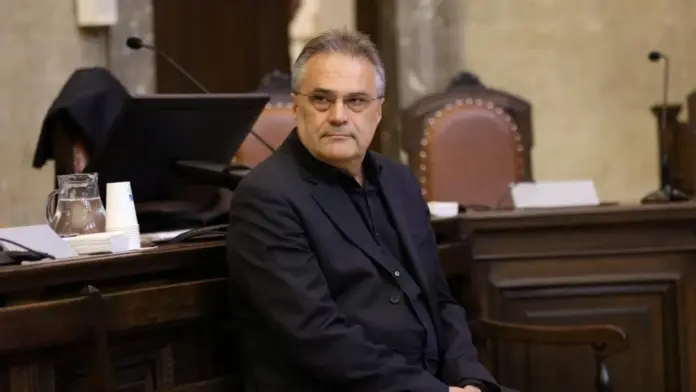
VIENNA — A Vienna court has convicted a former Austrian intelligence officer of espionage, handing down a sentence of four years and one month in prison after finding he systematically funnelled classified government data to Russian intelligence operatives and a fugitive corporate fraudster over a five-year period.
Egisto Ott, 63, was found guilty on multiple counts including spying, misuse of office, bribery, aggravated fraud, and breach of trust. The jury determined that between 2015 and 2020, Ott harvested secret information and personal data from restricted police databases, passing the material to Jan Marsalek — the fugitive former chief operating officer of the collapsed German payments company Wirecard — and to unidentified representatives of Russian intelligence, in exchange for financial compensation.
Austrian Spy Russia — Prosecutors argued that Ott’s motivations were rooted in financial gain and professional frustration, rather than any ideological allegiance to Moscow. Ott himself denied every accusation levelled against him in court, claiming instead that his activities formed part of a covert operation conducted in coordination with a Western intelligence service. The jury rejected that defence entirely.
Recommended Reading

Among the most damaging episodes detailed during the trial was the fate of work phones belonging to senior officials at the Austrian interior ministry. The devices were accidentally dropped into the River Danube during an official ministry boating trip. Ott recovered the phones, copied their contents, and passed the data to both Marsalek and Moscow.
Prosecutors also alleged that Marsalek commissioned Ott to obtain a laptop containing specialised electronic security hardware used by European Union member states for encrypted communications. That device was subsequently handed over to Russian intelligence — a breach with potentially far-reaching consequences for EU-wide secure communication infrastructure.
Marsalek, an Austrian citizen, has been the subject of an Interpol Red Notice since fleeing to Moscow via Austria in 2020, shortly before Wirecard’s spectacular collapse exposed a €1.9 billion accounting fraud. German police want him on charges of fraud and embezzlement, with prosecutors alleging he played a central role in artificially inflating the company’s balance sheet and reported sales figures. Beyond the corporate scandal, Marsalek is also suspected of having directed a network of Bulgarian nationals convicted in London in 2025 of conducting espionage on behalf of Russia — a finding that underscores the extent of his alleged ties to Russian intelligence.
Ott was arrested in 2024. At the time, Austrian Chancellor Karl Nehammer characterised the case in stark terms, describing it as "a threat to democracy and our country's national security." The conviction now lends judicial weight to those concerns, exposing a sustained penetration of Austrian state institutions by a foreign intelligence service at a time of heightened geopolitical tension across Europe.
Austrian Spy Russia: The Wider European Impact
The verdict carries significant implications beyond Austria’s borders. The alleged theft of EU-standard secure communications hardware points to a deliberate and sophisticated effort by Russian intelligence to compromise encrypted government channels used across the bloc. Security analysts have long warned that insider threats within Western intelligence and law enforcement agencies represent one of the most difficult vulnerabilities to detect and contain.
Ott’s lawyer has lodged an appeal against the conviction, meaning the case is not yet legally concluded. Nevertheless, the guilty verdict represents a landmark moment for Austrian authorities, who have faced persistent scrutiny over the country’s historical proximity to Russian influence networks. The trial laid bare how a single compromised official, motivated by money and grievance, can serve as a conduit for sustained intelligence collection against allied governments.
Marsalek himself remains beyond the reach of Western justice, believed to be sheltering in Moscow under Russian protection — a reminder that while Ott faces prison, the man prosecutors say commissioned much of his espionage continues to evade accountability.