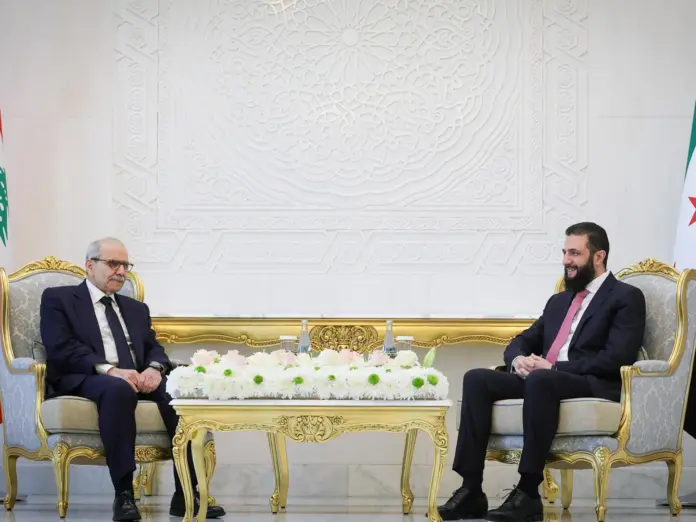
BEIRUT/DAMASCUS — Lebanese Prime Minister Nawaf Salam arrived in Damascus on May 9 for his second official visit to Syria since the collapse of Bashar al-Assad‘s government, as both countries absorb the consequences of relentless Israeli military pressure and attempt to forge a new bilateral relationship from the ruins of a deeply troubled past.
Lebanon Syria Diplomacy — The visit carries considerable symbolic weight. For decades, Lebanon existed in the shadow of Syrian dominance — a relationship defined by occupation, coercion, and political interference. Syria invaded Lebanon in 1976 under Hafez al-Assad, who had seized power five years earlier, and maintained a military presence there until 2005, when popular protests finally forced a withdrawal. That dynastic grip on power, inherited by Hafez’s son Bashar following his father’s death in 2000, endured for more than half a century before it was shattered almost overnight.
In December 2024, Syrian opposition forces launched a sweeping military offensive against government-held territory. Bashar al-Assad fled the country in the early hours of December 8, ending five decades of family rule. Ahmed al-Sharaa, who led the offensive, now serves as Syria’s president and received Salam in Damascus.
Recommended Reading
The two nations share more than geography. Both are currently under Israeli attack. Since March 2 — when Hezbollah launched strikes against Israel following the killing of Iranian Supreme Leader Ayatollah Ali Khamenei — Israeli forces have killed nearly 3,000 people in Lebanon and displaced more than 1.2 million. Israel has struck Syria more than 600 times in the year since al-Assad’s fall, and on May 17, Fadel Abdulghany of the Syrian Network for Human Rights accused Israel of gradually annexing southern Syria. Israel also seized additional land in the occupied Golan Heights the day after al-Assad’s government collapsed.
A ceasefire announced by Donald Trump on April 16 has done little to halt the broader pattern of violence reshaping the region.
The diplomatic thaw between Beirut and Damascus is complicated by unresolved grievances. More than 2,000 Syrians remain held in Lebanese prisons, though a transfer of 130 prisoners from Lebanon to Syria took place in March, signalling at least a tentative willingness to address outstanding issues. Syria had suspended the Lebanese-Syrian Higher Council in October, a move that underscored the institutional fragility of ties between the two governments.
The fall of al-Assad has also fundamentally altered the strategic landscape for Hezbollah. The group’s overland supply corridor — through which Iran channelled funding and weapons — was severed when the Syrian government collapsed. Al-Sharaa has since rejected proposals that Syrian troops be deployed to Lebanon to assist in disarming Hezbollah, a position that reflects both the limits of Damascus’s current capacity and the sensitivity of intervening in Lebanese internal affairs.
Lebanon’s modern statehood was itself carved out of Greater Syria under a French mandate following the First World War, a historical separation that has never been fully reconciled in the political imagination of either country. The Syrian uprising that began in 2011 deepened the entanglement, drawing Hezbollah fighters into the conflict on Assad’s behalf and cementing Lebanon’s role as a theatre for regional proxy competition.
Lebanon Syria Diplomacy: Regional Implications
Now, with a new Syrian leadership in place and both nations battered by external military campaigns, Salam’s visit to Damascus represents an attempt to establish a relationship based on mutual interest rather than coercion. Whether the two governments can translate diplomatic visits into durable cooperation — on prisoner exchanges, border security, economic ties, and the management of Israeli pressure — remains an open question.
Al-Sharaa’s international standing has risen sharply since taking power. In November 2025, he became the first Syrian leader to visit the White House, a milestone that reflects Washington’s recalibration toward the post-Assad order. That recognition has not, however, translated into protection from Israeli strikes, which continue to reshape the physical and political geography of southern Syria.
For Lebanon, the stakes of the Damascus relationship are immediate and existential. With its population displaced, its economy under strain, and its most powerful armed faction cut off from its principal supply chain, Beirut needs a functional relationship with its neighbour. The question is whether Damascus, itself under siege and still consolidating authority, has the capacity to be the partner Lebanon requires.