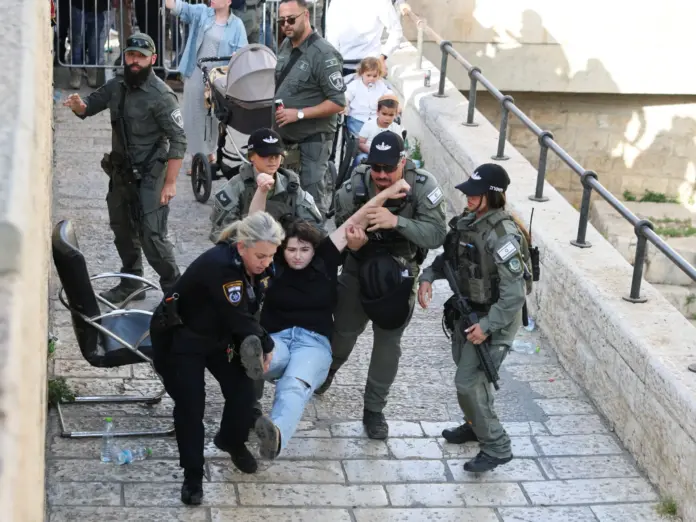
Jerusalem Day Violence — Tens of thousands of ultra-nationalist Israelis flooded the streets of occupied East Jerusalem on May 14, marking Jerusalem Day — Israel’s annual commemoration of its 1967 military capture of the city — with chants of ‘death to Arabs’ and ‘may your villages burn.’ The march, which wound through the Muslim Quarter of the Old City, was accompanied by provocative acts at Islam’s third-holiest site and a surge of settler violence across the West Bank that left at least two Palestinian teenagers dead within days.
Far-right National Security Minister Itamar Ben-Gvir raised the Israeli flag inside the Al-Aqsa Mosque compound during the day’s events, while Jewish Power legislator Yitzhak Kroizer prostrated himself before the Dome of the Rock. Israeli authorities imposed sweeping age-based restrictions on Palestinian access to the site, barring men under 60 and women under 50 from entering. The Palestinian Authority’s Jerusalem Governorate recorded more than 2,200 settler incursions during the week alone.
The violence had already begun the night before. On May 13, dozens of settlers operating under military protection launched a coordinated assault on the villages of Jilijliya, Sinjil and Abwein, north of Ramallah. During the attack, 16-year-old Youssef Kaabneh was shot in the chest and killed. Settlers stole hundreds of sheep and two tractors, and three Palestinian residents were arrested. Seven families were forcibly displaced from village outskirts the following day. In Sinjil, a settler identified as Jaber Shabaneh was stabbed in the leg during the unrest. Separately, settlers set fire to a mosque and vehicles in the village of Jibiya.
Recommended Reading
Three days later, on May 16, Israeli forces shot and killed another teenager — 16-year-old Fahd Awais — in al-Lubban ash-Sharqiya, south of Nablus, bringing the toll of young Palestinians killed in the West Bank to two within the span of seventy-two hours.
The week also brought a significant and alarming legal development. A death penalty law for Palestinians convicted of deadly acts of terrorism in the West Bank took effect after the Israeli military’s Central Command chief, Avi Bluth, signed the required military order. Human rights organisations have long warned that such a measure, applied exclusively within an occupied territory, represents a grave breach of international humanitarian law.
Territorial ambitions advanced on multiple fronts. Israeli authorities approved a plan to seize historic Palestinian properties in the Bab al-Silsila neighbourhood adjacent to Al-Aqsa, while the government greenlit construction of an Israeli military complex on the site of UNRWA’s demolished headquarters in Sheikh Jarrah — a neighbourhood already at the centre of longstanding dispossession disputes.
In Gaza, the killing continued. On May 14, brothers Tamer and Mohammad al-Mutawaq were killed in a drone strike on al-Nazha Street in Jabalia. The following day, Israel killed Izz al-Din al-Haddad, the head of Hamas’s armed wing, in a strike that also took the lives of his wife, daughter, and four other civilians. On May 17, three community kitchen workers were killed when a strike hit a food distribution site in Deir al-Balah, underscoring the persistent danger facing humanitarian personnel in the enclave.
Jerusalem Day Violence: Regional Implications
Prime Minister Benjamin Netanyahu confirmed that Israel now controls approximately 60 percent of the Gaza Strip. Since the October ceasefire collapsed, 877 Palestinians in Gaza have been killed and more than 2,600 injured. The cumulative death toll in Gaza since October 7, 2023, now stands at 72,769.
The humanitarian situation inside Gaza remains catastrophic. The World Health Organization estimates that more than 43,000 people have sustained life-changing injuries, a quarter of them children. Aid delivery has been severely constrained: the UN’s Office for the Coordination of Humanitarian Affairs reported that in the first eleven days of May, only one in every two aid trucks entering from Egypt was able to offload cargo at Israeli crossings.
Against this backdrop of escalating violence and territorial consolidation, Israel’s governing coalition submitted a bill to dissolve parliament, with elections now required by late October — injecting fresh political uncertainty into a country already navigating the pressures of a prolonged military campaign and deepening international isolation.