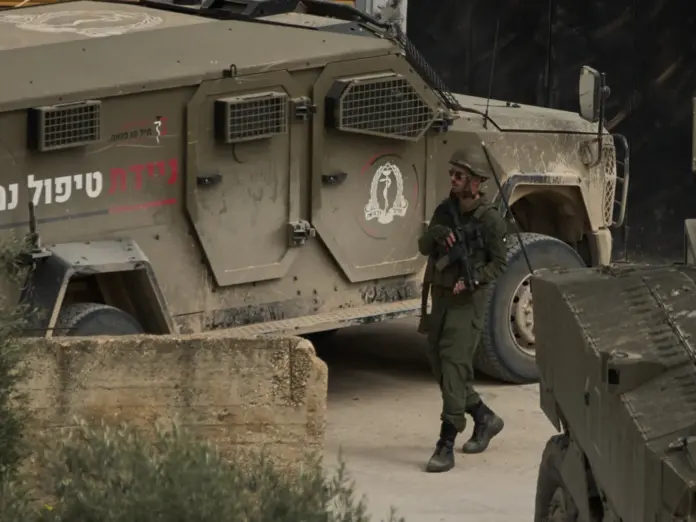
West Bank Violence — Israeli forces shot and killed a 34-year-old Palestinian man in Jenin Camp on Saturday, in the latest fatality from a sweeping military campaign that has reshaped daily life across the occupied West Bank. The Palestinian Ministry of Health identified the victim as Nour al-Din Kamal Hassan Fayyad. The Israeli military said its troops opened fire after the man attempted to infiltrate an area where soldiers were conducting operations inside the camp.
The killing unfolded against a backdrop of simultaneous Israeli military activity across multiple West Bank cities and towns. Soldiers stormed Tubas and Qalqilya, raided the towns of Tammun and Zaatara east of Bethlehem, and conducted an incursion into the village of Deir Jarir, east of Ramallah. In the Shu’fat refugee camp northeast of Jerusalem, soldiers assaulted and arrested a young Palestinian man. A separate arrest was carried out in the village of Zawata, west of Nablus.
The scale of Israeli military operations in the northern West Bank has grown dramatically since January of last year, when large-scale campaigns targeting Palestinian refugee camps began in earnest. UNRWA, the United Nations agency for Palestinian refugees, has reported that operations focused on Jenin and Tulkarem camps have displaced approximately 40,000 Palestinians — a figure that underscores the humanitarian toll of the prolonged military presence in densely populated civilian areas.
Recommended Reading
Saturday also brought a surge in settler violence. In the town of Sinjil, a Palestinian was assaulted by Israeli settlers. In Turmus Aya, northeast of Ramallah, settlers set fire to an agricultural outbuilding and daubed racist slogans across the town. The incidents formed part of a pattern of attacks that human rights observers have described as increasingly brazen.
The most alarming act of the day occurred in the village of Jibiya, where masked individuals set fire to a mosque and several vehicles. Hebrew graffiti was found at the scene, pointing to settler involvement. Ramiz Alakbarov, the deputy special coordinator for the Middle East peace process, swiftly condemned the attack, calling for an immediate and transparent investigation and demanding accountability for those responsible. His statement reflected growing international alarm over what officials describe as a dangerous escalation of settler violence endangering Palestinian civilians across the territory.
The events of Saturday illustrate the dual pressures bearing down on Palestinian communities in the West Bank: military operations that have uprooted tens of thousands from their homes, and a parallel wave of settler attacks targeting property, places of worship, and individuals. The combination has drawn repeated condemnation from United Nations officials and human rights organisations, though Israeli authorities maintain that military operations are necessary counter-terrorism measures.
The Jenin refugee camp has been a focal point of Israeli military activity for well over a year. Established to house Palestinians displaced during the 1948 Arab-Israeli war, the camp has become one of the most contested spaces in the West Bank, with Israeli forces conducting near-daily incursions that residents and aid workers say have left infrastructure severely damaged and civilian life severely disrupted.
West Bank Violence: Regional Implications
The arson attack on the Jibiya mosque adds to a growing list of attacks on Muslim religious sites in the West Bank, incidents that have drawn particular condemnation from international observers. The presence of Hebrew graffiti at the scene was consistent with previous settler attacks in the region, though Israeli authorities have not publicly attributed responsibility.
With displacement figures rising, military operations showing no sign of abating, and settler violence intensifying, the humanitarian situation across the occupied West Bank continues to deteriorate — placing renewed pressure on international actors to respond to conditions on the ground.