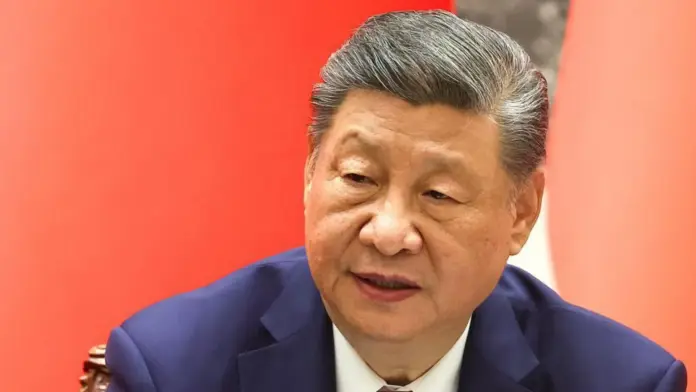
BEIJING/PYONGYANG — Chinese President Xi Jinping touched down in Pyongyang on June 8 for a two-day summit with Kim Jong Un, his first visit to North Korea since 2019 and a trip freighted with urgency over the Korean peninsula’s accelerating nuclear trajectory and a shifting web of great-power alliances.
Xi Jinping Pyongyang Visit — The visit, announced by China’s state broadcaster CCTV and made at Kim’s personal invitation, arrives at a moment of acute geopolitical flux. Just days before Xi’s plane landed, Kim toured a new nuclear facility and declared that North Korea’s weapons-grade nuclear materials production capacity had more than doubled over the past five years — a boast that underscored the limits of Beijing’s influence over its neighbour and ally.
On Thursday, North Korea’s state news agency KCNA reported that Kim had called for an exponential expansion of the country’s nuclear arsenal, a statement that placed the denuclearisation question squarely at the centre of Xi’s agenda. Hong Min of the Korea Institute for National Unification confirmed that Beijing is closely monitoring Pyongyang’s nuclear programme, reflecting Chinese anxiety about a weapons build-up it can neither fully endorse nor contain.
Recommended Reading
![Chinese President Xi Jinping and North Korean leader Kim Jong Un met in September in Beijing at a reception marking the 80th anniversary of the end of World War II [File: Florence Lo/Reuters]](https://world-tension.s3.us-east-2.amazonaws.com/articles/1292/8abe3b84ba184b378cf2886764e36647.webp)
The summit is Xi’s first to Pyongyang since he made the same journey in June 2019. Before that trip, no Chinese leader had visited North Korea for fourteen years, between 2005 and 2019, a gap that illustrated the periodic strains in a relationship that is nonetheless anchored by geography, history, and treaty obligation. The two countries share a 1,400-kilometre border and are bound by a mutual defence pact — the only such formal alliance China maintains with any nation — that commits each side to support the other if attacked. This year marks the 65th anniversary of that agreement.
China’s economic grip on North Korea remains overwhelming. According to 2022 figures from the National Committee on North Korea, Pyongyang depends on Beijing for up to 95 percent of its total trade and 85 percent of its exports, making China the indispensable lifeline for a country facing sweeping international sanctions over its nuclear weapons programme and alleged human rights violations.
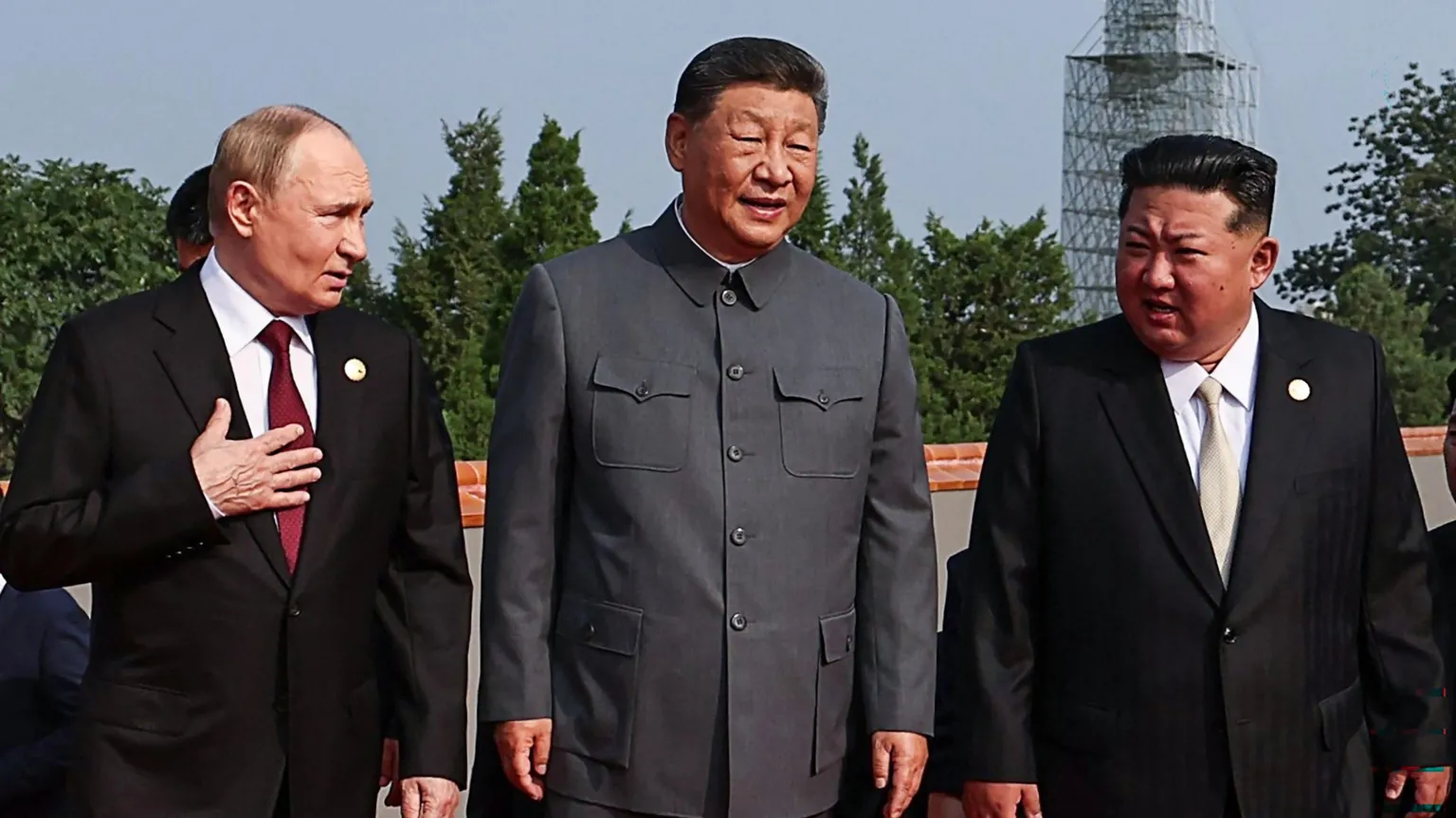
Yet leverage has not translated into compliance. North Korea has dramatically deepened its partnership with Russia since Moscow’s invasion of Ukraine, supplying troops and weapons to support the Russian war effort — a development that has generated visible unease in Beijing. Xi hosted Vladimir Putin in Beijing shortly before departing for Pyongyang, and the two leaders discussed, among other issues, the US conflict with Iran. The spectacle of Kim and Putin standing together as guests of honour at a Beijing military parade last September, marking the 80th anniversary of victory over imperial Japan, illustrated how the Pyongyang-Moscow axis has taken on a life of its own, one that China watches with wariness rather than enthusiasm.
Xi’s diplomatic calendar in recent weeks has been deliberately crowded. He welcomed US President Donald Trump to Beijing, where the two leaders reaffirmed a shared goal of denuclearising North Korea, according to a White House fact sheet. A Chinese foreign ministry spokesperson declined to directly confirm that characterisation at a subsequent press briefing, a small but telling divergence. Trump met Kim Jong Un more than once during his first presidential term, and South Korea’s minister of unification, Chung Dong-young, believes Xi will use the Pyongyang summit to explore the possibility of resuming US-North Korea dialogue.
The diplomatic backdrop on the Korean peninsula itself is bleak. In December 2024, Kim formally declared an end to reunification efforts with South Korea, labelling South Koreans a sworn enemy and severing all levels of communication with Seoul. The rupture makes the inter-Korean dimension of any diplomatic initiative vastly more complicated, even as a small thaw appeared in an unlikely arena: last month, North Korea’s women’s professional football team crossed into South Korea to compete against a South Korean side, a rare and anomalous contact given the frozen state of relations.
Xi Jinping Pyongyang Visit: Peninsula Security in Context
South Korea has expressed hope that Beijing can play a constructive role in encouraging North Korea to contribute to regional peace and stability. That hope rests on China’s unmatched economic leverage, but also on the reality that Beijing’s strategic interests — a stable peninsula, no nuclear escalation, no collapse of the Kim government that could send refugees flooding across the 1,400-kilometre border — do not always align neatly with Washington’s or Seoul’s preferred outcomes.
China’s Foreign Minister Wang Yi visited Pyongyang in April, calling on the two countries to enhance coordination on international and regional issues, a visit widely seen as preparatory groundwork for Xi’s trip. North Korea, despite its isolation, has not stood entirely still: Pyongyang has been developed and new beach and ski resorts have been constructed, projecting an image of domestic progress even as the country remains among the world’s most diplomatically isolated states.
What Xi can extract from Kim — on nuclear restraint, on the Russia relationship, on the possibility of renewed engagement with Washington — will define whether this rare summit produces durable results or merely reaffirms the surface warmth of an alliance whose internal tensions grow harder to conceal.