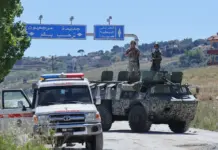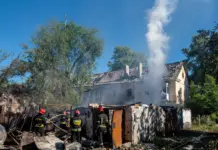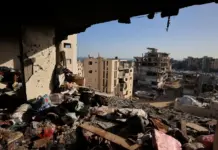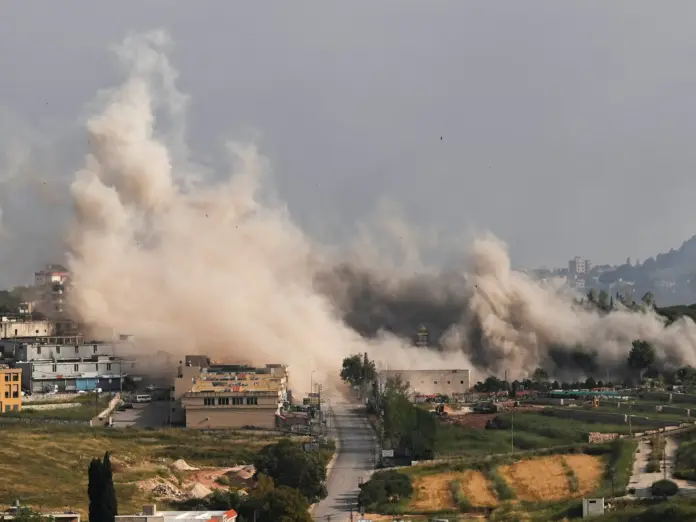
NABATIEH, Lebanon — Israeli forces struck the Lebanese city of Nabatieh repeatedly on Tuesday and Wednesday, conducting near-continuous artillery shelling on its outskirts and launching air strikes that hit a local cemetery, as the predominantly Shia Muslim city observed the Muslim holiday of Eid al-Adha. Israel simultaneously issued a forced displacement order for the city, triggering fresh civilian flight from a community already hollowed out by previous rounds of conflict.
Israel Strikes Nabatieh — The nearby village of Yohmor al-Shaqif was also struck multiple times. Lebanon’s Civil Defence forces worked through Wednesday to rescue 15 civilians trapped inside damaged buildings in Nabatieh, a city of deep historical and religious significance to Lebanon’s Shia community.
Hezbollah responded with artillery and drone strikes targeting Israeli forces in the area of Zawtar al-Sharqiya in the Nabatieh district, signalling that despite months of sustained Israeli pressure, the group retains offensive capacity in the south.
Recommended Reading
The strikes came a day after Prime Minister Benjamin Netanyahu announced that Israeli military operations had expanded beyond what his government calls the ‘yellow line’ — an approximately 10-kilometre buffer zone Israel has established inside Lebanese territory. The announcement prompted an immediate exodus of residents from Beirut‘s southern suburbs. Netanyahu has stated his military’s intention to ‘crush’ Hezbollah, framing the expanded operations as a continuation of that objective.
Nabatieh sits approximately 11 kilometres from Lebanon’s southern border, placing it squarely within the zone Israel now claims as an operational theatre. The Litani River, which flows north of the city, has historically served as a boundary in ceasefire frameworks, including United Nations Security Council Resolution 1701 following the 2006 war. Israel’s current push beyond the yellow line effectively renders those past demarcations obsolete on the ground.
The human cost of the conflict has been staggering. Since Israel intensified its war on March 2, at least 3,213 people have been killed in Lebanon. More than 1.2 million remain displaced across the country. The Committee for the Protection of Journalists has documented the deaths of at least 15 journalists. Many Nabatieh residents had already fled their homes during a mass displacement in 2024, when Israeli strikes destroyed the city’s historic souk — a cultural and commercial landmark that had survived decades of conflict.
Nabatieh’s history with Israeli military force stretches back generations. The city was attacked during Israeli invasions in 1978, 1982, 1993, 1996, 2006, and 2024, and now again in the current escalation. Its most symbolically charged moment came in 1983, during what became known as the Ashura Uprising, when tens of thousands of civilians confronted Israeli soldiers who attempted to drive through a religious procession. Israel occupied southern Lebanon from 1982 until its withdrawal in 2000.
Israel Strikes Nabatieh: Regional Implications
Lebanon’s President Joseph Aoun addressed the nation during the Eid al-Adha holiday, speaking as Israeli strikes continued to fall on southern communities. Hezbollah Secretary-General Naim Qassem delivered a televised address on Sunday, sharply denouncing Lebanon’s government for proceeding with direct negotiations with Israel. Those talks are scheduled for June 2 and 3, and Lebanon’s government has confirmed it is preparing for the sessions despite Hezbollah’s opposition.
The diplomatic track exists in stark tension with the military reality on the ground. A ceasefire announced by US President Donald Trump on April 16 has clearly failed to hold, with Israel’s expanded operations and the ongoing bombardment of Nabatieh representing a significant deterioration since that announcement. Whether the scheduled June negotiations can produce a durable framework — or whether they will be overtaken by further escalation — remains deeply uncertain as Israeli forces press deeper into Lebanese territory and civilian casualties continue to mount.