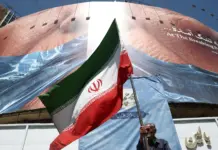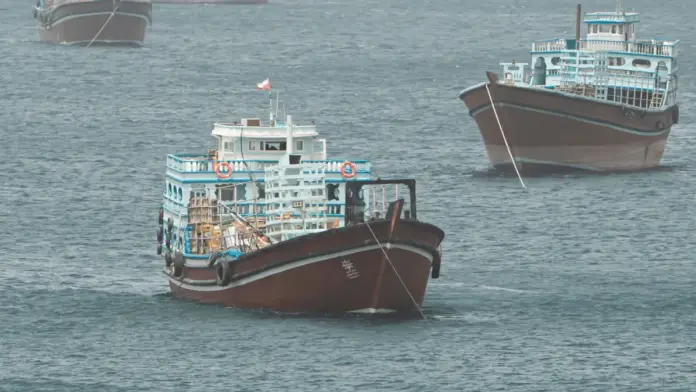
Iran Hormuz Blockade — Iran’s Islamic Revolutionary Guard Corps announced Wednesday that it had coordinated the transit of 26 vessels through the Strait of Hormuz within a 24-hour window, a declaration carried by state-affiliated news agency ISNA that appeared designed to project operational control over one of the world’s most strategically vital waterways.
The announcement came as negotiations between Washington and Tehran over restoring normal traffic through the strait remain stalled — a diplomatic impasse with consequences now rippling far beyond the two warring parties.
The conflict traces to February 28, when the United States and Israel launched military operations against Iran. Tehran responded by blockading the Strait of Hormuz, through which approximately one-fifth of global energy exports had been flowing. The Trump administration countered with its own blockade on Iranian ports, a move that has effectively strangled Iran’s oil exports — the country’s primary source of revenue.
Recommended Reading
The economic pressure is mutual, but analysts warn the humanitarian fallout is becoming global. The Food and Agriculture Organization of the United Nations issued a stark warning on Wednesday, stating that the ongoing disruption could trigger a severe global food price crisis within six to 12 months. The FAO described the situation as ‘the beginning of a systemic agrifood shock,’ outlining a cascading sequence of consequences: rising energy costs feeding into fertilizer prices, then seed availability, then lower agricultural yields, then commodity price spikes, and ultimately widespread food inflation.
The warning underscores how a regional military confrontation can rapidly metastasize into a global economic emergency. Energy markets, already destabilised by the closure of the strait, are now transmitting shocks into agricultural supply chains that feed billions of people across Asia, Africa, and Latin America.
On the diplomatic front, President Donald Trump struck a cautiously optimistic tone Wednesday, telling reporters that ‘progress’ had been made in negotiations with Iran. But he paired that assessment with a threat: if Tehran does not agree to a deal, the United States would resume military action.
Iran’s response was defiant. Foreign Minister Abbas Araghchi warned that a ‘return to war will feature many more surprises,’ while the IRGC went further, stating that any renewed attack on Iran would prompt the country to widen the conflict beyond the region entirely — a signal that Tehran is prepared to internationalise the confrontation if pushed.
Will Todman, a senior fellow at the Center for Strategic and International Studies, told a broadcaster Wednesday that both sides appear to be operating under the same strategic logic — and that this symmetry is precisely what makes resolution so difficult. Each party, Todman explained, believes that the longer its blockade remains in place, the greater the economic suffering inflicted on the other side, and therefore the greater its leverage at the negotiating table. That shared calculation, he suggested, is keeping both sides entrenched.
Iran Hormuz Blockade: Regional Implications
The Strait of Hormuz has long been considered the jugular vein of global energy supply. Situated between the Omani and Iranian coastlines, the narrow passage connects the Persian Gulf to the Gulf of Oman and serves as the exit route for oil and liquefied natural gas from Saudi Arabia, the United Arab Emirates, Kuwait, Iraq, and Iran itself. Its closure — even partial — sends shockwaves through commodity markets worldwide.
The IRGC’s claim of coordinating 26 vessel transits in 24 hours, while unverified independently, suggests Iran is attempting to demonstrate that it retains the ability to manage — and therefore restrict — maritime movement through the strait at will. Whether that constitutes a genuine easing of the blockade or a tactical messaging exercise remains unclear.
What is clear is that the window for a negotiated resolution is narrowing. The FAO’s timeline — six to 12 months before a full-blown food crisis materialises — gives diplomats a finite horizon. With Trump threatening renewed military action and Tehran warning of an expanded conflict, the gap between a deal and a deeper war appears, for now, to be widening rather than closing.