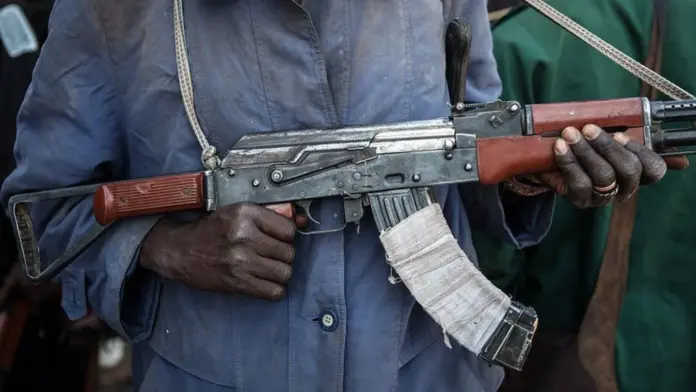
Nigeria School Kidnapping — Gunmen stormed three schools in the farming town of Mussa, Borno state, on Friday morning, abducting more than 50 children in one of the most alarming mass kidnappings north-eastern Nigeria has witnessed in recent years. The majority of the victims are nursery-age children between two and five years old.
The targeted institutions — Government Day Secondary School, Mussa Central Primary School, and the State Universal Basis Education Board (SUBEB) Secondary School — were struck in rapid succession. Eyewitnesses described scenes of chaos as armed men fired indiscriminately into the air, scattering residents and forcing parents to watch helplessly from a nearby hill as their young children were loaded onto motorcycles and driven away.
The timing of the assault was precise and deliberate. Resident Bukar Buba said the attackers descended on the town less than 30 minutes after a military patrol had departed, suggesting prior surveillance of troop movements. The militants used the abducted children as human shields as they fled on motorbikes, making any immediate armed response by security forces impossible without risking the children’s lives. Older students, better able to react to the unfolding violence, managed to escape into surrounding bushland during the confusion.
Recommended Reading

Abdu Dunama, headmaster of Mussa Central Primary School, confirmed that 34 children — predominantly nursery pupils aged five and under — were seized from his school alone. He added that troops had since returned to the area and were actively pursuing the abductors, though no recoveries had been confirmed at the time of reporting.
Senator Ali Ndume of Borno South issued a statement on Saturday placing the confirmed abduction figure at a minimum of 42 children taken from two of the three schools. The discrepancy between that figure and the higher estimates circulating from the ground reflects the difficulty of obtaining precise information in the immediate aftermath of such attacks in remote communities.
No armed group had claimed responsibility as of Saturday. However, the operational style — motorcycle-borne raiders exploiting gaps in military presence, targeting civilian institutions, and striking a rural community in Borno state — bears the hallmarks of either Boko Haram or its rival faction, the Islamic State West Africa Province (Iswap). The two groups have waged a bloody contest for territorial dominance across the Lake Chad Basin for years, frequently targeting schools, markets, and farming settlements.
Mussa is a predominantly agricultural community whose residents have endured cycles of militant violence for decades. The psychological toll of Friday’s attack was immediate: a number of residents abandoned the town in the hours that followed, unwilling to remain in a place that had so visibly been left exposed. Government officials did not issue a public response in the immediate aftermath.
Nigeria School Kidnapping: The Broader African Context
The abduction echoes a pattern of school kidnappings that has scarred northern Nigeria since Boko Haram’s insurgency intensified in the early 2010s. The mass abduction of 276 schoolgirls from Chibok in 2014 drew global condemnation and launched the #BringBackOurGirls campaign, yet the practice has persisted. Subsequent mass kidnappings in Kagara, Kankara, and Zamfara demonstrated that the tactic — whether employed for ransom, forced recruitment, or ideological terror — remains a central tool of armed groups operating across Nigeria’s north.
The vulnerability exposed in Mussa on Friday — a town left unguarded within minutes of a patrol’s departure, its youngest children taken in broad daylight — underscores the persistent gap between the scale of the security challenge and the resources deployed to meet it. For the families now waiting on a hillside with no news of their children, that gap is not a policy abstraction. It is a catastrophe measured in the faces of toddlers carried away on the backs of motorcycles.