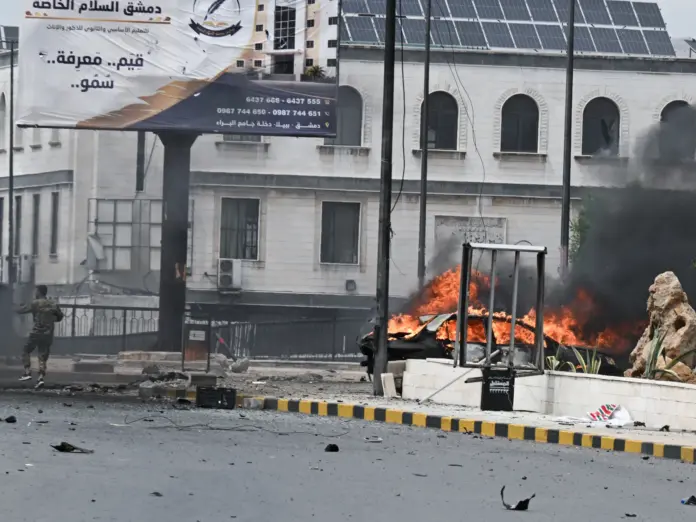
Damascus, Syria — A car bomb exploded near Syria’s Defence Ministry in central Damascus on Tuesday, killing at least one soldier and wounding more than 21 civilians and military personnel in one of the most significant security incidents to strike the capital since the fall of former president Bashar al-Assad.
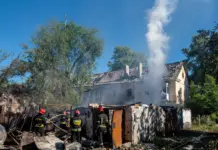
Damascus Car Bomb — The blast struck the Bab Sharqi district, a central neighbourhood of the Syrian capital, after members of an army unit discovered an improvised explosive device planted in the vicinity of the ministry building. As soldiers moved in to defuse the device, the car bomb detonated, sending plumes of smoke billowing into the sky above the city. Videos circulating on social media captured the scene, showing thick black smoke rising from the blast site as firefighters worked to extinguish the resulting blaze.
All 21 wounded individuals were transferred to nearby hospitals for medical treatment, according to Najib al-Naasan, head of Syria’s ambulance and emergency directorate. The Syrian Defence Ministry confirmed the explosion in an official statement carried by state media.
Recommended Reading
No group immediately claimed responsibility for the attack, leaving the identity of the perpetrators unclear. The sophistication of the device — planted near a high-security government installation and timed to detonate during a military disposal operation — suggests a deliberate and coordinated strike.
The bombing is the latest in a series of security incidents that have plagued Syria since al-Assad’s government collapsed in late 2024, ending more than 13 years of civil war. Explosions targeting both military and civilian vehicles have occurred intermittently across the country in the months since his fall, reflecting the fragile and contested security environment that has taken hold.
The violence is not confined to Damascus. In northern Syria, a car bomb killed at least 20 people on the outskirts of Manbij, underscoring the geographic breadth of the instability. The capital itself has not been spared: a suicide bomber struck inside a crowded Damascus church, killing at least 25 worshippers and wounding dozens more, while a separate device explosion in June 2024 claimed one life when it detonated inside a vehicle.
Tuesday’s attack near the Defence Ministry represents a particularly brazen escalation, targeting the symbolic heart of Syria’s new military establishment. The ability of attackers to plant an explosive device so close to a major government building raises urgent questions about the security capacity of the transitional authorities now attempting to govern the country.
Damascus Car Bomb: Regional Implications
Syria’s post-Assad landscape remains deeply fractured. Armed factions, remnants of the former regime, and extremist networks continue to operate across the country, and the central government has struggled to assert control over vast swaths of territory. International observers have repeatedly warned that the security vacuum left by the war’s end creates fertile conditions for precisely the kind of asymmetric attacks seen in recent months.
The full circumstances of Tuesday’s bombing — including the origin of the explosive device, the intended target, and the chain of events that led soldiers to the scene — remain under investigation. Syrian authorities have not publicly named any suspects or indicated which group may be responsible.
As Damascus works to stabilise after more than a decade of devastating conflict, attacks of this nature threaten to undermine confidence in the transitional government’s ability to provide basic security, both for its own institutions and for the civilian population.