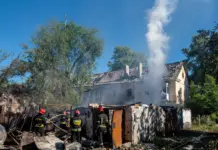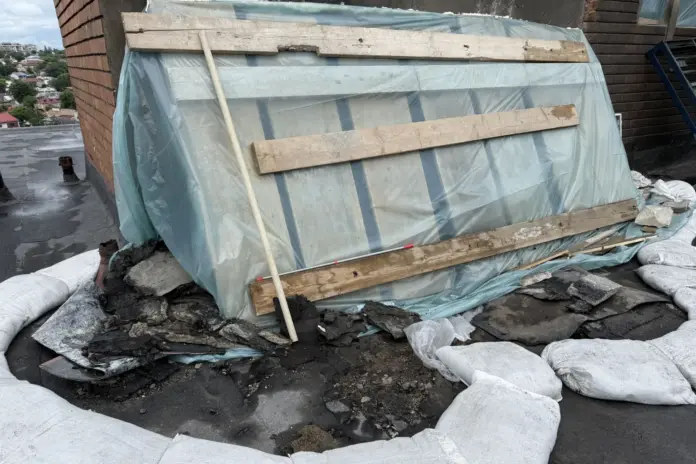
Russian Drone Strikes Romania — A Russian Geran-2 drone tore through the roof of an apartment building in the Romanian city of Galati in the early hours of Friday morning, wounding two civilians and triggering a sharp diplomatic confrontation between Bucharest and Moscow that has reverberated across the NATO alliance.
The strike punched a jagged hole several metres wide into the building’s roof, with the lift shaft absorbing the brunt of the blast and almost certainly preventing far greater casualties. A woman and her teenage son were hospitalised with bruises and minor burns. Romanian authorities issued an alert at approximately 02:00 warning of a drone approaching from the direction of the Ukrainian border, but the air force was unable to intercept the aircraft before it hit.
Romania tracked a swarm of 43 drones travelling from east to west that night. The Geran-2 — also known as the Shahed, an Iranian-designed loitering munition widely used by Russian forces — was among those targeting Ukrainian ports on the opposite bank of the Danube River. Those ports are critical arteries for Ukraine’s grain exports. One drone, struck by Ukrainian air defences, changed course and crossed into Romanian territory before hitting the residential building.
Recommended Reading

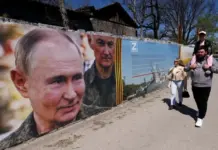
Romanian President Nicosur Dan confirmed the drone’s identity and noted that an identical device had been recovered four or five weeks earlier in Romania without detonating. Russian President Vladimir Putin denied any Russian involvement, claiming no evidence linked the drone to his forces — a position flatly contradicted by Bucharest’s own technical assessment.
The incident is the most serious of its kind on Romanian soil since Russia launched its full-scale invasion of Ukraine in 2022. Romania considered invoking Article 4 of the NATO treaty, which allows members to call consultations when their security is threatened, but ultimately rejected the step, with officials citing a desire to avoid generating public panic.
Instead, Bucharest moved on the diplomatic front. Romania shut down the Russian consulate in Constanta, the country’s main Black Sea port city, describing the closure as a formal warning. President Dan made clear the next escalatory measure would be the expulsion of the Russian ambassador, who remains in the country for now. The sequence of steps signals a deliberate, calibrated pressure campaign rather than an immediate rupture in relations.

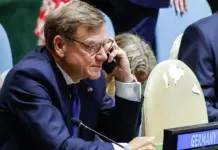
NATO allies were unambiguous in their condemnation. The alliance’s members described Russia’s conduct as "reckless", underscoring the risk that drone warfare along Ukraine’s western frontier poses to alliance territory. US Secretary of State Marco Rubio, however, declined to comment on the incident when approached by reporters, a silence that drew attention given Washington’s central role in shaping the Western response to the war.
Romania is not waiting passively. Bucharest is acquiring its own drone fleet and has entered into development agreements with Ukrainian companies to build additional systems domestically. The country has also intensified calls for NATO to accelerate the transfer of military equipment to its eastern flank, arguing that the pace of alliance commitments has not kept up with the evolving threat environment along the Danube corridor.
Russian Drone Strikes Romania: The Wider European Impact
The European Union, meanwhile, was finalising a new package of sanctions against Moscow at the time of the strike, adding economic pressure to the diplomatic fallout. The timing underscores the degree to which the war in Ukraine continues to destabilise its neighbours even as fighting remains concentrated on Ukrainian territory.
Romania’s geography makes it uniquely exposed. The Danube forms a natural border between Romanian and Ukrainian territory, and the Ukrainian ports on the river’s northern bank — essential to moving grain to global markets — have been a persistent target for Russian drone strikes. Stray munitions and redirected drones have repeatedly crossed into Romanian airspace, but Friday’s direct hit on a residential building represents a qualitative escalation in the danger faced by Romanian civilians.
A Romanian fighter jet previously demonstrated the country’s willingness to act, shooting down a Ukrainian drone that had been knocked off course and entered Estonian airspace — an episode that illustrated both the reach of the problem and Romania’s growing role in managing it. Whether Bucharest’s latest diplomatic measures prove sufficient to deter further incursions, or whether the Russian ambassador will ultimately be shown the door, may depend on what the coming days bring along the Danube.