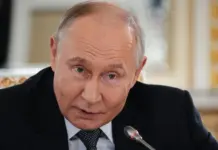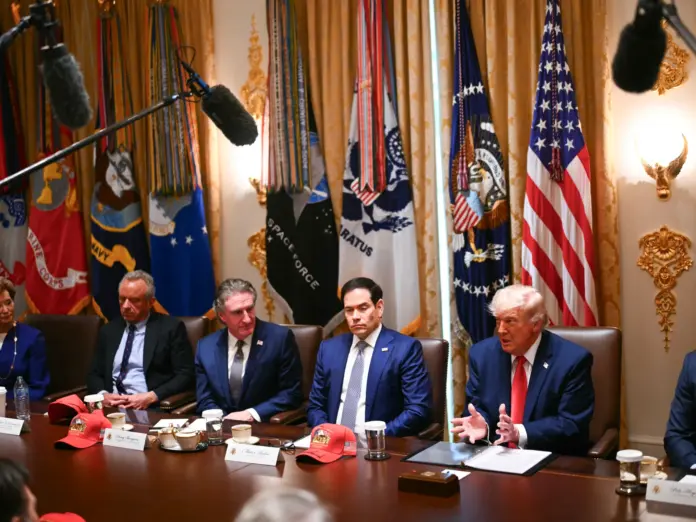
WASHINGTON / MUSCAT — President Donald Trump threatened to destroy Oman during a cabinet meeting in Washington on Wednesday, dramatically escalating a confrontation over control of the Strait of Hormuz that has rattled global energy markets and drawn the wider Gulf region toward open conflict.
Iran Hormuz Blockade — The threat, amplified when the US Department of State shared a transcript on social media explicitly referencing Oman, came as the sultanate was reportedly engaged in talks with Iran over a joint arrangement to oversee commercial passage through the strategically vital waterway. The strait carries more than 20 percent of the world’s oil traffic and sits almost entirely within Iranian and Omani territorial waters — a geographic reality that has become the central flashpoint of the current crisis.
Iran’s state television reported that Tehran and Washington had been close to agreeing on a memorandum of understanding under which Iran and Oman would jointly administer the strait. That prospect appears to have provoked Trump’s outburst. Oman, a nation of 5.3 million people with more than two centuries of diplomatic relations with the United States, does not host American military forces — a distinction that sets it apart from Gulf neighbours such as Qatar, Bahrain and the United Arab Emirates.
Recommended Reading
Esmaeil Baghaei, Iran’s Foreign Ministry spokesman, expressed solidarity with Muscat on Thursday, condemning what he characterised as threats against a sovereign nation engaged in legitimate diplomacy. The statement underscored how swiftly the confrontation has drawn in regional actors beyond the primary belligerents.
The crisis has its roots in a joint US-Israeli military operation against Iran on February 28, after which Tehran closed the Strait of Hormuz and began asserting sovereignty over it. Iran subsequently imposed transit tolls of as much as $2 million per vessel — a move that legal experts note violates international maritime law, which prohibits countries from charging fees for passage through natural straits, though states may offer ancillary services such as insurance and docking assistance.
A temporary ceasefire announced on April 8 failed to hold. Direct negotiations between American and Iranian delegations in Islamabad on April 11 and 12 collapsed without agreement. Since then, Iran has maintained control over Hormuz shipping lanes while US forces have enforced a blockade on Iranian ports, creating a volatile standoff with no clear diplomatic off-ramp.
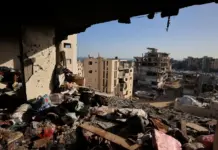
The situation deteriorated sharply on Thursday. Iran’s Tasnim news agency reported that four vessels — including a United Kingdom-flagged tanker — attempted to transit the strait with their radar systems switched off, a manoeuvre widely interpreted as an attempt to evade Iranian monitoring. The Islamic Revolutionary Guard Corps responded by firing warning shots at the vessels. Separately, the IRGC struck a US airbase in retaliation for an early morning American attack on a site near the airport in Bandar Abbas.
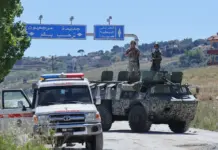
The violence was not confined to the strait itself. Kuwait’s military announced Thursday that its air defences were actively engaging hostile missile and drone attacks, signalling that the conflict is spreading beyond its original theatre.
Iran Hormuz Blockade: Regional Implications
Oman’s exposure to the crisis has been direct and costly. The commercial port of Duqm, in the Al Wusta governorate, was struck by two drones on March 1. A fuel tank at the same facility was hit in a follow-up attack two days later. Despite this, Muscat has persisted in its mediating role — a posture consistent with Oman’s long-standing tradition of quiet diplomacy in the Gulf.
Omani Foreign Minister Badr Albusaidi had been a central figure in US-Iran nuclear negotiations before the current conflict erupted. He met with US Vice President JD Vance in Washington on February 27 — the day before the US-Israeli strikes on Iran began — in what now appears to have been a last-ditch effort to avert hostilities.
Trump’s threat against a country that has served as one of Washington’s most reliable back-channel intermediaries in the region has alarmed diplomats and analysts. Oman’s unique position — maintaining ties with both Washington and Tehran while refusing to host foreign military bases — has historically made it indispensable in moments of crisis. Whether that role can survive the current pressure remains deeply uncertain.
With Kuwaiti air defences engaged, IRGC forces exchanging fire with US assets, and the world’s most critical oil chokepoint under contested control, the Strait of Hormuz crisis has moved well beyond a bilateral confrontation. The coming days will test whether any diplomatic architecture remains capable of containing it.