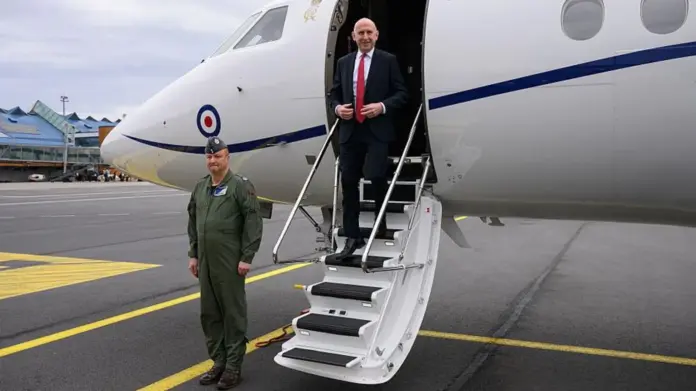
Raf Gps Jamming — An RAF jet carrying Defence Secretary John Healey was subjected to GPS signal jamming near the Russian border on Thursday, forcing pilots to abandon satellite navigation and rely on alternative systems for the duration of a three-hour return flight to the United Kingdom.
Healey was travelling back from Estonia, where he had met with British service personnel participating in a NATO military exercise close to the Russian border, when the aircraft’s GPS was disabled. The plane’s flight path remained visible on public aircraft tracking websites throughout the incident. Russia is believed to be responsible for the jamming.
The disruption came just one day after details emerged of a separate and far more physically dangerous confrontation over the Black Sea, in which two Russian warplanes conducted what the Ministry of Defence described as "repeated and dangerous" interceptions of an RAF surveillance aircraft.
Recommended Reading
During that earlier incident, a Russian Su-35 fighter closed on an RAF Rivet Joint surveillance plane at such proximity that it triggered the British aircraft’s emergency systems and disabled its autopilot. A second Russian jet, an Su-27, made six passes directly in front of the Rivet Joint, at one point coming within just six metres — approximately 19 feet — of the aircraft’s nose. The MoD labelled the behaviour "unacceptable" and characterised it as the most dangerous Russian action against British forces since 2022.
Healey praised the crew’s response, citing the "outstanding professionalism" of the RAF personnel involved in the Black Sea confrontation. The incident drew immediate comparisons to a 2022 episode in which a rogue Russian pilot fired a missile at a Rivet Joint operating in the same region.
Thursday’s GPS jamming attack is not without precedent. In 2024, an RAF aircraft carrying then-Defence Secretary Grant Shapps had its GPS signal jammed under near-identical circumstances while flying close to Russian territory. The recurrence of such incidents underscores what Western defence officials view as a deliberate and escalating pattern of Russian electronic and aerial harassment targeting NATO assets and senior officials.
The twin incidents — the Black Sea interception and the jamming of Healey’s flight — arrive at a moment of heightened tension between Moscow and Western governments over continued support for Ukraine. Healey’s visit to Estonia, a NATO member state sharing a border with Russia, was intended to demonstrate British commitment to the alliance’s eastern flank, where thousands of UK troops are deployed as part of a multinational deterrence force.
Raf Gps Jamming: The Wider European Impact
Electronic warfare and GPS jamming have become increasingly common tools in Russia’s broader strategy of grey-zone aggression — actions designed to intimidate and disrupt without crossing the threshold of direct armed conflict. Aviation authorities across Scandinavia and the Baltic region have logged hundreds of GPS interference events in recent years, many concentrated in areas close to Russian military installations.
The MoD has not yet issued a formal public statement specifically addressing the jamming of Healey’s aircraft, though the ministry’s condemnation of the Black Sea interceptions signals a hardening posture toward Russian provocations. Diplomatic fallout from both incidents is expected to feature in upcoming discussions among NATO defence ministers.
For Healey, the return flight served as an unintended demonstration of the very threat environment he had been discussing with troops on the ground in Estonia — one in which Russian interference, whether electronic or aerial, has become a routine hazard for British military and government operations across the continent’s eastern edge.