Russian Oil Sanctions Waiver — The United States has granted a second 30-day extension to a sanctions waiver shielding buyers of Russian oil from American penalties, a decision announced by Treasury Secretary Scott Bessent on Monday via a post on X. The waiver, which now runs until June 17, covers countries purchasing Russian crude and petroleum products already loaded aboard tankers at sea — a carve-out that applies to an enormous volume of oil currently in transit.
The extension arrives at a moment of acute global energy stress. Brent crude closed above $112 per barrel on Monday, a rise of roughly 2.6 percent in a single session, and was trading at approximately $110 on Tuesday. Prices have surged from $66 per barrel since the outbreak of hostilities involving US-Israeli strikes on Iran, with the effective closure of the Strait of Hormuz — a chokepoint through which roughly 20 percent of global oil and gas flows during peacetime — trapping an estimated 20 million barrels of Gulf crude per day.
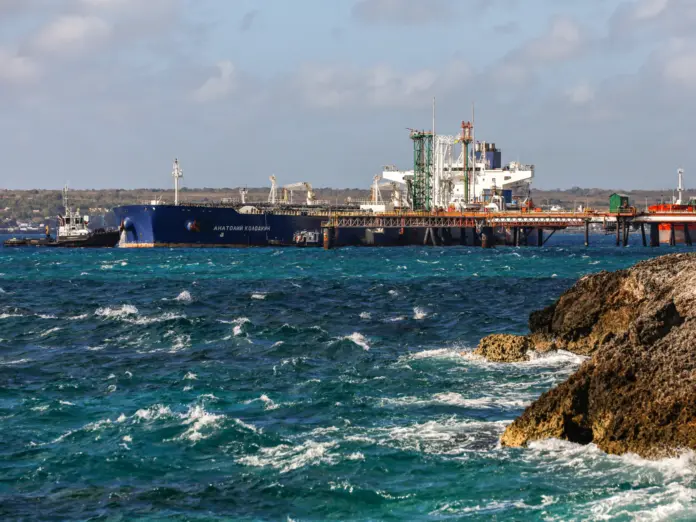
Against that backdrop, the scale of Russian oil at sea is striking. Data from commodity analytics firm Kpler shows approximately 113 million barrels of Russian crude and condensate currently loaded on ships, of which around 106 million barrels are in active transit. Floating storage of Russian crude has actually declined sharply, falling from about 19 million barrels in late January to roughly 7 million barrels today — suggesting the oil is moving rather than sitting idle.
Recommended Reading
The waiver’s practical effect is to prevent a secondary sanctions crisis from compounding an already volatile market. Washington first issued the 30-day exemption in March, after crude prices spiked above $100 per barrel in the immediate aftermath of the Iran strikes. At the time, Kremlin spokesman Dmitry Peskov characterised the move as an American effort to stabilise global energy markets — a framing that has infuriated critics in Washington.
Senators Jeanne Shaheen and Elizabeth Warren issued a joint condemnation of the latest extension, calling it an "indefensible gift" to Russian President Vladimir Putin. Their anger is rooted in the financial windfall the waiver effectively enables: with Russian Urals crude now trading between $97 and $100 per barrel — up from below $60 before the Iran conflict — Russia is earning an estimated $490 million per day from oil sales despite the broader sanctions architecture designed to cap its revenues.
The reversal is notable given that as recently as April, Bessent told reporters that Washington had no plans to renew the waiver. The shift underscores how rapidly the energy calculus has changed as the Iran crisis deepened.
The waiver also intersects with a complex web of trade flows involving India and China, the two largest buyers of discounted Russian crude. Russian exports to India climbed to more than 2 million barrels per day last month, up from 1.72 million barrels per day the month prior and well above the 1.62 million barrels per day recorded in September. The surge is partly explained by a mid-voyage course correction: at least seven tankers carrying Russian oil switched destination from China to India in March, including the Aqua Titan, which was expected to dock at New Mangalore Port on March 21.
Chinese imports of Russian crude, by contrast, have softened. Shipments to China dropped from 1.3 million barrels per day to 1.05 million barrels per day, a decline that may reflect both domestic demand factors and the logistical disruptions caused by the Hormuz closure.
Russian Oil Sanctions Waiver: The Energy Security Dimension
The India dimension carries its own political undertow. President Donald Trump claimed last October to have secured a commitment from Indian Prime Minister Narendra Modi to halt purchases of Russian oil — a pledge that the latest trade data suggests has not materialised. India’s appetite for discounted Urals crude has only grown as the price differential with Brent has widened.
On the supply side, Russia’s crude production has averaged roughly 9.1 million barrels per day, modestly below its OPEC+ quota of approximately 9.5 million barrels per day. The International Energy Agency reported that Russia’s overall crude exports rose by 250,000 barrels per day in April, reaching 4.9 million barrels per day — a figure that will add to congressional frustration over the sanctions waiver’s continued existence.
The broader energy shock is reverberating well beyond the oil market. Australia’s central bank has warned the country risks sliding into a 1990s-style recession as the oil price surge feeds through to fuel costs and inflation. Airlines including Qantas are grappling with acute fuel supply pressures as Iran war tensions persist. The Strait of Hormuz closure, if sustained, threatens to reshape global energy trade routes for months to come — making the question of how long Washington maintains its Russian oil exemption one of the defining economic policy decisions of the current crisis.