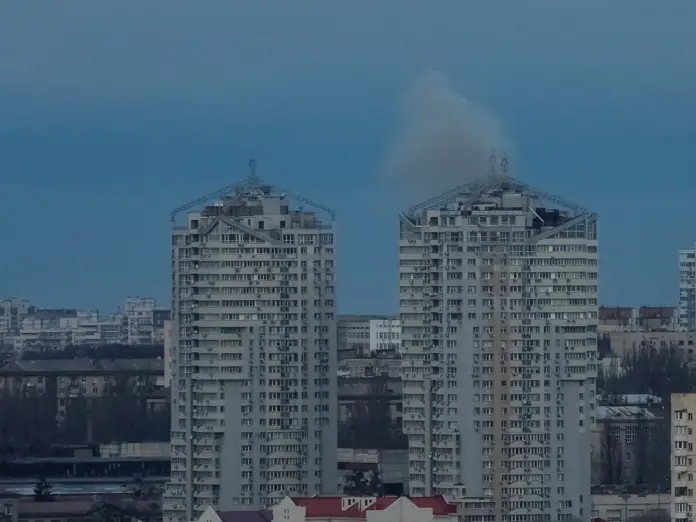
Russia Victory Day Strike Threats — Russia’s Foreign Ministry has issued an urgent warning to diplomatic missions in Kyiv, urging them to evacuate staff ahead of threatened retaliatory strikes tied to the country’s May 9 Victory Day commemorations. The warning, first issued by the Defence Ministry on Monday, was amplified Wednesday when Foreign Ministry spokeswoman Maria Zakharova posted a video on Telegram calling on diplomats to take the alert seriously.
The threats centre on what Moscow describes as potential Ukrainian efforts to disrupt the annual celebrations marking the Soviet Union’s defeat of Nazi Germany in World War II. A military parade is scheduled at Red Square on May 9, though Russian authorities have already announced the event will be scaled back, proceeding without military hardware for what they cited as security reasons.
Ukrainian President Volodymyr Zelenskyy addressed the situation directly at a meeting of the European Political Community in Armenia on Monday, attended by several EU member states. He acknowledged that Russia feared Ukrainian drones could penetrate Moscow’s airspace during the parade — a concern he suggested was well-founded. Writing on X on Thursday morning, Zelenskyy pointed to Russia’s redeployment of air defence systems from its regions to positions around Moscow as a significant tactical development.
Recommended Reading
"Russian leadership appears more concerned about its parade in Moscow than about the rest of Russia," Zelenskyy said, arguing that the concentration of air defences around the capital leaves other parts of the country more exposed to Ukrainian long-range strikes.
The convergence of military posturing and symbolic politics has produced a volatile diplomatic environment in the days leading up to the commemoration. Ukraine announced a unilateral ceasefire beginning May 6, while Russia put forward its own temporary truce timed to its Victory Day celebrations. Both gestures quickly unravelled — each side accused the other of breaching the respective ceasefires almost immediately after they were declared, underscoring the deep mutual distrust that has defined the conflict.
Russia’s decision to scale down the parade, stripping out the traditional display of military hardware, reflects the security anxieties Zelenskyy has sought to highlight. For a government that invests enormous political capital in Victory Day as a demonstration of national strength and historical continuity, the reduced spectacle carries symbolic weight that extends well beyond the military calculus.
The evacuation warning to diplomatic missions in Kyiv adds a further layer of tension. Foreign embassies and consulates operating in the Ukrainian capital now face pressure to reduce their footprint at a moment when international diplomatic engagement with Ukraine remains critical. Several Western nations have maintained or restored embassy operations in Kyiv since the early weeks of the full-scale invasion, and any large-scale withdrawal of diplomatic staff would carry significant political optics.
Russia Victory Day Strike Threats: The Wider European Impact
Zakharova’s decision to personally amplify the Defence Ministry’s warning through social media signals that Moscow intends the threat to be taken at face value rather than dismissed as routine rhetoric. The move places foreign governments in the difficult position of weighing staff safety against the symbolic importance of maintaining a diplomatic presence in the Ukrainian capital.
The standoff arrives against a backdrop of broader regional tension. The United States Navy recently fired on an Iranian-flagged oil tanker using a Super Hornet’s 20mm cannon, damaging the vessel’s rudder, prompting President Donald Trump to issue a fresh ultimatum to Tehran. Gold prices rose on global markets as Trump simultaneously touted progress in negotiations with Iran, reflecting investor uncertainty about the trajectory of that parallel crisis.
For now, the focus of European and Ukrainian officials remains fixed on the next 72 hours. Whether Russia follows through on its strike threats — or whether Zelenskyy’s warnings about drone vulnerability over Moscow prove prescient — the May 9 window has become one of the most closely watched flashpoints of the war’s current phase. The competing ceasefires, both now effectively defunct, have left the front lines as volatile as ever, with neither side showing any indication of stepping back from the brink.