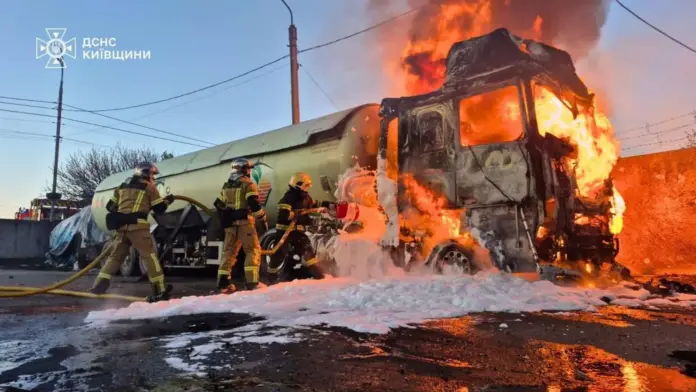
Ukraine Russia Ceasefire — Competing ceasefire declarations from Kyiv and Moscow have dissolved into fresh violence, with overnight missile and drone strikes killing five people and wounding dozens across Ukraine even as both governments claimed to be pursuing a halt to hostilities.
Ukraine announced an open-ended ceasefire beginning at midnight on 6 May. Russia followed with its own announcement of a truce covering 8 and 9 May — dates that coincide with the country’s most significant national commemoration. The overlapping but non-aligned proposals left the battlefield as active as ever, with both sides launching attacks in the hours surrounding their own declared pauses.
Ahead of its midnight deadline, Ukraine conducted a sweeping aerial offensive deep inside Russian territory. Flamingo cruise missiles, domestically produced weapons that President Volodymyr Zelensky publicly confirmed were deployed for the first time in this operation, struck a factory in Cheboksary, in the Chuvash Republic, that manufactures military components. The facility sits approximately 1,500 kilometres — roughly 930 miles — from the front line, underscoring the growing reach of Ukraine’s strike capability. A separate attack hit an industrial zone in Kirishi, in the Leningrad region.
Recommended Reading
Russia’s defence ministry said its air defences intercepted six Ukrainian Flamingo missiles and 601 drones during the overnight period. Despite those claims, a drone struck a high-rise building in central Moscow on Monday morning, and Moscow Mayor Sergei Sobyanin confirmed additional drones were downed near the capital. Several airports across Russia were temporarily shut on Tuesday as the attacks continued, disrupting civilian air traffic across a wide area.
The strikes on the Chuvash Republic carried a human cost inside Russia as well. A drone attack on Tuesday morning killed two people and injured 32 in the region — one of the deadliest single incidents on Russian soil in recent weeks.
Ukraine declared it would respond ‘symmetrically’ to any Russian military action from 6 May onward, a formulation that effectively tied its ceasefire commitment to Russian behaviour on the ground. Vladimir Putin‘s government, for its part, threatened a ‘massive missile strike’ on central Kyiv should Ukraine be deemed to have violated the truce — a warning that drew sharp international attention given the scale of destruction such an attack could cause in a densely populated capital.
The timing of Russia’s proposed two-day ceasefire is freighted with symbolism. The 9 May celebrations mark the Soviet Union’s defeat of Nazi Germany in the Second World War, an occasion the Kremlin treats as the centrepiece of its national identity and military prestige. This year, however, the grand parade on Red Square will be notably diminished. The Kremlin announced that no heavy military hardware would be on display, citing what it described as a terrorist threat from Ukraine. Muscovites were also warned that mobile internet access would be disrupted or cut off for several days leading up to the event — a security measure that reflects the degree to which drone warfare has reached the Russian heartland.
Ukraine Russia Ceasefire: The Wider European Impact
Ukraine has significantly intensified its long-range drone campaign in recent weeks, successfully targeting Russian energy infrastructure, oil refineries, and now military production facilities far behind the front lines. The strikes represent a strategic shift aimed at degrading Russia’s capacity to sustain its war effort rather than simply contesting territory along the contact line.
The violence comes more than three years after Russia launched its full-scale invasion of Ukraine in February 2022, a conflict that has claimed thousands of lives and reshaped European security. Despite periodic diplomatic overtures and international pressure — including efforts by the United States under President Donald Trump to broker negotiations — no durable ceasefire framework has taken hold. Both governments continue to frame their military actions as defensive necessities, even as the human toll mounts on both sides of the border.
The latest exchange of strikes and counter-strikes suggests that whatever diplomatic signalling surrounds the competing ceasefire announcements, neither side has yet found the conditions under which it is willing to stop fighting.