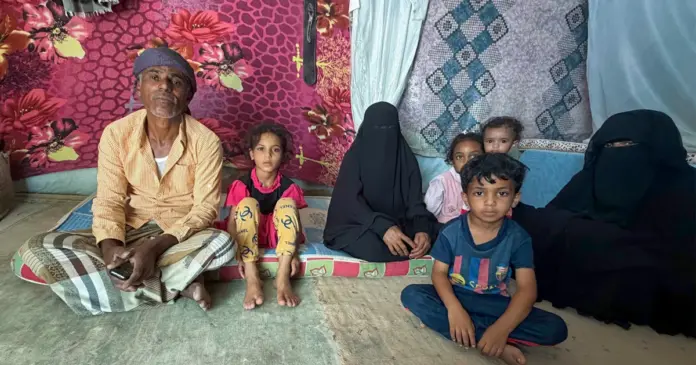
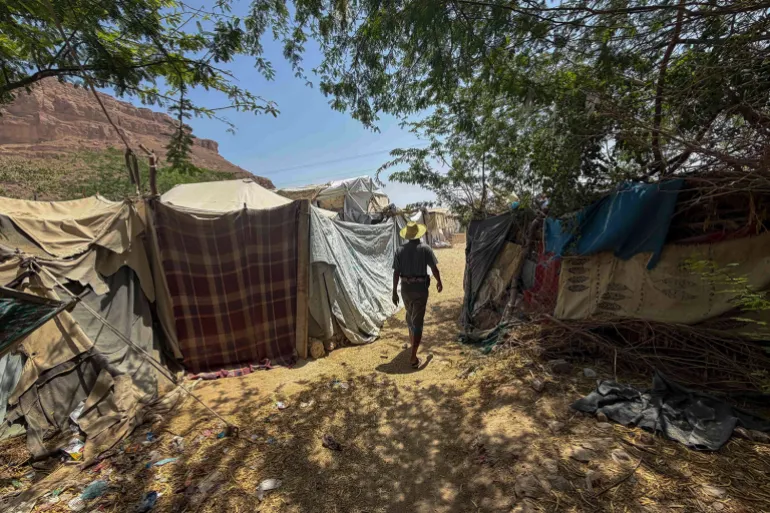
Yemen Displaced Millions — In the sweltering eastern city of Seiyun, thousands of Yemeni families displaced by nearly twelve years of war are living in makeshift shelters, surviving on dwindling aid and wages that barely cover a week’s food. The Maryamah displacement camp, one of several sites scattered across Wadi Hadramout province, has become a microcosm of a humanitarian catastrophe that the world has largely stopped watching.
Ali Sagher Shareem, 51, made the gruelling 1,000-kilometre journey from the western port city of Hodeidah two years ago, seeking safety for his wife and three children. He found shelter in Maryamah, but little else. Humanitarian assistance to the camp was slashed four years ago following severe funding cuts, and what remains is far short of what residents need. Summer temperatures in Seiyun average 40 degrees Celsius — 104 degrees Fahrenheit — and prolonged power cuts mean families cannot cool their tents, turning shelters into ovens for months at a time.
Seiyun’s camps collectively house 4,823 households, representing 38,487 people, while the broader Wadi Hadramout region shelters more than 10,000 displaced households in total. The Maryamah camp alone accommodates roughly 4,899 displaced families drawn from more than a dozen Yemeni provinces, including the capital Sanaa. Among them is Mohammed Mohammed Yahya, an octogenarian from the Tihama region in Hajjah province, who arrived in Seiyun six years ago with his wife and five children after violence consumed his home area.
Recommended Reading
The economic collapse shadowing the displacement crisis is equally devastating. Salah, a janitor at a local health facility, earns 50,000 Yemeni riyals each month — a sum that translates to just $33 at government-area exchange rates. He supports four children on that income. Khaled Hassan, a retired teacher, once received a pension worth $370 per month when displaced families first began arriving in Seiyun in 2017. The collapse of the Yemeni rial and an accelerating inflationary spiral have reduced that same pension to $85 today — a figure he exhausts within a single week.
The food situation has reached a critical threshold. More than half of Yemen‘s entire population is experiencing extreme food insecurity, with conditions deteriorating sharply since 2022 in what aid agencies describe as the worst hunger crisis the country has seen. Yemen’s 4.8 million internally displaced people are disproportionately exposed to that suffering, lacking the land, livelihoods and social networks that might otherwise provide a buffer.
The war that produced this displacement erupted in September 2014, when Iran-backed Houthi forces swept south and seized the capital, forcing the internationally recognised government into exile and triggering a Saudi-led military intervention. A United Nations report published in 2021 attributed 377,000 deaths — both direct and indirect — to the conflict, a toll that has continued to rise in the years since. The fighting has never truly stopped. In December, deadly clashes broke out between the Yemeni army and forces loyal to the Southern Transitional Council, the separatist faction backed by the United Arab Emirates, adding yet another layer of violence to an already fractured landscape.
For those sheltering in Maryamah and the surrounding camps, the geopolitical dimensions of the conflict are distant abstractions. What is immediate is the heat, the hunger and the uncertainty. Families who fled frontlines in Hodeidah, Hajjah and Sanaa arrived in Wadi Hadramout hoping for stability; instead, they found a province straining under the weight of mass displacement, an economy in freefall and an aid pipeline that has been steadily narrowing.
Yemen Displaced Millions: Regional Implications
The reduction in humanitarian funding four years ago marked a turning point for Maryamah. Organisations that once provided food rations, medical support and cash assistance have scaled back or withdrawn entirely, leaving residents to navigate survival with almost no external support. For an elderly man like Mohammed Mohammed Yahya, who arrived with his family six years ago and has watched conditions erode year by year, the prospect of return remains as remote as ever — his home province still contested, his savings long exhausted.
International attention to Yemen has ebbed and flowed with the broader currents of global news, often crowded out by other crises. Yet the numbers tell a story of unrelenting scale: nearly twelve years of war, 4.8 million displaced, more than half a population going hungry, and a currency so debased that a retired teacher’s pension disappears before the month is a week old. In Seiyun’s camps, that arithmetic is not an abstraction — it is the daily arithmetic of survival.