WASHINGTON/BEIRUT — The United States Treasury Department has sanctioned nine individuals accused of facilitating Hezbollah‘s grip on Lebanon, targeting a network that spans the Iranian-backed militant group’s leadership, the Lebanese parliament, Tehran’s diplomatic corps, and Lebanese state security institutions.
Hezbollah Lebanon Sanctions — The designations, announced Thursday, name individuals the Treasury says have actively obstructed Lebanon’s peace process and impeded efforts to disarm Hezbollah. Alongside the sanctions, Washington announced a reward of up to $10 million for information leading to the disruption of Hezbollah’s financial mechanisms — a signal that the United States intends to intensify economic pressure on the group.
Among those sanctioned is Mohamed Abdel-Mottaleb Fanich, identified as a senior leader within Hezbollah’s executive council, and Nizammeddine Fadlallah, a sitting member of the Lebanese parliament. Longtime Hezbollah officials Ibrahim al-Moussawi and Hussein Al-Hajj Hassan were also designated. The list extends to Mohammad Reza Sheibani, Iran’s ambassador-designate to Lebanon, marking a direct rebuke of Tehran’s role in Lebanese affairs.
Recommended Reading
The sanctions reach into Lebanese state structures as well. Ahmad Asaad Baalbaki and Ali Ahmad Safawi, both security officials affiliated with the Hezbollah-allied Amal Movement, were designated alongside Samir Hamadi, a branch chief within the Lebanese Armed Forces, and Khattar Nasser Eldin, a senior official at the General Directorate for General Security. The inclusion of figures embedded within official Lebanese institutions underscores Washington’s concern that Hezbollah’s influence has penetrated the country’s formal security apparatus.
Hezbollah dismissed the measures, declaring they would have absolutely no practical effect on its strategic choices. The group characterised the timing of the announcement as a deliberate attempt to intimidate Lebanese official security institutions ahead of upcoming negotiations — a charge that highlights the charged diplomatic environment surrounding the sanctions.
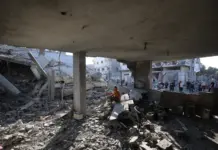
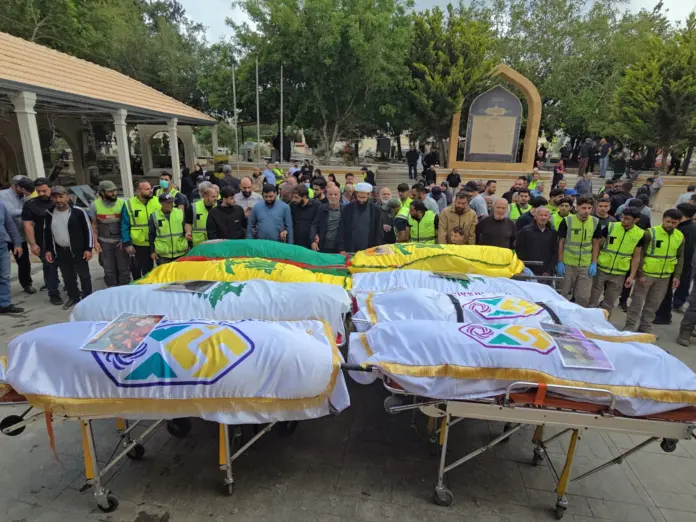
The designations arrive against a backdrop of continued military violence. Israel resumed its war on Lebanon on March 2, and despite a ceasefire that has since been extended for 45 days, Israeli military operations have not halted. On Thursday, an Israeli air raid killed one person travelling by motorcycle in the Tyre district. Israeli shelling struck the towns of Baraachit and Kfar Dounine, and a drone attack hit Yaroun. Two days earlier, an Israeli air strike on Deir Qanoun en-Nahr killed at least 14 people.
Lebanon’s Ministry of Public Health reports that Israeli attacks have killed at least 3,089 people and wounded at least 9,397 since March 2 — a toll that has mounted steadily even as ceasefire frameworks remain nominally in place.
Hezbollah Lebanon Sanctions: Regional Implications
Diplomatic efforts to stabilise the situation are nonetheless advancing on parallel tracks. Security-focused talks between Israeli and Lebanese military representatives are scheduled for May 29 at the Pentagon, with Lebanon’s army confirming its delegation will attend. Broader political negotiations are expected to resume on June 2 and 3. The proximity of these talks to the sanctions announcement adds a layer of strategic calculation to Washington’s move, suggesting the United States is using economic leverage to shape the conditions under which negotiations unfold.
The sanctions reflect a broader American effort to shore up Lebanese sovereignty at a moment when the country’s institutions remain deeply contested. By targeting individuals both inside and outside formal government structures, Washington is drawing a direct line between Hezbollah’s political network and what it describes as the systematic undermining of Lebanese statehood. Whether the designations translate into meaningful pressure — or whether Hezbollah’s dismissal proves accurate — will depend in large part on how Lebanon’s fragile political landscape responds in the weeks ahead.