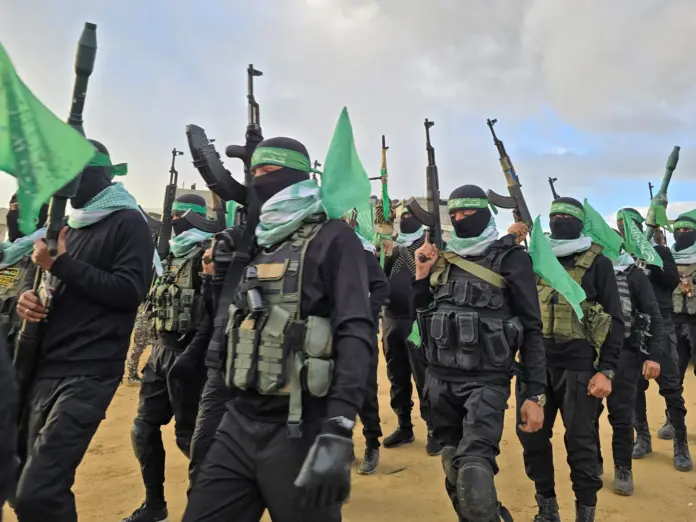
JERUSALEM — The senior American diplomat charged with managing the fragile Gaza ceasefire has opened the door to a political future for Hamas, provided the Palestinian militant group agrees to disarm — a condition he described as entirely non-negotiable.
Nickolay Mladenov, who serves on US President Donald Trump‘s International Board of Peace, addressed reporters in Jerusalem on Wednesday, offering the most explicit public framing yet of Washington’s position on Hamas’s long-term status. ‘We are not asking Hamas to disappear as a political movement,’ Mladenov said, while making clear that the surrender of its arsenal remains a firm prerequisite for any such accommodation.
Hamas Political Role — The remarks represent a significant rhetorical shift, acknowledging for the first time that the group could participate in Gaza’s governance after the conflict — but only after laying down its weapons. Mladenov identified disarmament as the central sticking point blocking progress on other elements of the agreement.
Recommended Reading
The ceasefire, which came into force on October 10, was structured in two phases. The first involved the release of captives seized during the October 2023 attacks on southern Israel in exchange for Palestinians held in Israeli detention. The second phase envisioned Hamas surrendering its weapons, a full Israeli military withdrawal, and the large-scale rebuilding of devastated areas across Gaza.
That second phase has not materialised. Hamas has refused to relinquish its arsenal, and the group’s spokesperson, Hazem Qassem, responded to Mladenov’s statements without signalling any change in position. Hamas has also accused Israel of continuously violating the terms of the truce.
The human cost of the ongoing hostilities has been severe. At least 856 Palestinians have been killed since the ceasefire came into effect, with Gaza’s Ministry of Health recording 120 deaths — including eight women and 13 children — since a separate truce with Iran took effect on April 8. Israeli forces now control more than 50 percent of the Gaza Strip.
Data from the Armed Conflict Location and Event Data Project (ACLED) shows that Israeli attacks in April surged 35 percent compared to March, a period that followed Israel halting joint bombing operations with the United States against Iran five weeks prior to the ACLED assessment.
Humanitarian organisations have raised persistent alarms about access to Gaza. Aid groups say Israel has not permitted the volume of assistance promised under the ceasefire framework, leaving civilians with acute shortages of food, medicine, and basic supplies across the territory.
Hamas Political Role: Regional Implications
The international legal backdrop to the conflict has grown increasingly stark. A United Nations inquiry conducted last year concluded that Israel’s military campaign in Gaza amounted to genocide, finding that Israeli soldiers had intentionally killed civilians during the course of operations.
Mladenov’s comments arrive at a moment of deep uncertainty about the ceasefire’s viability. With disarmament talks deadlocked, Israeli forces expanding their territorial footprint, and humanitarian conditions deteriorating, the gap between the agreement’s stated objectives and conditions on the ground has widened considerably. Whether the prospect of a political role for Hamas — however conditional — is enough to shift the calculus for the group’s leadership remains to be seen.
The United States has invested significant diplomatic capital in the ceasefire framework, and Mladenov’s willingness to publicly acknowledge a potential political pathway for Hamas suggests Washington may be recalibrating its approach as the second phase of the deal remains stalled. For now, the fundamental impasse over weapons holds everything else in suspension.