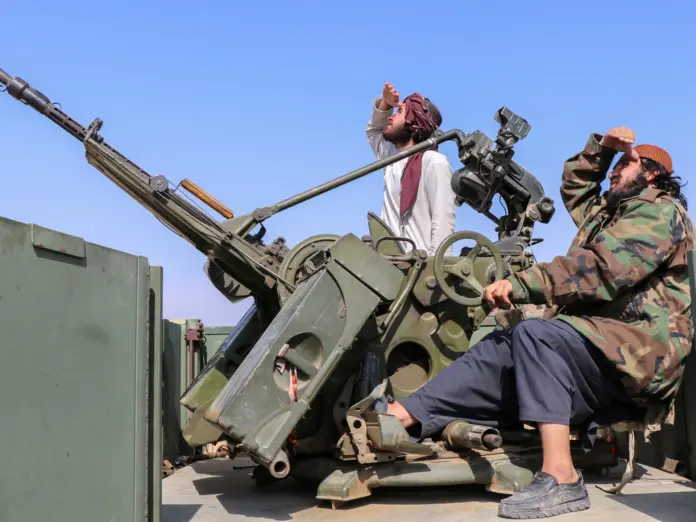
Taliban Pakistan Border Strike — Afghanistan’s Taliban-led government has accused Pakistan of carrying out a deadly cross-border strike on civilian infrastructure in Dangam district, Kunar province, killing three people and wounding 14 others in an attack Kabul has labelled a war crime.
Deputy government spokesman Hamdullah Fitrat confirmed the casualties and said the strike targeted homes, schools, a health centre, and mosques in the border district — civilian sites that carry no military justification under international law. The attack has placed severe strain on a fragile ceasefire brokered by China in April, which had been intended to end months of cross-border fighting that left hundreds of people dead or injured.
Pakistan’s Ministry of Information and Broadcasting flatly rejected the allegations, suggesting that Afghanistan may have staged the destruction. Officials in Islamabad claimed the images released by Kabul showed damage inconsistent with artillery strikes, though they offered no alternative explanation for the casualties reported by Afghan authorities.
Recommended Reading
The accusation comes amid a deeply entrenched cycle of mutual blame. Earlier cross-border attacks in March and April killed nine people, incidents Islamabad attributed to Afghan-based militants. Pakistan has long accused Kabul of harbouring the Tehrik-e Taliban Pakistan (TTP), a Pakistani offshoot of the Afghan Taliban waging an armed insurgency against the Pakistani state. The Taliban government in Kabul consistently denies sheltering the group.
The security environment along the border deteriorated further on Monday when Pakistani security forces in Khyber Pakhtunkhwa province foiled a suicide attack on a military checkpoint. The attacker’s vehicle, packed with explosives, detonated before reaching its target. One person was killed and several others were injured in the blast.
Muhammad Amir Rana, Director of the Pak Institute for Peace Studies (PIPS), said the recurring civilian toll from Pakistani cross-border operations reflects a fundamental operational failure. "Precision is a real problem," Rana said, identifying effective and foolproof intelligence as the critical missing link in Pakistan’s border strategy. He also noted that Pakistan’s overall security situation has worsened since February 28, when war with Iran began — a development that has stretched military and intelligence resources across multiple fronts.
The Dangam strike underscores how quickly the China-mediated ceasefire is unravelling. That agreement had been seen as a rare diplomatic achievement, with Beijing leveraging its relationships with both Islamabad and the Taliban administration in Kabul to halt hostilities that had claimed hundreds of lives. Its collapse — or even its serious erosion — would represent a significant setback for Chinese regional diplomacy and could reignite broader conflict along one of South Asia’s most volatile frontiers.
Taliban Pakistan Border Strike: Regional Security Implications
For the Taliban government, the attack provides both a grievance and a propaganda opportunity. By framing the strike as a war crime and releasing images of damaged civilian buildings, Kabul is appealing to international norms it has otherwise shown little interest in upholding domestically. The move signals that the Taliban intends to contest Pakistani military pressure through diplomatic and informational channels, even as the two governments remain locked in a security standoff over the TTP.
Pakistan, for its part, faces a compounding crisis. The TTP insurgency has intensified in Khyber Pakhtunkhwa, as Monday’s foiled suicide bombing illustrates. Islamabad’s cross-border strikes are framed domestically as necessary counter-terrorism operations, but analysts like Rana warn that without reliable intelligence, such operations risk killing civilians and inflaming Afghan public opinion — outcomes that ultimately strengthen the TTP’s recruitment narrative.
The situation in Kunar and Khyber Pakhtunkhwa reflects a broader regional dynamic in which no party holds a decisive advantage. China’s ceasefire initiative demonstrated that diplomatic solutions are possible, but Monday’s events suggest the underlying drivers of conflict — the TTP insurgency, disputed border demarcations, and deep mutual distrust between Kabul and Islamabad — remain unresolved. Without sustained diplomatic engagement and verifiable intelligence-sharing mechanisms, analysts warn that further escalation is likely.