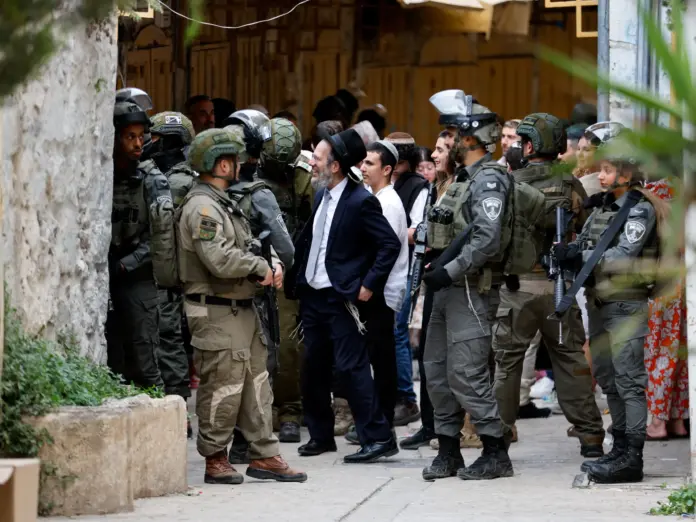
West Bank Settler Violence — A senior Israeli military commander has warned that unchecked settler violence in the occupied West Bank risks igniting a new Palestinian uprising, as a wave of attacks, demolitions, land seizures and killings pushes the territory toward a breaking point.
Major-General Avi Bluth, commander of Israeli military forces in the West Bank, delivered the stark assessment in a closed forum, describing settler conduct as "a disgrace to the Jewish people." His warning was echoed by Tamir Pardo, former chief of the Mossad intelligence agency, who toured Palestinian villages that had suffered settler attacks and told Israeli television: "What I saw today made me feel ashamed to be Jewish."
The warnings come amid a surge of documented settler and military actions across the West Bank. On Saturday, settlers attacked Palestinians in Jalud, Hebron and Ein ad-Duyuk near Jericho, wounding at least six people, including a 71-year-old woman. Settlers also closed roads in Yatta and Deir Jarir near Ramallah, while Israeli forces bulldozed Palestinian agricultural roads in Sinjil.
Recommended Reading
In Beita, south of Nablus, Jewish settlers established a fifth new illegal outpost in the Umm al-Jarb area. Major-General Bluth himself signed an order seizing approximately 11 dunams — roughly 1.1 hectares — near Khirbet Main in the Southern Hebron Hills for military purposes, a move that underscores the complex dual pressures the military faces in the territory.
The violence has turned deadly. On April 29, Ibrahim Abd al-Khayat, a 16-year-old, was shot and killed by Israeli forces during a raid in Hebron. Four days later, Nayef Samaro died from Israeli gunfire during a military operation in Nablus. A drunk Israeli military reservist from a nearby illegal settler outpost also opened fire on Palestinian homes in the Arroub refugee camp near Hebron using his military-issued weapon.
On May 4, Israeli forces demolished a two-storey house in Deirat village, east of Yatta, displacing four families — 25 people in total. Separately, Israeli soldiers were filmed chasing and dragging a Palestinian child with disabilities during a raid on the Shu’fat camp in occupied East Jerusalem, drawing further condemnation. Israeli authorities did arrest a Jewish man captured on video attacking a Christian nun in occupied East Jerusalem.
Compounding the humanitarian and political strain, Finance Minister Bezalel Smotrich withheld April’s clearance revenues from the Palestinian Authority — approximately 740 million shekels, equivalent to $249 million. Major-General Bluth advised the Israeli cabinet that releasing the funds would help reduce tensions, a recommendation that has so far gone unheeded.
The crisis extends beyond the West Bank. In Gaza, Israeli strikes have killed at least 828 Palestinians and wounded more than 2,342 since a ceasefire with Hamas collapsed in October. A nine-year-old child was killed in a strike east of Khan Younis on April 28. The following day, paramedic Ibrahim Saqr died in a strike near Gaza City. Three more Palestinians were killed near the Kuwait Roundabout in Gaza City on April 30, and at least one person died in a drone strike on the Bureij refugee camp on May 4. Since Israel launched its war on Gaza following the October 7, 2023 Hamas attack, more than 72,600 Palestinians have been killed.
West Bank Settler Violence: Regional Implications
Gaza’s health system is nearing collapse. The territory’s Ministry of Health warned that 86 percent of laboratory and blood bank supplies have been entirely depleted. New maps issued by Israel in mid-March expanded restricted zones inside Gaza to cover nearly two-thirds of the Strip’s territory, further constraining civilian movement and aid delivery.
Ceasefire negotiations remain deadlocked. Hamas has refused to commit to Israel’s demand for full disarmament, instead submitting a counteroffer insisting that any discussion of its weapons be embedded within a broader framework leading to the establishment of a Palestinian state — a condition Israel has rejected.
On the international stage, the Israeli navy intercepted the Global Sumud Flotilla — a 58-ship convoy — in international waters near Greece. Approximately 175 activists from more than 20 boats were detained. Flotilla organisers reported that Israeli forces smashed engines and destroyed navigation equipment aboard the vessels, an action that drew immediate criticism from human rights groups and participating nations.
The convergence of settler violence, military operations, economic pressure on the Palestinian Authority, and the ongoing Gaza offensive has created what analysts describe as a multi-front crisis with few visible off-ramps. Major-General Bluth’s rare public dissent signals growing unease within Israel’s own security establishment about the trajectory of events in the occupied territories.