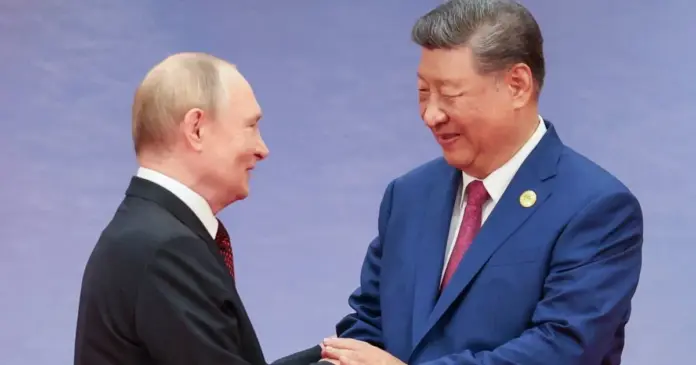
BEIJING — Vladimir Putin touched down in Beijing on Tuesday evening, setting the stage for a high-stakes summit with Chinese President Xi Jinping on Wednesday morning — arriving in the Chinese capital just 24 hours after Donald Trump had departed following his own meetings with Xi last week.
Putin Xi Beijing Summit — The extraordinary sequence of visits, with the leaders of the United States and Russia appearing in Beijing on consecutive days, crystallises China’s emergence as the indispensable pivot of 21st-century great-power diplomacy. Xi received Trump, who touted sweeping trade agreements during his stay, and now turns to Putin — a choreography that signals Beijing’s determination to engage all sides while formally aligning with none.
The Putin-Xi meeting carries particular symbolic weight: the two leaders are marking the 25th anniversary of the 2001 Treaty of Good-Neighborliness and Friendly Cooperation, the foundational document of the Sino-Russian strategic partnership. In the years since, that relationship has deepened considerably, driven by shared resentment of Western sanctions and a mutual wariness of American foreign policy under successive administrations.
Recommended Reading
The partnership, however, is far from a partnership of equals. Russia has emerged as the junior, dependent partner following its invasion of Ukraine, relying heavily on Chinese dual-use technologies — particularly components critical to drone production — to sustain its war effort. China, in turn, secures discounted access to Russian energy resources, a vital buffer for an economy under pressure from Western trade restrictions.
"The relationship is transactional at its core," said Timothy Ash, an associate fellow at the Russia and Eurasia Programme at Chatham House. The asymmetry is structural: Moscow needs Beijing far more than Beijing needs Moscow.
Ukraine is expected to feature prominently in Wednesday's discussions. China has long presented itself as a potential mediator in the conflict, and Xi has cultivated the image of a neutral statesman capable of bridging warring parties. That posture — of a superpower that refuses to publicly align with any bloc — is central to Beijing's broader foreign policy identity. Both Russia and China publicly espouse the construction of a multipolar world free from dominant powers, a framing that conveniently challenges American primacy.
Looming over both summits is the volatile situation in the Middle East. The ongoing US-Israeli military campaign against Iran has largely closed the Strait of Hormuz, sending shockwaves through global energy markets. The disruption falls disproportionately on China, whose economy is far more exposed to Gulf energy flows than Russia's. Moscow, by contrast, is benefitting in the short term: with Gulf competitors sidelined, Russian energy exports face less competition and command stronger prices.
Both Russia and China have previously shared intelligence and technology with Iran, complicating their diplomatic positioning as the conflict escalates. When Trump met Xi last week, he pressed for Chinese leverage to help end the Iran war — but left without a commitment. Beijing offered no public assurances, and the contentious issues of Taiwan and Iran remained unresolved.
Putin Xi Beijing Summit: The Diplomatic Context
Marina Miron, a postdoctoral researcher in defence studies at King's College London, noted that China's refusal to deliver on Iran reflects the limits of Xi's mediator role. "China benefits from strategic ambiguity," she said. "Resolving these conflicts prematurely would reduce its leverage."
Oleg Ignatov, a senior Russia analyst at Crisis Group, pointed to the structural logic binding Moscow and Beijing together despite their imbalanced relationship. "Russia has few alternatives," he said. "Western sanctions have made China not just a preferred partner but an essential one."
The optics of Beijing hosting both Trump and Putin within days of each other are not lost on analysts. Xi has effectively positioned China as the world's indispensable interlocutor — a nation that can sit across the table from adversaries simultaneously without formally committing to either. Whether that balancing act is sustainable, particularly as the Iran crisis deepens and Ukraine grinds on, remains the central question hanging over Wednesday's summit.
For Putin, the visit offers a rare opportunity to project diplomatic relevance beyond the battlefield. For Xi, it is another carefully managed performance of strategic centrality — one that began with Trump's arrival and now concludes, at least for this week, with the Russian president.