PYONGYANG — North Korean leader Kim Jong Un has directed his military to construct a 10,000-tonne destroyer and develop classified underwater weapons systems, marking the most ambitious naval expansion announcement in the country’s modern history, state media reported Saturday.
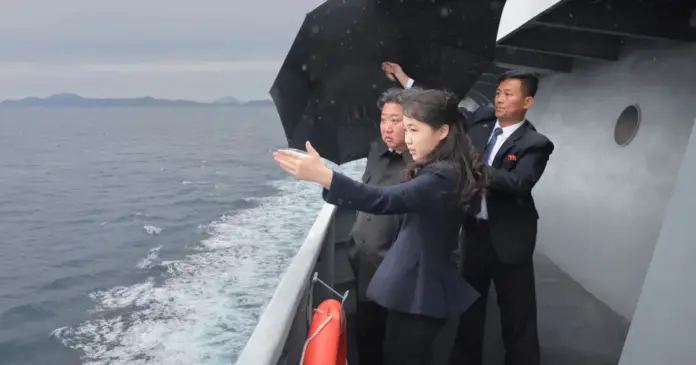
North Korea Naval Expansion — Kim personally supervised a naval exercise Thursday, boarding the 5,000-tonne destroyer Kang Kon and observing a second warship of the same class, the Choe Hyon. His teenage daughter, Ju Ae, accompanied him during the inspection — a recurring signal that Kim is grooming her for a future leadership role.
The Kang Kon carries a troubled history. In May 2025, the vessel partially capsized during its launch ceremony at Chongjin port, an embarrassment Kim publicly condemned as a ‘criminal act that could not be tolerated.’ The warship was subsequently towed to Rajin port for repairs, and a second launch ceremony was held the following month before the vessel was formally named and commissioned.
Recommended Reading
Thursday’s inspection appeared designed to demonstrate that the setback had been overcome. Kim used the occasion to call for powerful military capabilities across land, sea and air, framing naval expansion as essential to deterring a nuclear strike against the North. The remarks were published by the official Rodong Sinmun newspaper.
The naval announcement came on the same day Kim visited a newly opened nuclear material production facility, where he demanded an ‘exponential’ increase in North Korea’s atomic arsenal. The dual declarations — one focused on conventional naval power, the other on nuclear stockpiles — underscore Pyongyang’s determination to project strength on multiple fronts simultaneously.
Hong Min, a senior analyst at South Korea’s Institute for National Unification, noted that this marks the first time North Korea has publicly announced a plan to build a 10,000-tonne destroyer. The disclosure is significant: such a vessel would represent a generational leap in North Korean naval capability, far exceeding anything currently in its fleet.
Hong Min also suggested the timing of the announcements may not be coincidental. Chinese President Xi Jinping is scheduled to visit Pyongyang on June 8 and 9 — his second trip to the North Korean capital in seven years. Kim may be deliberately staging a display of military progress to project confidence and leverage ahead of those high-stakes talks.
The relationship between Pyongyang and Beijing remains the most consequential bilateral dynamic on the Korean Peninsula. China is North Korea’s primary economic lifeline and diplomatic shield, and any summit between the two leaders carries outsized regional significance. Kim’s decision to couple Xi’s visit with a flurry of military announcements suggests he intends to negotiate from a position of demonstrated strength rather than dependency.
North Korea Naval Expansion: Peninsula Security in Context
The broader pattern of North Korean military activity in recent months has alarmed regional neighbours and Western governments alike. Pyongyang has accelerated its weapons testing programmes, deepened military cooperation with Russia, and continued advancing its ballistic missile capabilities. The addition of a large-displacement destroyer to its naval ambitions adds a blue-water dimension to what has historically been a coastal defence force.
For now, the 10,000-tonne destroyer remains an order rather than a vessel — but the announcement alone reshapes the strategic calculus in Northeast Asia. Whether Pyongyang possesses the industrial capacity and technical expertise to deliver such a warship remains an open question, but Kim’s willingness to publicly commit to the project signals that naval power is no longer an afterthought in his military doctrine.
Xi’s arrival in Pyongyang next week will be closely watched by Seoul, Tokyo, and Washington as a barometer of how closely China is willing to align itself with a North Korea that is openly accelerating both its conventional and nuclear capabilities.